

GRACE Doctrine — Systems Governance, Operational Resilience and Democratic Legitimacy
Publication YP-145-26 | Author: Andrew Young
Updated June 2026
The GRACE doctrine architecture originally emerged as a foundational systems-governance methodology examining visibility, attribution, accountability, operational transparency and interconnected institutional behaviour across modern governance environments.
As the wider System Analysis series evolved across subsequent governance-note sequences, additional doctrinal themes progressively emerged concerning cumulative pressure, safeguarding legitimacy, institutional interaction, democratic resilience, behavioural adaptation, strategic continuity and long-duration systems governance under conditions of sustained operational strain.
The publication below therefore reflects the expanded doctrinal development of the wider GRACE Framework as it evolved across the broader governance-note ecosystem, associated safeguarding-analysis work, and the continuing integration of systems-governance, legitimacy and operational-resilience analysis throughout the wider framework architecture.
The GRACE Framework operates as a systems-governance methodology examining how modern governance environments behave under conditions of cumulative pressure, institutional interaction, safeguarding demand, fiscal exposure, operational dependency, strategic transition and long-duration governance strain.
Within the GRACE Framework, the term “doctrine” does not refer to political ideology, party allegiance or rigid dogmatic instruction.
Rather, it refers to a recurring governance-analysis methodology built around structured operational principles concerning visibility, attribution, safeguarding legitimacy, operational continuity, accountability, reconciliation and systems resilience across interconnected governance environments.
As the wider framework has evolved across multiple governance-note sequences, recurring analytical principles have progressively emerged concerning cumulative pressure, institutional interaction, dependency mapping, systems visibility, safeguarding integrity, strategic continuity, behavioural adaptation and long-duration operational sustainability within modern democratic systems.
Within this context, doctrine refers to the structured operational assumptions, governance methodologies and systems-analysis principles repeatedly applied throughout the wider GRACE Framework architecture.
Doctrine is not treated as fixed ideological instruction, but as accumulated operational understanding progressively emerging through repeated governance analysis, systems observation, safeguarding examination and long-duration institutional study across interconnected democratic environments over time.
The framework additionally recognises that constitutional systems rely not solely upon formal law, administrative structure or political process alone, but also upon institutional confidence, civic continuity, behavioural legitimacy and wider public belief that democratic systems remain operationally capable of preserving stability, accountability and constitutional protections over time.
Within this context, governance resilience increasingly depends not solely upon legal authority itself, but upon whether populations continue perceiving democratic institutions as coherent, trustworthy, operationally functional, safeguarding-capable and worthy of long-duration public confidence across generations.
The framework therefore increasingly functions not solely as a policy-analysis model, but as an integrated systems-governance doctrine examining how complex operational systems behave, adapt, degrade, stabilise or fragment under prolonged conditions of cumulative operational pressure over time.
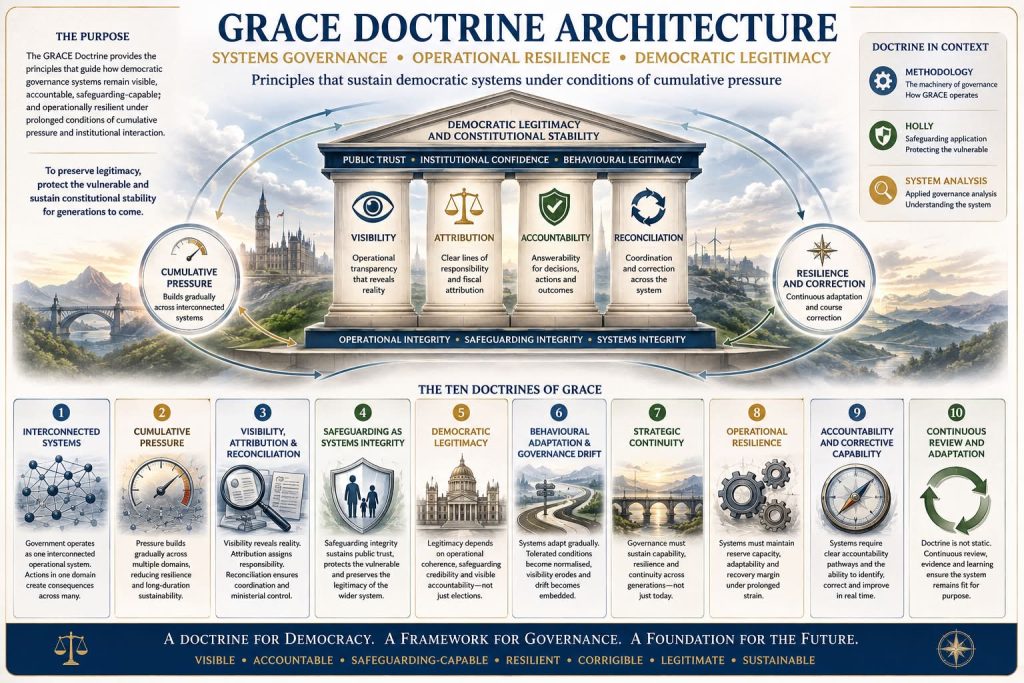
Although the GRACE doctrines emerged progressively through the development of the original Green Paper and subsequent governance research, they now form the constitutional foundations of the mature GRACE Framework. They provide the enduring governance principles from which the wider methodology, governance assessment, evidence frameworks, constitutional assurance and continuing governance discipline are derived.
Governance as an Interconnected Operational System
Within modern democratic states, government departments are frequently treated politically, administratively and operationally as separate governance environments despite functioning continuously within one wider interconnected national system.
Health operates separately from housing.
Education operates separately from policing.
Defence operates separately from immigration.
Energy operates separately from industrial policy.
Treasury decisions operate separately from safeguarding, infrastructure or local-authority pressure.
In practice, however, these systems continuously interact.
Housing pressure affects healthcare demand.
Migration policy affects schools, policing, infrastructure and local-authority capacity.
Energy costs affect industry, employment, inflation and household resilience.
Safeguarding failures affect policing, healthcare, education and criminal justice simultaneously.
Workforce shortages affect defence capability, healthcare continuity, logistics resilience and economic productivity at the same time.
Although ministries and departments may operate separately administratively, the wider operational environment experienced by the public functions as one interconnected national system.
Within a GRACE-aligned framework, this becomes a central systems-governance principle.
Policy development occurring within one operational domain may generate downstream fiscal pressure, workforce strain, safeguarding implications, infrastructure demand, operational displacement effects or institutional consequences across multiple other governance environments simultaneously.
Under prolonged conditions of cumulative interaction, pressure may propagate across the wider governance system itself rather than remaining isolated within any single policy environment alone.
This creates an important distinction between political management and systems governance.
Within political systems, ministers may face pressure arising from party discipline, electoral strategy, coalition management, media pressure or reputational protection. However, the operational requirements of the wider national system may not always align neatly with short-term political incentives.
Within a GRACE-aligned framework, governance analysis therefore examines not solely whether political messaging remains coherent, but whether the aggregate operational system itself remains sustainable, resilient, visible, accountable and operationally capable of functioning effectively over extended periods of time in the interests of the wider public, constitutional stability and long-duration national continuity.
The significance of this interconnected-systems principle becomes increasingly visible under conditions of cumulative operational pressure.
Modern governance systems rarely experience strain in isolation. More commonly, pressure develops progressively across multiple interconnected operational environments simultaneously, with conditions emerging gradually through interaction, accumulation and prolonged systemic exposure over time.
Cumulative Pressure Doctrine
Cumulative pressure increasingly forms one of the central operational conditions examined throughout the wider GRACE systems-governance doctrine.
Within complex operational environments, pressure rarely emerges through singular isolated events alone. More commonly, cumulative interaction develops gradually across interconnected domains including infrastructure, procurement, fiscal exposure, workforce sustainability, administrative throughput, safeguarding obligations, industrial continuity, logistics resilience, technological transition, energy dependency, public-service demand and strategic capability maintenance.
Under prolonged conditions of cumulative interaction, systems may continue appearing operational while underlying stabilisation capacity progressively weakens beneath the surface.
This may reduce resilience, reserve capacity, coordination flexibility, recovery margin and long-duration operational sustainability across interconnected governance environments over time.
Within a GRACE-aligned framework, cumulative pressure therefore represents not solely a sector-specific condition, but a wider systems-governance doctrine examining how interconnected operational strain may progressively alter the resilience, stability and long-duration sustainability capacity of the wider operational environment itself.
This doctrine increasingly examines stabilisation thresholds, reserve capacity, operational saturation, pressure interaction, resilience degradation, coordination strain, systems absorption limits, interconnected failure amplification and long-duration sustainability conditions across modern governance systems operating under cumulative operational pressure.
Visibility, Attribution and Reconciliation
A central principle within the GRACE doctrine concerns the relationship between operational reality, institutional visibility and democratic accountability across interconnected governance environments.
Modern governance systems frequently operate across highly fragmented institutional environments involving multiple agencies, departments, contractors, regulators, local authorities, legal frameworks and operational layers functioning simultaneously across the wider state environment.
Under such conditions, public visibility may weaken even while expenditure, operational pressure, safeguarding exposure or institutional risk continues expanding beneath the surface.
The GRACE Framework therefore places particular emphasis upon visibility, attribution, reconciliation, operational transparency, accountability mapping, downstream consequence analysis, institutional coordination and measurable operational verification across interconnected governance environments.
This principle is operationalised through the wider E–S–V–Z–O architecture:
E — exposure, escalation and threshold environments
S — fiscal attribution and systems burden
V — visibility, metrics and operational transparency
Z — reconciliation, coordination and ministerial control
O — oversight, audit and independent assurance
Within a GRACE-aligned framework, these layers operate not as isolated analytical concepts, but as one interconnected governance-control architecture designed to preserve operational visibility, accountability, institutional coherence and corrective capability under prolonged conditions of cumulative strain.
Governance legitimacy cannot rely solely upon symbolic presentation, reputational signalling, narrative identity, institutional branding, emotional association, political self-description, or performative legitimacy as substitutes for operational verification.
Governance systems ultimately require mechanisms capable of distinguishing measurable reality from symbolic construction.
This distinction is foundational to the GRACE Framework itself.
Safeguarding as Systems Integrity
The GRACE Framework increasingly examines safeguarding not solely as a social-policy issue, but as a wider systems-legitimacy, governance-integrity and democratic-stability condition.
Modern safeguarding failure rarely emerges solely through complete absence of institutional systems alone.
More commonly, safeguarding deterioration emerges where operational visibility, institutional confidence, intervention consistency, accountability clarity, whistleblower protection, investigative capability and public trust progressively weaken simultaneously across multiple governance layers over extended periods of time.
Within this framework, safeguarding legitimacy therefore becomes increasingly connected to operational confidence, democratic legitimacy, institutional trust, behavioural authority, constitutional visibility and wider public belief that vulnerable people remain visibly protected under the law.
This principle increasingly extends across women and children, modern slavery, coercive exploitation, trafficking, grooming, institutional hesitation, operational paralysis, and wider coercive-environment analysis.
The HOLLY safeguarding architecture operates as a companion safeguarding doctrine examining how safeguarding fragmentation, operational fear, procedural defensiveness, institutional paralysis and cumulative legitimacy deterioration may progressively emerge within modern governance systems operating under prolonged conditions of cumulative pressure.
Safeguarding integrity and democratic legitimacy increasingly operate as interconnected conditions within modern governance systems.
Where populations progressively lose confidence that vulnerable individuals remain visibly protected, wider confidence in institutional coherence, constitutional stability and democratic authority may also begin weakening simultaneously across the broader governance environment.
Democratic Legitimacy and Constitutional Stability
Within modern democratic systems, legitimacy increasingly depends not solely upon elections, legal frameworks or formal institutional structure alone, but upon continued public confidence that democratic governance systems remain operationally coherent, safeguarding-capable and constitutionally functional over time.
Legitimacy also depends upon public confidence that governance systems remain operationally capable of functioning coherently, protecting vulnerable populations, maintaining visible accountability, preserving operational continuity and enforcing constitutional protections consistently across the wider state environment.
This creates an important distinction between liberty on paper and functioning liberty.
Formal legal rights alone do not automatically guarantee operational freedom in practice.
Rights must also remain operationally visible, practically exercisable, consistently enforceable and realistically accessible without fear, coercion or institutional abandonment.
Within this framework, constitutional stability therefore increasingly depends upon institutional confidence, behavioural legitimacy, safeguarding credibility, public trust, operational visibility and long-duration civic confidence in the wider democratic environment itself.
Behavioural Adaptation and Governance Drift
Modern governance systems rarely undergo significant transformation through singular dramatic decisions alone.
More commonly, systems evolve gradually through accumulated tolerated conditions, institutional adaptation, behavioural reinforcement, visibility degradation, procedural simplification, reputational self-protection and repeated exposure environments operating over prolonged periods of time.
Within such conditions, institutional thresholds may recalibrate, operational caution may normalise, public sensitivity may fatigue, administrative systems may adapt around recurring pressure, and unresolved contradictions may gradually become embedded across the wider governance environment itself.
The GRACE Framework increasingly examines how modern governance systems behave under such cumulative adaptive conditions.
This includes narrative environments, institutional defensiveness, reputational protection, operational fatigue, behavioural conditioning, symbolic legitimacy, public trust fragmentation and cumulative governance drift across interconnected democratic systems.
Within this context, governance analysis increasingly becomes an examination of how democratic governance systems adapt, recalibrate, stabilise or progressively fragment under prolonged conditions of cumulative operational pressure over time.
Over prolonged periods of cumulative adaptation, governance systems may gradually influence not solely immediate operational behaviour, but the wider long-duration resilience, continuity and sustainability condition of the national environment itself.
This increasingly extends governance analysis beyond short-term administrative management alone and into wider questions concerning strategic continuity, institutional durability and the preservation of operational capability across generations.
Strategic Continuity and Long-Duration Governance
The GRACE Framework increasingly examines governance not solely through short-term political cycles or immediate administrative conditions, but through longer-duration continuity environments affecting strategic resilience, institutional durability and national operational sustainability over time.
This includes industrial continuity, energy resilience, workforce sustainability, scientific capability, demographic pressure, infrastructure dependency, logistics continuity, administrative throughput, technological transition, institutional resilience and strategic national capability preservation across generations.
Within this framework, governance systems are examined not solely according to whether they remain politically functional temporarily, but whether they remain operationally sustainable, institutionally resilient and strategically capable across prolonged periods of cumulative pressure and interconnected institutional interaction.
The Purpose of the Doctrine Framework
The purpose of the GRACE doctrine architecture is not to promote fear, fatalism, ideological hostility or political extremism.
Nor does it assume that democratic systems, institutions or governance environments are inherently malicious.
Rather, the framework examines how complex democratic governance systems behave, adapt, stabilise or fragment under cumulative operational conditions involving pressure, institutional interaction, safeguarding demand, visibility degradation, operational dependency and long-duration systemic strain.
The framework therefore increasingly operates as a structured systems-governance doctrine designed to strengthen visibility, accountability, safeguarding coherence, operational sustainability, institutional resilience and democratic stability across modern interconnected governance environments operating under cumulative pressure.
Within this context, the GRACE Framework ultimately functions as a governance-analysis architecture examining how democratic systems preserve legitimacy, operational continuity, safeguarding integrity, public trust and constitutional stability under prolonged conditions of cumulative operational pressure over time.