
Transparency, Accountability & Public Trust
Series Introduction — Transparency, Accountability & Public Trust
This series examines transparency mechanisms, audit structures, reporting obligations, and public accountability systems. It considers how trust is established, maintained, or eroded within governance frameworks.
Readers are directed to the GRACE Framework Executive Summary for context. Governance notes within this series provide applied analysis of accountability systems (S9).
A GRACE Framework governance note
Published 2026 | Author: Andrew Young
This governance note forms part of the Transparency, Accountability & Public Trust series (S9) within the System Analysis page.
It applies the GRACE Framework to examine how governance systems behave under conditions of pressure, dependency, and reduced transparency.
The preceding safeguarding notes demonstrate how coercive environments can persist where risk is visible but not acted upon.
This series extends that analysis into wider governance systems.
It examines how similar structural conditions — dependency, reduced visibility, and fragmented accountability — can give rise to convergence, patronage risk, and institutional distortion.
Where these conditions emerge, the impact is not confined to individual harm. They may affect the allocation of public resources, the operation of regulatory systems, and the integrity of democratic processes.
Modern governance systems operate within environments where economic, social, regulatory, and political forces overlap. Where these forces align around the same actors or networks, influence can accumulate in ways that are not immediately visible within formal institutional structures.
The purpose of this series is to examine how governance systems identify, attribute, and act on these risks at formation stage, before distortion becomes embedded.
This paper should be read alongside the Safeguarding Governance Notes within the System Analysis series. Those notes examine coercive environments from a safeguarding perspective, focusing on vulnerability, disclosure, and institutional response.
A worked demonstration of how the GRACE Framework identifies and disrupts governance risk arising from overlapping influence systems.
Introduction
Modern democratic systems rely on the fair and transparent allocation of public resources.
Where public funding systems lack transparency, local networks of influence can emerge that combine economic pressure, regulatory leverage, and political patronage. These systems rarely begin as overt corruption. Instead, they evolve gradually through opaque decision-making and weak attribution of public spending.
This paper does not assess communities or social structures themselves. It examines how public systems must remain neutral and resilient where overlapping influence networks interact with institutional decision-making.
This demonstration integrates the concept of convergence into the GRACE test case framework and illustrates how such risks can be detected and addressed through structured governance controls.
Convergence Model
Convergence describes situations where economic, social, regulatory, and political influence systems align around the same actors or networks.
These systems may include economic, social, regulatory, and political forms of leverage operating across the same networks. Economic leverage may arise through housing access, employment dependency, or control of customer networks. Social leverage may operate through reputation, informal leadership structures, and community pressure. Regulatory leverage may emerge through exposure to licensing, inspection, or complaint systems. Political leverage may arise through voter mobilisation, campaign alignment, or influence within local institutions.
Convergence does not require the use of public money at the outset.
Influence systems may develop within community or economic networks and only later intersect with public institutions.
Governance Risk — Dependency Networks
In many local environments, individuals and small businesses depend on overlapping systems such as housing access, employment opportunities, customer networks, regulated licences, and community organisations.
Where access to these systems is mediated by a limited number of intermediaries, dependency relationships can form. When multiple dependencies exist simultaneously, individuals may feel unable to challenge those exercising influence.
This creates the conditions for an opaque dependency ecosystem, where economic, social, and regulatory pressures reinforce each other.
Test Case — Local Gatekeeper Capture
Stage 1 — Dependency Formation
Intermediaries assist residents with housing, employment opportunities, translation services, and administrative processes.
Stage 2 — Economic Pressure
Economic pressure may be applied through coordinated boycotts, reputational campaigns, or online review activity.
Stage 3 — Regulatory Vulnerability
Where livelihoods depend on licences or permits, individuals may fear regulatory complaints or inspections.
Stage 4 — Public Funding Interaction
Without attribution transparency, it becomes difficult to determine who controls recipient organisations, how decisions are made, or whether public value is delivered.
Stage 5 — Escalation
Individuals who resist pressure may face economic retaliation, reputational damage, or intimidation. Reporting declines and institutional visibility weakens.
Interaction With Public Institutions
Governance risk emerges when converging influence networks intersect with public systems, including grant programmes, licensing authorities, procurement systems, and regulatory inspection regimes.
At this stage, informal influence may translate into institutional leverage, where access to public systems begins to reflect underlying network alignment rather than neutral administrative process.
GRACE Gate Analysis — First-Pass (Initial Diagnostic)
This initial assessment identifies early convergence signals through a first-pass GRACE gate review. At this stage, the objective is not full validation, but the detection of structural risk indicators.
DCT-1 — Democratic Consent Test Gate
Early indicators suggest potential distortion where dependency relationships may influence participation or access.
ARG-1 — Absolute Rights Gate
Emerging conditions may indicate pressure or constraint affecting individual autonomy.
EG-1 — Economic Case Gate
Funding flows appear insufficiently attributable, with limited visibility of outcome alignment.
IG-1 — Implementation Gate
Safeguards against capture, including attribution and role separation, are not fully evidenced.
RAG-1 — Risk & Assurance Decision Gate
Observable patterns do not yet trigger structured escalation or review.
VAR — Value Assurance Review
Outcomes are not yet independently verified against stated objectives.
E–S–V–Z (Initial Interpretation)
Annex V — Visibility
Partial visibility of funding flows, governance structures, and network relationships.
Annex E — Risk Classification
Signals present, but not yet formalised into defined thresholds or triggers.
Annex S — Fiscal Attribution
Incomplete linkage between expenditure, actors, and outcomes.
Annex Z — Control & Escalation
No unified mechanism converting signals into corrective action.
First-Pass Outcome
Taken together, these indicators suggest the presence of structural convergence risk. Visibility is partial, attribution is incomplete, and escalation mechanisms have not activated.
A full second-pass GRACE assessment is therefore required to determine whether these conditions constitute a systemic governance failure.
GRACE Progressive Gate Assessment — Second Pass (Escalation to Full Gate Review)
Where first-pass assessment indicates structural convergence or emerging distortion, a second-pass review applies full GRACE gate testing, escalating assurance depth and outcome validation.
This test case demonstrates how coercive dynamics identified in safeguarding environments can reappear within economic and governance systems when influence structures converge.
The same structural conditions identified in earlier safeguarding notes — dependency, pressure, reduced reporting, and fragmented institutional response — may therefore manifest within public systems where transparency and attribution are weak.
Within the GRACE Framework, this is analysed not as isolated misconduct but as a multi-gate governance failure condition.
DCT-1 — Democratic Consent Test Gate
Public institutions must operate in a manner that preserves free and unpressured civic participation.
Where convergence of influence systems creates dependency relationships capable of shaping behaviour — including voting patterns, public participation, or access to services — democratic consent may be distorted.
Evidence requirements include transparent allocation of public resources, clear separation between political influence and administrative decision-making, and demonstrable neutrality of institutional processes.
Where individuals are unable to act freely due to overlapping economic, social, or regulatory pressures, the system fails DCT-1 as framed.
ARG-1 — Absolute Rights Gate
Systems must not enable conditions of coercion, intimidation, or constrained autonomy.
Where convergence produces:
- Fear of economic retaliation
- Suppression of reporting
- Dependency relationships limiting individual agency
The environment may approach thresholds analogous to those observed in coercive safeguarding contexts.
Such conditions are incompatible with the protection of fundamental rights.
Where coercive pressure is structurally embedded, continuation is not permissible.
EG-1 — Economic Case Gate
Public expenditure must be:
- Transparent
- Attributable
- Demonstrably linked to public value
Where funding flows:
- Concentrate within connected networks
- Lack measurable outcomes
- Cannot be traced to independent governance structures
The economic case fails as framed.
Opacity in funding allocation creates the conditions under which influence systems can intersect with public resources.
IG-1 — Implementation Gate
Delivery systems must be capable of operating free from capture or influence distortion.
Minimum requirements include:
- Beneficial ownership transparency
- Conflict-of-interest controls
- Auditable funding and decision pathways
- Separation between advisory, delivery, and political roles
Where convergence allows the same networks to operate across:
- Funding receipt
- Regulatory exposure
- Community influence
- Political engagement
Implementation integrity is compromised.
In such conditions, delivery is not governance-safe.
RAG-1 — Risk & Assurance Decision Gate
Convergence generates identifiable early warning signals.
These include concentration of funding across linked entities, overlapping governance or leadership structures, asymmetrical regulatory outcomes, and declining reporting or challenge behaviour.
Within GRACE, such signals must trigger:
- Audit review
- Corrective action
- Programme suspension
Failure to act on these signals allows convergence to develop into systemic capture.
VAR-3 — Value Assurance Review (Benefits Realisation Stage)
Programmes must demonstrate that:
- Outcomes align with stated public purpose
- Benefits are independently verifiable
- Value is not confined within closed networks
Where outcomes:
- Diverge from funding
- Remain unverified
- Primarily benefit connected actors
Continuation requires redesign, enforcement action, or termination.
Convergence Finding — Governance Equivalence with Coercive Environments
This analysis demonstrates a critical governance principle:
The structural conditions that enable coercive environments in safeguarding contexts are functionally equivalent to those that enable convergence and patronage risk within governance systems.
In both cases, dependency replaces autonomy, pressure suppresses challenge, visibility declines, and institutional response weakens.
The difference is not structural, but domain-specific.
Where safeguarding systems fail, individuals are exposed to harm.
Where governance systems fail, the same structural dynamics can extend into:
- Public resource allocation
- Regulatory behaviour
- Democratic participation
Governance Conclusion
Coercive environments should not be understood as isolated safeguarding failures.
They represent a broader class of governance risk that can emerge wherever:
- Dependency is concentrated
- Transparency is weak
- Attribution is unclear
- Oversight is delayed
Within the GRACE Framework, convergence is therefore treated as an early-detection condition.
The purpose of governance is not only to respond once capture becomes visible, but to identify the structural signals that precede it.
Transparency Infrastructure (E–S–V–Z) — Convergence Detection and Control
Within the GRACE Framework, convergence risk is not identified through isolated observations but through the interaction of the E–S–V–Z control spine.
This system operates as a continuous detection, attribution, and escalation mechanism, ensuring that early signals of convergence cannot remain hidden within fragmented institutional environments.
Annex V — Visibility (Detection Layer)
Transparency dashboards provide structured visibility of:
- Funding flows
- Recipient organisations
- Governance and leadership structures
- Programme outcomes
In convergence conditions, Annex V enables:
- Identification of repeated funding patterns
- Detection of overlapping organisational leadership
- Visibility of network concentration
This converts otherwise opaque relationships into observable governance signals.
Annex E — Risk Register (Signal Interpretation Layer)
Risk registers translate observed patterns into structured governance risk signals.
Examples include:
- Concentration thresholds
- Repeated award patterns
- Linked governance structures
- Asymmetrical regulatory activity
These signals are not treated as isolated anomalies but as indicators of emerging convergence risk.
Annex S — Fiscal Reconciliation (Attribution Layer)
Fiscal systems ensure that:
- Funding is attributable
- Expenditure aligns with outcomes
- Resource allocation reflects public value
In convergence scenarios, Annex S identifies:
- Disproportionate allocation to connected entities
- Divergence between funding and measurable outcomes
- Embedded dependency within funding structures
This ensures that convergence is not only visible but financially provable.
Annex Z — Control Layer (Action and Escalation)
Annex Z converts signals from E, S, and V into:
- Defined actions
- Accountable ownership
- Timelines for intervention
- Escalation pathways
This includes:
- Audit initiation
- Programme suspension
- Corrective redesign
- Ministerial accountability triggers
Without Annex Z, convergence remains observable.
With Annex Z, convergence becomes actionable.
Control Spine Conclusion
The E–S–V–Z system ensures that convergence cannot develop silently.
This is achieved where:
- Visibility reveals patterns (V)
- Risk registers classify them (E)
- Fiscal systems prove them (S)
- Governance triggers act on them (Z)
The system moves from passive observation to active control.
Key Governance Findings
Finding 1 — Coercive environments and convergence systems share the same structural conditions
Dependency, pressure, reduced reporting, and fragmented visibility are not unique to safeguarding contexts. These same conditions can arise within economic and governance systems where influence structures converge.
Finding 2 — Visibility failure is the primary enabler of system distortion
Where funding flows, governance structures, and decision pathways are not transparent, convergence can develop without detection. In such conditions, institutional systems may continue to operate while underlying control has already shifted.
Finding 3 — Convergence suppresses challenge before it suppresses compliance
In both safeguarding and governance contexts, the first failure is not always unlawful behaviour but the gradual reduction in reporting, challenge, and institutional visibility.
This allows influence systems to stabilise before formal detection occurs.
Finding 4 — Late intervention reflects system design failure, not isolated breakdown
Where intervention occurs only after legal, political, or public escalation, this indicates that early detection mechanisms were absent, ineffective, or not acted upon. Governance systems must be designed to identify convergence at formation stage, not at point of failure.
Finding 5 — Attribution is the critical control mechanism across all domains
The ability to trace funding, decisions, and governance structures to accountable actors is the most effective safeguard against convergence. Without attribution, neither safeguarding systems nor governance systems can reliably identify or disrupt coercive or captured environments.
Conclusion and Governance Outcome
This note demonstrates that coercive environments identified within safeguarding systems and convergence risks observed within governance systems are not separate phenomena, but structurally related conditions arising from the same underlying failures.
Where dependency is concentrated, visibility is reduced, and accountability is fragmented, systems become vulnerable to distortion. In safeguarding contexts, this exposes individuals to harm. In governance contexts, it exposes public systems to capture, misallocation, and loss of institutional integrity.
The central governance insight is therefore consistent across domains:
System failure rarely originates at the point of crisis. It emerges earlier, at the stage where warning signals are present but not recognised, not connected, or not acted upon.
The GRACE Framework addresses this failure through a structured control architecture. By integrating visibility (Annex V), risk classification (Annex E), fiscal attribution (Annex S), and enforced action (Annex Z), the framework is designed to detect convergence conditions at formation stage and trigger intervention before systemic distortion becomes embedded.
This shifts governance from reactive response to proactive control.
Within this model, coercive environments cannot persist where:
- Signals are visible
- Patterns are attributable
- Thresholds are defined
Action is mandatory
The outcome is not the elimination of risk, but the removal of the conditions in which risk can stabilise undetected.
For policymakers, auditors, and institutions, the implication is clear:
The effectiveness of a governance system is determined not by how it responds to failure once exposed, but by its ability to detect and disrupt the structural conditions that allow failure to develop.
Where convergence is identified early, intervention remains proportionate and corrective.
Where convergence is identified late, intervention becomes disruptive, costly, and often reactive.
The purpose of governance design is therefore to ensure that systems remain visible, attributable, and controllable at all times.
This is the core function of the GRACE control spine.
It ensures that:
- Coercion cannot hide behind silence
- Convergence cannot hide behind opacity
- Institutional accountability cannot be deferred
In this way, safeguarding and governance are unified within a single principle:
Risk must be seen early, understood clearly, and acted upon decisively.
Anything less allows the system itself to become the environment in which harm is permitted to persist.
This note establishes the structural model of convergence within governance systems. It demonstrates how overlapping influence, dependency, and reduced visibility can combine to distort institutional behaviour before formal failure becomes visible.
Subsequent notes in this series examine how these dynamics manifest under specific system pressures and operational environments, including electoral cycles, regulatory systems, and public funding frameworks. The purpose is not to restate the model, but to apply it — testing how governance systems respond when convergence conditions are allowed to develop in practice.
A GRACE Framework governance note
Published 2026 | Author: Andrew Young
This governance note forms part of the Transparency, Accountability & Public Trust series (S9) within the System Analysis page.
It applies the GRACE Framework to examine how governance systems behave under conditions of pressure, dependency, and reduced transparency.
Introduction
This note examines election cycles not only as mechanisms of democratic accountability, but as structural forces that interact with convergence conditions, shaping when and how governance systems act on known risk.
Structural Observation
Election cycles do not simply measure governance performance. They influence when and how governance action occurs. Where cycles overlap, governance systems operate under persistent pressure rather than periodic review. Where convergence conditions are present — including dependency, reduced visibility, and fragmented accountability — electoral cycles do not operate neutrally. They interact with these conditions, amplifying pressure to delay or defer corrective action.
Stage Analysis
Stage 1 — Early Signal (Devolved Elections)
Devolved elections act as early indicators of public sentiment.
Impact:
This produces increased visibility of dissatisfaction and creates pressure to recalibrate policy direction.
Stage 2 — Behavioural Adjustment
Institutions may respond by delaying contentious decisions, reducing enforcement intensity, prioritising short-term stability, and deferring action on known governance risk.
Stage 3 — Fragmentation Risk
Divergent responses across jurisdictions may create inconsistent policy application, reduced coordination, and uneven enforcement environments.
Stage 4 — Pre-Election Distortion
As general elections approach, decision-making becomes shorter-term, high-risk interventions are avoided, political cost becomes dominant, and actions that may disrupt existing networks are deferred.
Stage 5 — Outcome Phase
Systems either stabilise through early intervention or become reactive following accumulated pressure.
GRACE Interpretation
Within the GRACE Framework:
Annex V (Visibility): Risk signals become measurable
Annex E (Escalation): Signals may not trigger action under pressure
Annex S (Fiscal): Costs accumulate through delay
Annex Z (Control): Intervention may be deferred
This produces a structural divergence between known risk and applied action, where governance systems retain visibility but defer intervention.
This condition reflects structural pressure rather than institutional failure. It reflects a structural interaction between electoral timing and governance action thresholds.
| Where electoral pressure delays action on known risk, governance systems do not remain neutral — they become structurally distorted. |
Under first-pass assessment, governance systems may appear compliant. Risk signals are visible (Annex V), thresholds are defined (Annex E), and control mechanisms exist in principle (Annex Z).
However, under second-pass assessment, where electoral pressure is applied, escalation may be deferred despite the presence of clear signals. This represents a failure not of system design, but of system activation under pressure.
In GRACE terms, this reflects a breakdown at the RAG stage, where defined thresholds do not result in timely intervention.
This note identifies why action may be delayed despite visible risk.
It does not indicate absence of system capability, but a structural condition in which timing pressure alters when escalation occurs.
Convergence Link (Series Integration)
This note connects directly to convergence dynamics identified in YP-24-26.
Election cycles act as a convergence amplifier where political incentives, institutional caution, and public pressure align to delay action on known risk.
This creates conditions in which:
Dependency increases, reporting declines, visibility weakens, and intervention is deferred.
Key Governance Risk
Election cycles create conditions where:
- Risk is known
- Signals are visible
- Intervention is possible
However, action is delayed.
This is not a failure of knowledge, but a failure of action under structural pressure.
Conclusion and Governance Outcome
Effective governance requires systems capable of operating consistently across electoral cycles.
This requires:
- Defined thresholds
- Enforced escalation
- Transparent attribution
- Mandatory action triggers
Within the GRACE Framework, the control spine ensures that:
- Risk remains visible
- Thresholds trigger action
- Accountability cannot be deferred
The core principle is therefore clear:
Systems do not fail at the point of crisis.
They fail at the point where early signals are visible but not acted upon.
Within this model, electoral pressure does not remove governance visibility, but alters the conditions under which action occurs. Where convergence is present, the effect is not neutral delay, but structured deferral of intervention despite identifiable risk. This reinforces the central GRACE principle that system effectiveness depends not only on the existence of controls, but on their activation under pressure.
Election cycles increase the probability that early signals are not acted upon.
The purpose of governance design is to prevent it.
This establishes a core governance condition:
Where action is structurally delayed despite visible risk, the system does not remain neutral. It becomes directionally biased toward inaction.
A GRACE Framework governance note
Published 2026 | Author: Andrew Young
This governance note forms part of the Transparency, Accountability & Public Trust series (S9) within the System Analysis page.
It applies the GRACE Framework to examine how governance systems behave under conditions of pressure, dependency, and reduced transparency.
Introduction
Notes 24 and 25 establish that convergence conditions and structural pressure can distort governance outcomes even where risk is visible. This note extends that analysis into the democratic domain, examining whether transparency standards applied to regulated systems should also apply to actors exercising public power.
Principle Overview
Across regulated sectors, entities are required to disclose organisational structure, beneficial ownership, control relationships, and governance arrangements. These requirements exist to ensure accountability, visibility of influence, and the ability to identify risk.
This note examines whether an equivalent principle should apply within democratic systems.
Extension to Democratic Systems
Where political organisations and affiliated structures influence public decision-making, allocate resources, or shape institutional direction, the question arises whether transparency obligations should reflect the level of public authority exercised.
The proposal is not to impose new restrictions, but to examine whether existing transparency principles should be applied consistently across domains.
| Governance ConsistencyA governance inconsistency therefore arises:Transparency obligations applied to regulated entities may be lower than those applied to actors exercising public authority. |
Where democratic systems determine allocation of public resources, legislative direction, and institutional control, the case for transparency is not weaker — it is stronger.
GRACE Interpretation
Within the GRACE Framework, transparency is a prerequisite for effective governance control. Where influence structures are not visible, convergence risk cannot be fully identified, and escalation mechanisms may not activate.
This creates conditions in which influence may operate without attribution, and where system behaviour may diverge from public purpose without detection.
Convergence Link
This principle aligns directly with the convergence model set out in Note 24. Where economic, social, and political influence systems intersect, transparency becomes the primary safeguard against hidden dependency and patronage structures.
Governance Implication
The issue is not whether influence exists — it is whether it is visible, attributable, and subject to governance control.
Where transparency standards are inconsistent, governance systems may apply higher scrutiny to regulated entities than to actors shaping public authority, creating an imbalance in accountability.
Closing Principle
Transparency is not a constraint on democratic systems. It is the condition that allows them to function with legitimacy.
Where public authority is exercised, visibility of structure, influence, and control is a governance requirement — not an optional standard.
Operational implication: Where applied, this principle would require equivalent transparency standards across political, regulatory, and administrative systems where public authority is exercised.
A GRACE Framework governance note
Published 2026 | Author: Andrew Young
This governance note forms part of the Transparency, Accountability & Public Trust series (S9) within the System Analysis page.
It applies the GRACE Framework to examine how governance systems behave under conditions of pressure, dependency, and reduced transparency.
It should be read alongside the Safeguarding Governance Notes (S1) and the preceding S9 notes on convergence, liability, and governance pressure.
Introduction
The preceding notes establish that governance systems do not fail through absence of knowledge, but through failure to act on known risk. Where dependency, reduced visibility, and fragmented accountability converge, systems may continue to operate while underlying control conditions deteriorate.
This note provides a worked test case demonstrating how those conditions manifest within a welfare system environment.
This test case applies the convergence model set out in Note 24, the pressure dynamics identified in Note 25, and the transparency considerations introduced in Note 26, demonstrating how known risk can persist within a system where escalation is structurally deferred.
System Context — Welfare, Entitlement, and Exposure
The UK welfare system is structured around eligibility, need, and statutory entitlement. It is designed to provide support while maintaining controls to prevent misuse.
However, where high-value fraud occurs, a structural condition emerges:
An individual may generate significant loss to the public purse, be subject to enforcement action, and subsequently re-enter the welfare system without any automatic reconciliation between prior liability and ongoing entitlement.
This produces a condition in which liability, enforcement, and entitlement operate in parallel rather than as an integrated system.
Structural Conditions — Convergence Within Welfare Systems
Within this environment, dependency on welfare support interacts with administrative control over access to entitlement, while real-time visibility of fraud, recovery, and entitlement remains limited. At the same time, accountability is fragmented across enforcement, entitlement, and oversight functions. Taken together, these conditions create a system in which risk is visible but not structurally enforced.
These conditions reflect the convergence model described in Note 24, where dependency, reduced visibility, and fragmented accountability combine to weaken system response.
First-Pass Gate Assessment — Formal Compliance
At a formal level, the system appears compliant.
Eligibility is defined. Legal processes exist. Administrative controls operate.
Under this assessment:
DCT-1 — Satisfied
ARG-1 — Satisfied
IG-1 — Operational
The system appears lawful.
Second-Pass Gate Assessment — Structural Stress Conditions
This reflects the pressure dynamics described in Note 25, where escalation may be deferred despite the presence of clear system signals.
While the system appears compliant under first-pass assessment, second-pass analysis reveals structural stress conditions that are not resolved through existing controls.
Under real-world conditions:
- Recovery is partial or delayed
- Entitlement may continue independently
- System linkage between loss and ongoing support is absent
At this stage:
EG-1 — Fails
IG-1 — Weakens
RAG-1 — Fails
VAR-3 — Not satisfied
ARG progression becomes relevant:
ARG-1 is satisfied formally, but system behaviour may move toward ARG-3 conditions where fairness perception, trust, and institutional legitimacy are affected.
E–S–V–Z Control Interpretation
Annex V — Visibility of fraud, recovery, and entitlement is fragmented
Annex E — Escalation triggers are not enforced
Annex S — Loss and ongoing expenditure are not reconciled
Annex Z — No mechanism enforces linkage between liability and entitlement
Where transparency of system interaction is incomplete, as explored in Note 26, visibility does not translate into enforceable control.
| Comparative Enforcement: Entitlement and State Debt (UK–Spain Contrast)In Spain, public liability and entitlement are operationally linked. Where debt to the state exists, enforcement mechanisms may include:Direct attachment of fundsIncome stream reconciliationContinuous recovery processesThe system operates as a continuous enforcement loop. In the UK model, entitlement and liability remain structurally separate. This creates a measurable gap between loss, liability, and ongoing entitlement. The governance question is not whether support should exist, but whether it should exist without reconciliation. |
| Retrospective GRACE Gate and Control ReviewApplying the GRACE framework retrospectively: DCT — Not satisfied in terms of visibility of exposureARG — Formally satisfiedEG — Not passedIG — Not passedRAG — Not passedVAR — Not satisfied E — No effective trigger linkageS — Loss without integrated recoveryV — Absence of real-time transparencyZ — No reconciliation action Conclusion:The system operated without an integrated control loop linking detection, liability, recovery, and entitlement. |
Governance Outcome
The system does not fail at the point of fraud detection.
It fails at the point where:
- Loss is known
- Liability is established
- Reconciliation is not enforced
This allows parallel operation of entitlement and debt, weakening deterrence, fiscal recovery, and public confidence.
This test case demonstrates what occurs when known risk is not structurally enforced.
The issue is not detection, but the absence of an integrated control loop linking liability, recovery, and entitlement.
Conclusion
The question is not whether welfare support should exist following conviction.
The question is whether support should operate without reconciliation where public harm has been established.
Effective governance requires:
- Risk visibility
- Enforceable liability
- Conditional entitlement
- Integrated system response
Systems do not fail at the point of detection. They fail at the point where known conditions are not structurally enforced.
A GRACE Framework governance note
Published 2026 | Author: Andrew Young
This governance note forms part of the Transparency, Accountability & Public Trust series (S9) within the System Analysis page.
It applies the GRACE Framework to examine how governance systems behave under conditions of pressure, dependency, and reduced transparency.
It should be read alongside YP-24-26 (Convergence), YP-25-26 (Election Cycles), and YP-27-26 (Convergence in Welfare Systems).
Introduction
The preceding notes establish that convergence is not a sector-specific anomaly, but a structural condition that emerges where dependency, reduced visibility, and fragmented accountability intersect.
YP-27 demonstrated this within a welfare system context.
This note extends that analysis into public service delivery, using healthcare governance as a test environment.
The purpose is not to assess policy preference, but to examine whether different delivery models remain governance-safe under GRACE control conditions.
System Context — Healthcare as a Governance Environment
Healthcare systems operate at the intersection of:
- Public funding
- Operational delivery
- Regulatory oversight
- Political accountability
This creates a complex governance environment in which multiple actors interact under high public expectation.
Structural Conditions — Convergence Risk in Public Service Systems
Across healthcare systems, a common set of structural conditions may emerge. These include dependency on continuous access to care, capacity pressure where demand exceeds delivery capability, fragmentation across multiple providers, and reduced visibility where cost, performance, and outcomes are not consistently reconciled. Taken together, these conditions mirror those identified in earlier governance contexts and create an environment in which system performance may diverge from underlying control conditions.
First-Pass Gate Assessment — Model Compliance
At a formal level, all three healthcare models can satisfy baseline governance requirements.
Each delivery model presents distinct governance characteristics. A public control model provides clear lines of accountability but may be constrained by capacity limitations. A mixed delivery model introduces flexibility in service provision, while increasing the risk of fragmented accountability across providers. A market-oriented model may strengthen performance incentives, but also increases exposure to cost opacity and system fragmentation.
Under this assessment:
DCT — Satisfied
ARG-1 — Satisfied
IG — Operational
Each model appears valid as framed.
Second-Pass Gate Assessment — Structural Stress Conditions
Under real-world pressure:
- Capacity constraints increase
- Delivery expands across providers
- Accountability becomes diffused
- Performance varies
At this stage:
EG — May fail where cost is not reconciled
IG — Weakens where coordination breaks down
RAG — Fails where escalation is not triggered
VAR — Not satisfied where outcomes diverge from expenditure
ARG progression becomes relevant:
ARG-1 may remain formally satisfied, but movement toward ARG-3 conditions may occur where system fairness, access, and trust are affected.
E–S–V–Z Control Interpretation
Annex V — fragmented performance visibility across providers
Annex E — weak escalation of systemic underperformance
Annex S — cost not fully attributable across delivery pathways
Annex Z — no unified corrective mechanism
| NHS Governance Models: Control vs DeliveryThree models illustrate differing delivery assumptions: A public control model provides unified accountability but may be constrained by capacity limitations. A mixed delivery model introduces flexibility in service provision while increasing the risk of fragmented accountability across providers. A market-oriented model may strengthen performance incentives, but also increases exposure to cost opacity and system fragmentation. Governance observation:Delivery structure does not determine system integrity.Control architecture does. In each case, governance risk arises not from the model itself, but from the absence of integrated control across it. |
| GRACE InterpretationUnder the GRACE framework:Annex S requires full fiscal traceability Annex V requires performance transparency Annex Z requires reconciliation into action Absent these controls, all models are vulnerable to:Cost driftPerformance opacityReduced public trust |
Governance Outcome
Healthcare systems do not fail solely because of delivery model choice.
They fail where:
- Cost is not attributable
- Performance is not visible
- Variation is not corrected
This produces a condition in which systems continue operating while underlying control weakens.
This demonstrates that system variation is not inherently destabilising.
Risk emerges where variation operates without unified control, attribution, and correction mechanisms.
Conclusion
The central governance question is not: who delivers healthcare but:
whether delivery operates within a system that makes cost visible, performance testable, and failure corrigible.
Where control conditions are absent, convergence risk emerges regardless of model.
Where they are present, different delivery structures can operate safely.
Closing Principle
Governance is not defined by structure alone.
It is defined by whether systems remain:
- Visible
- Attributable
- Controllable
Where this is achieved, variation in delivery becomes manageable.
Where it is not, variation becomes risk.
And that risk accumulates within the system itself.
A GRACE Framework governance note
Published 2026 | Author: Andrew Young
This governance note forms part of the Transparency, Accountability & Public Trust series (S9) within the System Analysis page.
It applies the GRACE Framework to examine how governance systems behave under conditions of pressure, dependency, and reduced transparency.
It should be read alongside YP-24-26 (Convergence), YP-25-26 (Election Cycles), YP-27-26 (Convergence in Welfare Systems), YP-28-26 (NHS and Public Service Governance), and YP-29-26 (Democratic Systems, Influence Structures, and Constrained Participation).
Introduction
The preceding notes establish that governance systems do not fail through absence of knowledge, but through failure to act on known risk.
Where dependency, reduced visibility, and fragmented accountability converge, structural conditions may emerge that influence behaviour, distort outcomes, and weaken institutional integrity.
YP-29 extended this analysis into democratic systems, identifying that participation may remain procedurally valid while operating within conditions that are not fully visible or attributable.
This note addresses the next stage in that progression.
It examines how such conditions are detected, defined, and translated into enforceable governance action.
The Structural Problem — Visibility Without Activation
In many governance environments, structural conditions are not entirely hidden.
Patterns may be observed.
Relationships may be recognised.
Outcomes may raise questions.
However, these observations do not consistently translate into defined governance signals or enforceable action.
A system may therefore exhibit observable concentration of influence, repeated interaction between the same actors or structures, divergence between inputs and outcomes, and a reduction in challenge or reporting behaviour.
Yet these conditions may remain:
- Unclassified within formal risk systems
- Unlinked to defined thresholds
- Untethered from escalation mechanisms
This creates a condition in which risk is visible, but not operational.
The system is aware, but does not act.
Detection as a Governance Function
Effective governance requires the ability to identify structural conditions before they manifest as overt failure.
Detection operates at the level of pattern rather than allegation.
It does not depend on establishing intent or misconduct.
It depends on recognising the interaction of conditions that, taken together, indicate potential distortion or constraint within the system.
These conditions may include the alignment of economic, administrative, and institutional influence within defined networks, repeated concentration of resource allocation or decision-making authority, measurable divergence between system inputs and outcomes, and a reduction in independent challenge or reporting behaviour.
Detection at this level does not conclude wrongdoing.
It establishes the presence of conditions requiring structured assessment.
Thresholds — From Observation to Action
This note isolates the core system mechanism within the series.
Governance failure does not arise because risk is unseen, but because observed conditions are not translated into defined thresholds that require action.
Detection alone does not constitute governance control.
For a system to act, observed conditions must be translated into defined thresholds that trigger response.
This introduces a central governance question:
The central governance question is not whether patterns exist, but when they require mandatory intervention.
Within a structured governance framework, thresholds may be defined by reference to scale, including the magnitude of concentration, exposure, or divergence; persistence, including the duration over which conditions remain present without correction; and convergence, including the number of interacting systems or domains affected by the same pattern.
Where thresholds are defined, the transition from observation to action becomes formalised.
Where thresholds are absent, action remains discretionary.
In such environments, systems may continue to observe conditions without being required to respond.
Detection Without Accusation
A governance system must distinguish between identifying conditions and asserting wrongdoing.
Detection focuses on:
- Patterns
- Structures
- Relationships
It does not require:
- Attribution of intent
- Presumption of misconduct
This distinction is essential.
It allows systems to identify emerging risk without relying on retrospective evidence or formal allegation.
It also ensures that intervention remains proportionate to observed conditions.
Governance Safeguards — Conditions for Action
For detection and thresholds to function effectively, governance systems must ensure that observed conditions lead to structured response.
This requires:
- That visibility of patterns is maintained across relevant systems
- That thresholds are clearly defined and consistently applied
- That responsibility for assessment and escalation is identifiable
- That defined triggers result in action rather than continued observation
Where these conditions are met, detection becomes operational.
Where they are not, detection remains descriptive.
Governance Implications
Where detection and threshold mechanisms are absent or incomplete:
- Risk remains visible but inactive
- Intervention is delayed
- Accountability becomes retrospective
Where detection and thresholds are defined and enforced:
- Risk becomes measurable
- Action becomes structured
- Systems remain responsive to emerging conditions
This distinction determines whether a governance system operates as a passive observer or an active control environment.
Conclusion
Governance systems do not fail because risk is unknown.
They fail because known conditions do not trigger action.
The effectiveness of a system is therefore determined not only by its ability to observe conditions, but by its ability to define thresholds, require response, and enforce accountability.
Detection is not intervention.
It is the condition that makes intervention possible.
Where thresholds are defined and action is required, governance moves from observation to control.
Where they are absent, risk remains embedded within the system itself.
A GRACE Framework governance note
Published 2026 | Author: Andrew Young
This governance note forms part of the Transparency, Accountability & Public Trust series (S9) within the System Analysis page.
It applies the GRACE Framework to examine how governance systems behave under conditions of pressure, dependency, and reduced transparency.
It should be read alongside YP-24-26 (Convergence), YP-25-26 (Election Cycles), YP-29-26 (Democratic Systems, Influence Structures, and Constrained Participation), and YP-30-26 (Detection, Thresholds, and Democratic Safeguards).
Introduction
The preceding notes establish that governance systems do not fail through absence of structure, but through the interaction of conditions that are not fully visible, not fully attributed, and not consistently acted upon.
These conditions have been examined across multiple domains.
They have been shown to arise where dependency, reduced visibility, and fragmented accountability combine.
They have been shown to persist where detection does not translate into action.
They have been shown to influence participation even where procedural systems remain intact.
This note extends that analysis to the structure of authority itself.
It examines how authority is distributed across modern governance systems, and how that distribution alters the way democratic consent operates in practice.
Delegated Authority as a Structural Feature
Modern governance systems do not operate through a single point of decision-making.
Authority is distributed across institutions, each operating within defined mandates.
These may include parliamentary authority, executive government, independent regulatory bodies, statutory and arm’s-length institutions, judicial processes, and international frameworks and treaty-based systems.
Delegation is not an anomaly. It is a designed feature of contemporary governance.
Where authority is delegated to independent institutions, the conditions under which that authority is exercised may evolve beyond those present at the point of mandate.
Contemporary examples illustrate how the conditions under which delegated authority operates may evolve significantly beyond the point at which mandate was originally conferred. This reflects a structural condition in which the operational environment of delegated institutions evolves beyond the conditions under which democratic mandate was originally conferred.
These examples are illustrative of structural conditions and are not assessments of individual cases.
The governance question is therefore not whether delegation is appropriate, but whether the system provides sufficient transparency, attribution, and oversight to demonstrate how delegated authority is exercised in practice, and whether it remains aligned with the consent originally conferred.
It is intended to:
- Introduce technical expertise
- Provide continuity across electoral cycles
- Stabilise decision-making
- Separate operational delivery from political pressure
In this sense, delegation enhances system capability. However, it also alters the structure through which authority is exercised.
The operational independence of the Bank of England was established within a defined policy context, with the intention of introducing stability, technical expertise, and insulation from short-term political pressure. However, governance analysis requires consideration of whether the conditions surrounding that delegation remain consistent with those originally envisaged.
This raises a broader governance consideration. It is a visibility and attribution condition.
Where authority is delegated to independent institutions, the democratic mandate is conferred at a fixed point in time, but exercised under evolving conditions.
The question is not whether such delegation is appropriate, but whether the system maintains sufficient transparency and accountability to demonstrate that institutional behaviour remains aligned with the mandate originally given.
Where such alignment cannot be clearly demonstrated, the distance between democratic consent and exercised authority increases.
This is not a failure of delegation.
Where institutional frameworks interact with evolving regulatory standards, cultural norms, or external influence structures, the practical exercise of authority may extend beyond its initial scope. Publicly reported cases involving financial institutions have illustrated how institutional decision-making can intersect with questions of political alignment, reputational risk, and access to services.
This does not require misconduct. It reflects a structural condition in which the operational environment of delegated institutions evolves beyond the conditions under which democratic mandate was originally conferred. Where this evolution is not fully visible or attributable, the ability to assess alignment with that mandate becomes constrained.
The governance question is not whether such outcomes are justified in any individual case. It is whether the system provides sufficient transparency, attribution, and oversight to demonstrate how such decisions arise, and whether they remain consistent with democratic consent.
Within the GRACE Framework, this raises a structural consideration. Where authority is delegated and subsequently exercised within conditions that differ materially from those at the point of mandate, the distance between democratic consent and operational decision-making increases. If such conditions are not fully visible or attributable, the risk emerges that institutional behaviour may reflect converging pressures rather than clearly defined public purpose.
In such environments, the boundary between independent operation and institutional capture becomes increasingly difficult to assess. This does not necessarily require misconduct. It arises where visibility is incomplete, accountability is distributed, and decision-making occurs within systems that are not fully understood by those from whom authority is ultimately derived.
The implication for governance is therefore not prescriptive, but structural. Systems must be capable of demonstrating how delegated authority is exercised in practice, how decisions align with mandate, and how emerging conditions are identified and addressed. Without this, the interaction between independence, influence, and control may create conditions in which coercive or exclusionary effects can arise without clear attribution or timely challenge.
Modern democratic mandates are conferred within a defined temporal and political context. They reflect a set of commitments, assumptions, and conditions as understood at the point of election. However, governance analysis requires recognition that the conditions under which those mandates are exercised may evolve significantly over time.
In practice, there is no single, agreed definition of what constitutes a “broken mandate.” Formal tracking mechanisms may record limited instances of direct non-compliance, while public perception may reflect a broader sense of non-delivery, delay, or reinterpretation. This divergence is not merely political. It represents a structural condition in which the relationship between mandate, delivery, and accountability becomes less clearly defined.
This analysis does not attempt to quantify or attribute mandate deviation to any specific government.
As policy environments shift — through economic change, institutional constraint, regulatory evolution, or external pressure — the practical exercise of authority may depart from the assumptions present at the point of mandate. Where such divergence occurs without clear attribution or transparent explanation, the ability to assess whether outcomes remain consistent with democratic consent becomes increasingly constrained.
Within the GRACE Framework, this condition is understood as a visibility and attribution problem. The issue is not whether adaptation occurs, but whether it is demonstrably aligned with mandate and subject to effective oversight. Where systems cannot clearly show how decisions relate to the authority originally conferred, accountability becomes interpretive rather than structural.
This creates a governance risk. Where mandate, delivery, and operating conditions diverge without clear reconciliation, public understanding may weaken, trust may erode, and institutional behaviour may be perceived as misaligned with democratic intent. In such environments, the absence of clear attribution can allow perceptions of unfairness, exclusion, or bias to emerge, even where formal processes remain intact.
The implication is therefore structural rather than political. Effective governance requires that the link between mandate and delivery remains visible, attributable, and testable over time. Where that link becomes obscured, the system does not necessarily fail in procedural terms, but it becomes progressively more difficult to assess, to challenge, and to correct.
Distance Between Consent and Decision
Where authority is exercised directly through elected institutions, the relationship between consent and decision-making is immediate and visible.
Where authority is exercised through delegated structures, that relationship becomes indirect.
Decisions are made within institutions that derive their authority from legislative mandate, but which are not directly subject to electoral change.
This does not remove democratic consent.
It changes how it is experienced.
It introduces distance between:
- The point at which consent is given and the point at which authority is exercised
As this distance increases, the visibility of decision-making may decrease.
The ability to attribute outcomes to specific actors may become more complex.
Distributed Authority and Institutional Interaction
In practice, authority is not exercised in isolation.
It is exercised through interaction between institutions operating across overlapping domains.
These interactions may include:
- Policy design by government departments
- Implementation by delivery bodies or contracted providers
- Oversight by regulators or audit institutions
- Interpretation through legal or judicial processes
- Constraint or alignment through international obligations
Each component may operate within its mandate.
However, the system as a whole operates through their combined interaction.
This creates a structure that is not linear.
It is networked and multi-layered.
Divergence Within a Layered System
Within such systems, mandates do not always align.
Authority may be:
- Defined at one point in time
- Exercised under different conditions
- Interpreted through evolving frameworks
This may produce divergence between:
- Electoral direction and institutional behaviour
- Policy intent and operational delivery
- Legislative authority and external constraint
These conditions do not indicate system failure.
Each component may continue to operate within its defined role.
However, the system as a whole may become more difficult to direct.
Decision-making may slow.
Outcomes may appear inconsistent.
Responsiveness may be reduced.
Institutional Constraint and Operating Conditions
In some environments, institutions may operate within conditions that limit the range of practical choices available to them.
These conditions do not require overt control.
They may arise through:
- Dependence on established funding structures
- Alignment with prevailing regulatory or legal frameworks
- Exposure to reputational or economic consequences
- Interaction with external systems or obligations
Within such conditions, institutions may continue to operate lawfully, while experiencing reduced practical autonomy.
Choices may remain formally available, but become increasingly constrained in practice.
Capture as a Structural Risk
Where authority is distributed across multiple layers and operating conditions are not fully visible, the risk of capture emerges.
Capture does not require misconduct.
It may arise through:
- Alignment of interests across connected systems
- Gradual reinforcement of existing structures
- Reduced challenge or variation within decision-making
- Stability of outcomes that reflect underlying conditions rather than stated objectives
Such conditions may remain consistent with formal mandates.
They may not be immediately visible through conventional oversight mechanisms.
They may persist without triggering structured intervention.
The Hierarchy Gap
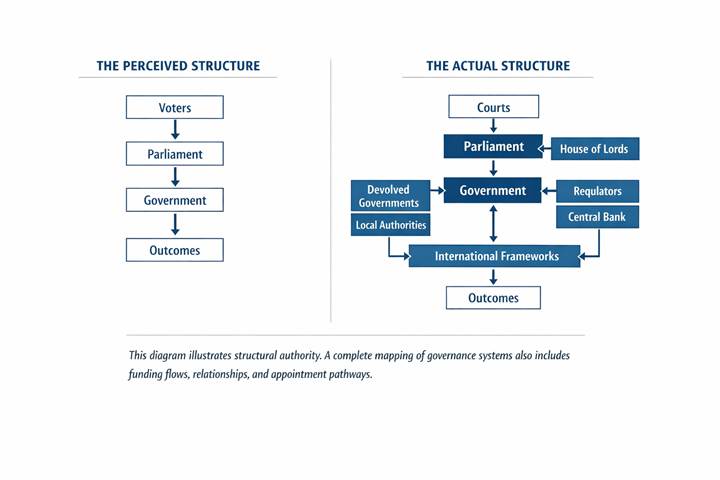
Democratic systems are often understood through a simplified model of authority.
In this model, power flows:
- From voters
- To elected representatives
- To government
- To outcomes experienced by the public
This model reflects the principle of democratic consent.
However, it does not fully represent how authority is exercised in practice.
In reality, authority is distributed across multiple institutions, operating within overlapping mandates and interacting across different domains.
This creates a gap between:
- The perceived structure of authority and the actual structure through which decisions are made
This gap may result in:
- Reduced visibility of where decisions originate
- Difficulty attributing outcomes to specific actors
- Increased complexity in understanding how authority operates
Power continues to be exercised.
But it is not always clearly visible.
This explains why system visibility becomes fragmented.
Where authority is distributed across multiple interacting layers, attribution becomes complex, and the link between decision and responsibility may weaken.
GRACE Analytical Framing — Structural Visibility
Within the GRACE Framework, this condition is assessed as a question of visibility, attribution, and control.
The issue is not whether authority exists.
The issue is whether authority is:
- Visible
- Attributable
- Subject to defined thresholds and action
Where authority is distributed but not clearly visible, governance systems may continue to operate while becoming increasingly difficult to assess.
Where attribution is incomplete, accountability may become diffuse.
Where thresholds are not applied to structural conditions, divergence and constraint may persist without correction.
Governance Implications
The distribution of authority does not remove democratic control.
It alters how that control must be exercised.
Effective governance within such systems requires:
- Visibility of institutional roles and interactions
- Attribution of decision-making and outcomes
- Detection of divergence between mandate and behaviour
- Structured response where conditions indicate constraint or misalignment
Where these conditions are met, distributed systems remain governable.
Where they are not, systems may continue to function while becoming progressively harder to direct, assess, and correct.
Conclusion
Modern governance systems operate through distributed authority across institutional and international layers.
This structure provides capability, continuity, and resilience. However, it also introduces complexity, distance, and potential constraint.
The central governance challenge is not to eliminate this structure.It is to ensure that it remains visible, attributable, and subject to effective control.
Where authority is visible, systems can be understood. Where it is attributable, responsibility can be assigned.
Where it is subject to thresholds and action, outcomes can be corrected.
Where these conditions are absent, systems do not fail outright. They become progressively more difficult to see, to attribute, and to direct.
A GRACE Framework governance note
Published 2026 | Author: Andrew Young
This governance note forms part of the Transparency, Accountability & Public Trust series (S9) within the System Analysis page.
It should be read alongside YP-24-26 through YP-31-26.
Introduction
The preceding notes establish that authority within modern democratic systems is distributed across multiple institutional layers. These systems remain lawful and operational, yet may exhibit divergence, constraint, reduced responsiveness, and limited visibility of decision-making structures.
This note concludes the series by examining the requirement for comprehensive visibility of authority — not only as a principle of transparency, but as a structural condition for meaningful democratic participation.
GRACE Analytical Framing
This note applies the GRACE Framework as an analytical method for examining how authority is structured, exercised, and made visible within modern democratic systems.
GRACE does not assess political outcomes or preferences. It examines whether systems remain coherent, accountable, and intelligible under conditions of complexity, institutional layering, and distributed authority.
Within this framework, transparency is not treated as a communications function, but as a structural requirement. The central analytical question is therefore not whether authority exists, but whether it can be seen, understood, and reconciled across the system in which it operates.
The Limits of Electoral Visibility
Democratic participation is exercised primarily through elections at local, devolved, and national levels. These processes establish political direction and confer legislative authority through representative institutions.
However, electoral processes do not capture the full structure through which authority is exercised. A significant proportion of decision-making authority operates through delegated, regulatory, advisory, and operational systems that persist beyond electoral cycles.
This creates a structural distinction between the point at which democratic consent is given and the points at which authority is exercised. Where this extended system is not visible, the public understanding of authority becomes incomplete.
The Extended Authority System
Authority within a modern state is not contained solely within elected institutions. It operates across an extended system that includes the civil service, regulatory bodies, the judiciary, contracted delivery partners, advisory networks, and international frameworks.
These components form an interconnected system through which decisions are developed, interpreted, implemented, and enforced. Each element may operate lawfully within its mandate, yet the cumulative structure is rarely visible as a whole.
As a result, authority becomes distributed across multiple actors, each exercising a portion of decision-making power. The system functions collectively, but it is not commonly perceived collectively.
This creates a condition in which the structure of authority exceeds the structure of visibility.
Structural Evolution of Authority
Modern democratic systems have evolved beyond the institutional structures through which they are commonly understood.
Authority has expanded in response to complexity — incorporating regulatory frameworks, delegated decision-making, contracted delivery models, international coordination, and advisory ecosystems.
However, public models of understanding have not evolved at the same pace. Electoral representation remains the primary visible anchor, while operational authority extends beyond it.
This creates a divergence between the structure of governance and the structure through which governance is perceived.
Relationship, Influence, and System Legibility
Where authority operates across multiple actors, it is shaped not only by formal mandates but also by relationships, dependencies, and influence structures.
Where authority, influence, and dependency exist, visibility must extend beyond formal structures to include the relationships through which decisions are shaped.
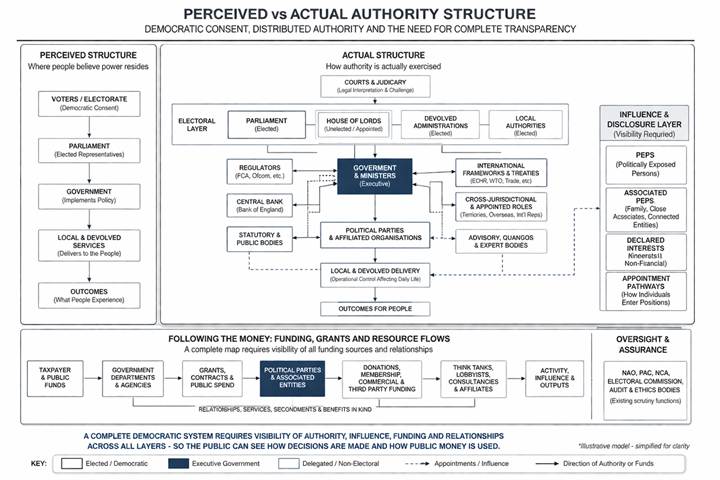
Within a GRACE-aligned governance model, visibility of authority requires structured disclosure of relationships — both financial and non-financial — extending beyond direct actors to include associated and proximate networks. This includes beneficial interests, advisory roles, institutional affiliations, and repeat interaction pathways capable of influencing decision-making outcomes. Where such relationships are not disclosed to a sufficient degree of separation to reveal material influence structures, system visibility remains incomplete, and accountability becomes partial.
This includes financial and non-financial relationships, institutional proximity, advisory roles, career pathways, and influence networks capable of affecting decision-making outcomes.
These relationships do not imply impropriety but form part of system reality. Where they are not visible, accountability becomes partial.
This note addresses the visibility gap identified in preceding notes.
It examines whether the structure through which authority operates is fully observable within the system itself.
| The Structural QuestionIf authority within a democratic system is distributed across an extended network, a fundamental question arises:Is the system, as it actually operates, fully visible to those subject to its effects? |
Where visibility does not match structure, the system may remain lawful, but it cannot be fully understood. Where it cannot be fully understood, accountability becomes partial.
To illustrate this structural condition, the following diagram contrasts the simplified public perception of authority with the extended system through which authority is actually exercised. It highlights the gap between visible democratic structures and the broader network of institutions, relationships, and influence pathways that shape real-world outcomes.
Diagram 1 — Simplified Democratic Model vs Extended Authority System
System Behaviour Under Reduced Visibility
When authority is distributed but not fully visible, predictable system behaviours emerge. Decision-making becomes fragmented, responsibility diffused, and corrective action delayed.
Systems may remain lawful while becoming increasingly difficult to interrogate. Reduced visibility creates a gap between lived experience and system understanding.
The following diagram expands this model by mapping authority, influence, and interaction across the full system environment. It illustrates how formal institutions, associated actors, and relational networks combine to form an extended authority structure. The purpose is not to imply impropriety, but to render visible the system as it operates in practice, including the relationships through which decisions may be shaped.
Diagram 2 — Full System Map: Authority, Influence, and Interaction
Democratic Consequence
Where authority is not fully visible, democratic participation becomes partial. Consent is given to a system that is only partially seen.
Accountability becomes difficult to attribute clearly, and responsibility may be shared without being fully owned.
System Visibility as a Democratic Requirement
For democratic systems to function effectively, they must render authority visible in a form that reflects how the system actually operates.
Visibility must extend beyond formal structures to include relationships, dependencies, and influence networks.
Visibility is not optional transparency. It is a precondition for accountability.
Where authority is not visible, it cannot be fully interrogated or held to account. Where it cannot be held to account, democratic consent cannot fully form.
The purpose of mapping authority is therefore structural — enabling the system to see itself as it operates.
A GRACE Framework governance note
Published 2026 | Author: Andrew Young
This governance note forms part of the Transparency, Accountability & Public Trust series (S9) within the System Analysis page.
It applies the GRACE Framework to examine how governance systems behave under conditions of pressure, dependency, and reduced transparency.
The preceding notes have not described isolated governance issues. They describe a system.
This concluding note integrates the series by identifying a single governing condition:
Governance systems do not fail solely through lack of visibility, but through failure to convert visibility into attributable responsibility and enforceable action.
Across this series, a consistent set of structural conditions has emerged, demonstrating how influence, visibility, and accountability interact across domains. Electoral pressure has demonstrated how systems may retain awareness of risk while deferring action under cyclical constraints. Regulatory parity has established that transparency is not a sector-specific requirement, but a general condition for governance integrity. Application within welfare and public service systems has illustrated that these conditions are not theoretical, but observable within operational environments. Examination of democratic participation has shown that procedural validity may coexist with structural influence, and that participation may remain formally intact while the conditions shaping it become less visible. The analysis of detection and thresholds has demonstrated that risk may be recognised without being converted into action, and that governance failure often arises not from absence of knowledge, but from absence of activation. The examination of distributed authority has shown that modern systems do not operate through a single chain of command, but through layered institutional arrangements in which authority is exercised across multiple interacting bodies.
Taken together, these conditions do not point to isolated weakness. They describe a coherent system dynamic.
Within such a system, authority is not absent, but distributed. Influence is not necessarily hidden, but not fully visible in aggregate. Decisions are not made outside the system, but across it. The effect is not immediate failure, but increasing complexity in understanding how outcomes are formed and where responsibility lies.
The mapped structures presented in the preceding note illustrate this condition directly. They show that authority extends beyond a linear relationship between voter, representative, and government, and instead operates across a network of institutions, regulatory bodies, delivery mechanisms, and external frameworks. These structures are not inherently problematic. They reflect the evolution of modern governance, including the need for technical expertise, continuity, and operational capacity. However, their cumulative effect is to create a system in which visibility, attribution, and control must be actively maintained.
It is within this structure that the behaviours identified in earlier notes become understandable. Convergence develops where overlapping systems align around the same actors or networks. Pressure delays action where decision-making is sensitive to electoral or institutional risk. Transparency gaps allow influence and dependency to persist without full attribution. Distributed authority increases the distance between the point at which consent is given and the point at which decisions are made. Detection without defined thresholds allows systems to observe conditions without being required to act upon them.
The result is a system that continues to function, but becomes progressively more difficult to see in full. Outcomes remain lawful. Processes continue to operate. Decisions are made within defined mandates. Yet the relationship between authority, influence, and outcome becomes less immediately visible. Accountability remains present, but is distributed. Responsibility exists, but may be difficult to trace across interacting layers.
Principle — Influence, Visibility, and Governance Control
Influence is an inherent feature of all social, economic, and political systems. It operates across a spectrum of activity, from legitimate representation and advocacy through to the shaping of institutional behaviour and decision-making environments.
The presence of influence does not in itself constitute corruption, impropriety, or governance failure.
Within democratic systems, influence may arise through lawful and necessary functions, including legal advocacy, political engagement, administrative discretion, professional expertise, and community representation. These forms of influence are not only permissible but integral to the functioning of complex governance environments.
The governance question is therefore not whether influence exists.
The governance question is whether influence is:
- Visible within the system in which authority is exercised
- Attributable to identifiable actors, relationships, or structures
- Subject to scrutiny, challenge, and defined governance controls
Where influence remains visible and attributable, it can be assessed, understood, and governed. Under these conditions, influence operates within the bounds of legitimate system behaviour.
Where influence is not visible, not attributable, or not capable of being challenged, a structural governance risk emerges.
This risk does not depend on intent or misconduct.
It arises from the system condition itself.
In such environments, influence may shape:
- The allocation of public resources
- The operation of regulatory or enforcement systems
- The conditions under which participation and decision-making occur
These effects may not be fully observable within formal governance structures.
At this point, the distinction between legitimate influence and structural distortion becomes unclear.
Within the GRACE Framework, this transition is understood as a visibility and attribution failure across the control spine:
Annex V — Visibility is incomplete
Annex S — Attribution is partial or obscured
Annex E — Risk is not formally classified or escalated
Annex Z — No corrective action is triggered
Where these conditions coincide, influence is no longer operating solely as a feature of system interaction. It becomes a condition capable of shaping outcomes without corresponding visibility or accountability.
This does not, in itself, constitute corruption.
However, it creates the structural conditions in which distortion, capture, or coercive system behaviour may emerge and persist without detection.
The purpose of governance is therefore not to eliminate influence.
It is to ensure that influence remains visible, attributable, and subject to control within the system in which authority is exercised.
This condition does not represent the absence of governance. It represents a shift in how governance must be understood.
Within the GRACE Framework, the central requirement is not simply that systems operate, but that they remain visible, attributable, and subject to control. Visibility ensures that structures, relationships, and patterns can be observed. Attribution ensures that decisions, funding, and outcomes can be traced to accountable actors. Control ensures that where conditions indicate divergence, constraint, or emerging risk, systems are capable of responding in a structured and timely manner.
Where these conditions are maintained, complexity does not undermine governance. It becomes manageable. Where they are not, complexity becomes opacity, and opacity allows structural conditions to persist without correction.
The central conclusion of this series is therefore not that democratic systems fail when procedures break down. It is that they become progressively harder to assess when the structures through which authority operates are not fully visible or attributable.
Participation may continue. Elections may take place. Institutions may function. Yet without integrated visibility of authority, influence, and funding, the ability to understand how outcomes are formed—and where responsibility lies—becomes increasingly constrained.
Democratic systems do not lose legitimacy through visible failure.
They lose clarity when the structure through which power operates can no longer be fully seen, attributed, or understood.
The purpose of governance design is therefore not only to ensure that systems function, but to ensure that they remain intelligible.
Visibility, attribution, and control are the conditions that determine whether governance remains intelligible, accountable, and capable of correction.
The implication is direct.
If a system cannot be fully seen, it cannot be fully understood.
If it cannot be understood, it cannot be effectively challenged.
And if it cannot be challenged, accountability becomes conditional rather than structural.
The purpose of governance design is therefore not only to ensure that systems operate, but to ensure that they remain visible, attributable, and capable of being governed.
System Visibility as a Governance Requirement
Modern governance systems have developed the capability to identify, verify, and track individuals across multiple domains with increasing precision.
This capability strengthens attribution at the level of the individual. However, the preceding analysis demonstrates that equivalent visibility does not yet exist in reverse.
The system itself — across funding, decision-making, and institutional interaction — is not fully visible in aggregate to those subject to its effects.
This creates a structural asymmetry.
The system can verify the individual.
The individual cannot fully verify the system.
Within the GRACE Framework, this is not a neutral condition.
It represents an imbalance between authority and accountability.
If governance requires that decisions, influence, and outcomes remain visible and attributable, then this requirement must apply equally to the system itself.
This introduces a further governance condition.
The system must be capable of being seen as it operates.
This includes:
- How public funds are allocated and distributed
- How decision-making authority is exercised across institutional layers
- How influence structures interact with formal governance
- How fiscal exposure and risk accumulate over time
Where this visibility is absent, attribution becomes partial.
Where attribution is partial, accountability becomes conditional.
The logical extension of the framework is therefore clear.
Governance systems must develop structured mechanisms through which they can be made visible, attributable, and testable in their entirety.
This is not a matter of transparency as communication.
It is a matter of transparency as control.
Where the system can be seen, it can be understood.
Where it can be understood, it can be challenged.
Where it can be challenged, it can be governed.
This completes the control logic established throughout the series.
A GRACE Framework governance note
Published 2026 | Author: Andrew Young
This governance note forms part of the Transparency, Accountability & Public Trust series (S9) within the System Analysis page. It should be read alongside the GRACE Framework, which defines the governance methodology applied in this analysis.
This note builds on the preceding analysis of system visibility and distributed authority. Where governance systems operate across multiple layers that are not fully visible or easily understood, the relationship between observed outcomes and underlying decision structures may become unclear. In such conditions, simplified narratives can emerge as a way of interpreting complex system behaviour.
This paper applies the S9 analytical framework to migration policy.
The preceding S9 notes examine how governance systems behave under conditions of distributed authority, partial visibility, and fragmented attribution. Here, that framework is applied to a real-world policy domain, illustrating how narrative, visibility, and operational reality interact in practice.
Introduction
This note examines how narratives form around system behaviour, particularly in the context of migration policy. Where outcomes are visible but underlying structures are not, simplified explanations may emerge.
Real Policy Drivers
Migration policy is shaped by multiple drivers, including demographic change, labour demand, conflict, legal obligations, and environmental pressures. These factors generate competing pressures rather than a single coordinated outcome.
Narrative Formation
Where systems are complex and outcomes uneven, narratives may emerge that attribute coherence and intent to fragmented processes. These narratives simplify multi-factor systems into singular explanations.
System Reality
In practice, migration policy is characterised by distributed authority, national decision-making, and institutional constraint. International actors may contribute analysis, but do not control domestic policy outcomes.
Governance Interpretation
Within the GRACE Framework, analysis focuses on observable criteria: lawfulness, proportionality, and accountability. This allows structured evaluation without reliance on inferred intent.
Where system visibility is limited, narratives will emerge. Effective governance requires distinguishing between narrative interpretation and system reality, focusing on structure, evidence, and accountability.
Real Policy Drivers of Migration Systems
Migration policy does not emerge from a single source. It is shaped by a combination of structural pressures and policy choices, including:
- Demographic change, including ageing populations and declining birth rates in parts of Europe and North America
- Labour market demand across sectors requiring workforce participation
- Conflict, instability, and displacement in origin regions
- Legal obligations under international and domestic frameworks
- Emerging pressures linked to environmental and climate conditions
Importantly, these drivers do not produce a single policy outcome. They generate competing pressures, trade-offs, and political responses that vary significantly across jurisdictions.
The Formation of Narrative
Where systems are complex and outcomes are uneven, there is a natural tendency to seek simplified explanations. Narratives such as “borderless world” or “population replacement” emerge as interpretive frameworks through which individuals attempt to understand large-scale change.
- Attribution of unified intent to multiple independent actors
- Assumption of long-term coordinated strategy across institutions
- Simplification of multi-factor systems into single explanatory causes
- Substitution of system visibility with inferred motivation
Such narratives can gain traction where transparency is limited, where outcomes are locally disruptive, or where policy communication is unclear or inconsistent.
System Reality: Distributed Authority and Policy Fragmentation
In practice, migration policy is not centrally controlled by a single entity or coordinated through a unified global mechanism. It is characterised by:
- National sovereignty over immigration decisions
- Divergent policy approaches between countries
- Political contestation within domestic systems
- Legal constraints and judicial oversight
- Operational limitations at borders and within administrative systems
International organisations may contribute analysis or discussion, but they do not exercise direct control over national migration policy decisions.
Governance Risk: Narrative Substitution for Analysis
Where narratives replace structured analysis, several risks emerge:
- Misidentification of policy drivers
- Reduced ability to evaluate proportionality and effectiveness
- Erosion of trust in institutions without evidential basis
- Displacement of policy debate from measurable outcomes to assumed intent
This does not invalidate public concern. It indicates that concern is being expressed through explanatory models that may not reflect system reality.
A GRACE Framework Interpretation
Within the GRACE Framework, governance analysis does not attempt to infer hidden intent. It evaluates system performance through observable criteria.
This requires asking:
- Lawful (ARG) — Are migration policies and decisions consistent with legal frameworks?
- Proportionate (EG) — Are outcomes balanced in relation to economic capacity, social impact, and public interest?
- Accountable (V/Z) — Are decisions, costs, and responsibilities visible and attributable?
These questions allow for structured assessment without reliance on assumptions regarding coordination or motive.
Reframing the Question
The relevant governance question is not:
“Is there a coordinated effort to create a borderless world?”
It is:
- What are the drivers of migration policy?
- How are those policies being implemented?
- What are the measurable outcomes?
- Where are the points of accountability?
Closing Observation
Narratives of system intent emerge where complexity meets limited visibility.
They provide simplified explanations for outcomes that are experienced but not fully understood. However, effective governance requires moving beyond narrative interpretation to structured analysis. Migration systems must be assessed not by assumed motives, but by whether they operate in a lawful, proportionate, and accountable manner.
Principle — Narrative vs System Reality
Where system visibility is limited, narratives will emerge to explain outcomes. Governance analysis must distinguish between narrative interpretation and observable system behaviour, focusing on evidence, structure, and accountability rather than inferred intent.
A GRACE Framework governance note
Published April 2026 | Author: Andrew Young
This governance note forms part of the Transparency, Accountability & Public Trust series (S9) within the System Analysis page. It should be read alongside the preceding S9 notes, which examine how governance systems behave under conditions of distributed authority, partial visibility, and fragmented attribution.
This note provides a forward-facing bridge from the S9 series.
This note introduces identity and verification as emerging factors within those conditions, and points toward the S6 series, where identity is examined as a system layer in its own right.
Introduction
The preceding notes establish that modern governance systems operate through structures that are not fully visible in aggregate. Authority is distributed, influence operates across overlapping domains, and attribution is often partial or incomplete.
Within such systems, outcomes may remain lawful while becoming progressively more difficult to trace, understand, and challenge.
This creates a structural condition in which governance systems function, but do not remain fully intelligible to those subject to their effects.
This note examines the introduction of a new system layer within this context.
A New System Layer — Identity Infrastructure
Recent policy developments have introduced proposals relating to digital identity systems.
These systems are presented as mechanisms for improving verification, access, efficiency, and fraud reduction across public services and administrative processes.
At a functional level, digital identity enables the system to:
- Recognise individuals across multiple domains
- Verify identity in a consistent and repeatable manner
- Attribute actions and interactions to a defined identity
- Integrate data across institutional boundaries
These capabilities increase system coherence and operational efficiency. However, they are introduced into systems that already exhibit the structural conditions identified throughout this series.
Interaction with Existing System Conditions
The S9 analysis demonstrates that governance systems currently operate with:
- Partial visibility of authority
- Fragmented attribution of decision-making
- Distributed control across institutional layers
- Influence structures (financial and non-financial) that are not fully visible in aggregate
The introduction of identity infrastructure does not replace these conditions.
It interacts with them.
Verification Asymmetry
Digital identity strengthens the ability of the State to verify the individual.
It enables:
- Persistent recognition
- Attribution of activity
- Cross-system linkage
However, the preceding analysis demonstrates that the system itself is not fully verifiable to the individual.
This creates a structural asymmetry:
– The State can verify the individual
– The individual cannot equivalently verify the State
Where this asymmetry exists, the balance between authority and accountability becomes uneven.
Attribution and Influence
Identity systems strengthen attribution at the level of the individual.
Actions, transactions, and interactions can be linked to a verified identity. However, attribution at the level of the system remains incomplete.
This includes:
- Attribution of public expenditure
- Attribution of decision-making authority
- Attribution of financial and non-financial influence structures
- Attribution of control mechanisms and escalation pathways
The system therefore operates with asymmetrical attribution:
- High attribution of the individual
- Partial attribution of the system
Reciprocal Verification and Governance Integrity
Where the State requires individuals to verify their identity, a corresponding governance condition arises.
Identity verification must be matched by system verification.
The system must be capable of being verified in terms of:
- Public expenditure
- Decision-making responsibility
- Influence structures
- Control mechanisms
Verification, to remain consistent with democratic accountability, must operate in both directions.
Democratic Consent Under Conditions of Verification
Democratic consent extends beyond elections to the ability to verify how authority is exercised.
Where verification is possible, consent becomes informed.
Where it is not, consent remains partial.
Transitional Governance Condition
The introduction of identity systems into partially visible systems creates a structural condition:
Increased capability without equivalent accountability.
Return to Series 6: Identity as a System Layer
The next series (S6) examines how identity systems must be designed to ensure governance remains verifiable, attributable, and controllable.
Verification applied only to the individual increases control.
Verification applied to both the individual and the system enables accountability.
A GRACE Framework governance note
Published 2026 | Author: Andrew Young
This governance note forms part of the Transparency, Accountability & Public Trust (S9) series within the System Analysis page. It applies the GRACE Framework to examine how governance systems behave under conditions of visibility, attribution, and control, with particular focus on how risk is identified, interpreted, and acted upon within complex systems.
Introduction
This note builds directly on Governance Note YP-88-26, extending the analysis of system conditions as connected governance behaviour rather than isolated policy events. Within the S9 framework, this progression reflects the movement from visibility of conditions to attribution and ultimately to enforceable control.
Public discussion often presents policy areas such as migration, housing, public services, safeguarding, fiscal exposure, and governance as separate issues. Each is analysed independently, reported independently, and debated independently.
Within a GRACE-aligned framework, this interpretation is incomplete.
These areas operate as part of a connected system. The purpose of the System Analysis series is to examine how that system behaves, how conditions emerge, how they interact, and how they become visible over time.
This note provides an overview of that system. It is not intended to replace the individual series notes, but to provide a framework through which those notes can be understood as connected components of a single system rather than isolated observations.
From Isolated Issues to System Behaviour
At surface level, system conditions may appear as discrete challenges. However, those visible pressures are better understood as connected expressions of wider system behaviour.
Conditions that appear isolated at surface level often represent connected expressions of the same underlying system behaviour. Housing pressure, administrative backlog, fiscal exposure, institutional response, public service strain, and wider public disruption do not emerge independently from one another. They interact across the same governance environment, reinforcing pressure, reducing visibility, and weakening attribution over time. Where these interactions are not assessed collectively, systems may continue to appear operational while underlying control conditions progressively weaken.
Within a GRACE-aligned framework, the purpose of system analysis is therefore not only to identify visible outcomes, but to examine the pathways through which those outcomes are produced, connected, and sustained across the wider governance environment.
Each condition can still be analysed on its own terms. The point of system analysis is not to remove that specificity, but to show how those conditions interact across the same governance environment.
Within a connected system, these are not separate issues. They are different expressions of the same underlying process.
They represent system behaviour.
This distinction is critical. Isolated analysis can describe what is visible. It does not explain how that visibility was produced.
A system-based view examines not only outcomes, but the pathways that generate those outcomes.
The System Pathway
Across the System Analysis series, a consistent pathway is identified.
At the point of entry, individuals become part of the system. Entry establishes participation, not final outcome.
Over time, participation continues. Where processing capacity is constrained or delayed, duration extends. Extended duration contributes to system load.
That load does not remain within administrative systems. It transfers into housing provision, public services, and local environments, where it becomes directly observable.
Where pressure persists, it becomes visible through institutional response, policy adjustment, or community-level impact. At each stage, cost is incurred and distributed across multiple domains.
Without consolidation, total system exposure is not immediately visible.
This sequence can be understood as:
Entry → Interaction → Duration → Load → Impact → Response → Cost → Attribution → Control
This is not a theoretical construct. It is the observable behaviour of the system over time.
Visibility and Its Limits
System conditions become visible through a range of indicators, including backlog and processing delay, housing demand and availability, service usage and strain, community-level experience, incident reporting, and institutional response. These indicators provide different windows into the same system condition. None is complete on its own, but together they allow the system to observe where pressure is accumulating and where response may be required.
Visibility is necessary. It allows the system to observe its own condition.
Visibility alone does not provide control.
A system may be highly visible and still lack the ability to respond effectively. Visibility shows what is happening. It does not explain why it is happening or how to change it.
This creates a critical distinction between visibility and attribution.
Attribution — The Basis of Control
Control requires attribution.
Attribution is the ability to link outcomes to underlying system conditions.
It connects observed impact, system behaviour, and underlying drivers. Without attribution, system conditions are observed in isolation, cause and effect remain disconnected, and response becomes reactive rather than targeted. With attribution, system behaviour becomes understandable, decisions can be aligned with outcomes, and control mechanisms can operate on a coherent basis.
Attribution is therefore the transition point between observation and control.
From Observation to Control — The GRACE Spine
The GRACE Framework defines a structured approach to system control.
It requires the identification of system conditions, visibility of those conditions, attribution of outcomes and cost to underlying drivers, and reconciliation of inputs and outputs within a unified framework.
Together, these elements form the E–S–V–Z control spine.
Where this structure is applied:
- System behaviour becomes measurable
- Thresholds can be defined
- Response can be triggered in a structured way
Where it is not applied:
- Conditions remain visible but unmanaged
- Pressure accumulates
- Response remains fragmented
Control is not achieved by visibility alone. It is achieved by integrating visibility with attribution and reconciliation.
System Control and Its Constraints
Control is not solely a function of system design. It depends on institutional capacity, fiscal sustainability, procurement and delivery integrity, governance structures, the ability to adjust rules and thresholds, and the presence of identity and attribution systems. Where these conditions are aligned, the system is more capable of recognising pressure and responding before that pressure is displaced into other domains.
Where these conditions are strong, system behaviour can be managed.
Where they are weak, control becomes partial.
This introduces an important condition.
A system may continue to operate even where full control is not achieved. In such cases, pressure does not disappear. It is redistributed across different parts of the system.
Safeguarding as a Continuous Condition
Safeguarding operates across all stages of the system.
Risk may emerge at entry, during extended participation, within housing and services, or under broader conditions of system pressure. Effective safeguarding therefore requires early detection of vulnerability, continuous monitoring, integration across institutions, and timely escalation and response. It cannot operate as a detached compliance function; it must remain embedded within the wider system loop.
Safeguarding is not a separate function. It is the protection layer within the system.
Its effectiveness depends on the same conditions that enable system control: visibility, attribution, integration, and response.
The Complete System Loop
Taken together, the System Analysis series defines a complete system loop. S10 examines system design and expansion pathways. S8 examines system stress and capacity under pressure. S7 examines how impact transfers into communities and services. S3 examines institutional response and decision formation. S2 examines fiscal exposure, attribution, and system cost. S6 examines control through identity and governance. S1 examines safeguarding as a continuous protection layer.
Each series represents a different lens applied to the same system.
They are not separate domains. They are connected perspectives.
Understanding system behaviour requires moving across these perspectives rather than analysing them in isolation.
GRACE Gate Analysis
DCT — Democratic Consent Test
System behaviour must be visible and understandable, ensuring that the relationship between decisions, outcomes, and system exposure is clear.
ARG — Absolute Rights Gate
Visibility and attribution must operate within legal protections, ensuring that system transparency does not override due process, safeguarding duties, or individual rights.
EG — Economic Gate
The cost of system operation, including distributed fiscal exposure, must be visible and understood in relation to outcomes.
IG — Implementation Gate
Systems must be capable of presenting clear lines of attribution, linking decisions to outcomes across domains.
RAG — Risk & Assurance Gate
Risk emerges where system behaviour remains fragmented or opaque, preventing early recognition of exposure and limiting effective response.
VAR — Value Assurance Review
Value is defined in terms of system clarity, ensuring that visibility and attribution enable effective governance and informed decision-making.
E–S–V–Z–O Review
E — Risk
Risk emerges where system behaviour is not visible or not understood, limiting the ability to identify exposure or respond effectively.
S — Fiscal
Fiscal exposure increases where cost is distributed and not fully attributed, reducing clarity over total system impact.
V — Visibility
Visibility requires that system inputs, behaviour, and outcomes are observable across domains.
Z — Reconciliation
Reconciliation requires linking visibility and attribution to enable corrective action where divergence occurs.
O — Oversight (Annex O)
Independent oversight must be capable of assessing system behaviour, attributing responsibility, and requiring corrective action.
Outcome — A Framework for Understanding
The purpose of this note is to provide a framework for understanding system behaviour.
Within a GRACE-aligned framework:
Conditions are examined as part of a connected system, visibility is extended across domains, attribution links outcomes to underlying drivers, control mechanisms operate on a unified basis, and safeguarding remains a continuous requirement.
Where these principles are applied, system behaviour becomes understandable and manageable.
Where they are not, conditions may appear fragmented even where they are structurally connected.
Systems do not fail in isolation.
They behave in patterns.
Understanding those patterns is the first step to control.
Clarification — System Analysis Scope
This overview does not assess specific policies, institutions, or outcomes. It summarises structural system behaviour as examined across the System Analysis series.
The purpose of this note is to provide a coherent framework through which individual developments and system conditions can be understood in context.
Within a GRACE-aligned framework, the focus remains on visibility, attribution, control, and safeguarding as core components of effective governance.
However, system behaviour is not produced solely by internal interaction. It is shaped by external conditions that define the level and nature of pressure acting upon the system.
A GRACE Framework governance note
Published 2026 | Author: Andrew Young
This governance note forms part of the Transparency, Accountability & Public Trust (S9) series within the System Analysis page. It should be read alongside the GRACE Framework, Annex V (Dashboards, Methods & Publication), Annex Z (Reconciliation & Control), and Annex O (Independent Oversight & Assurance), and in conjunction with preceding notes on system pathways (S10), external context (S4), and system behaviour (S9).
Introduction
Public understanding of complex systems is shaped through narrative.
Information is presented through political communication, media reporting, institutional statements, and public discussion. These narratives influence how system conditions are interpreted, how risks are perceived, and how outcomes are understood.
Within a GRACE-aligned framework, narrative is not treated as separate from system behaviour.
It is part of how system behaviour becomes visible.
However, narrative does not always reflect the full structure of the system. It may simplify, emphasise, or isolate specific elements of system behaviour. This creates a potential divergence between perception and underlying system reality.
This note examines that divergence.
In Governance Note YP-91-26, system pathways were examined as mechanisms of participation and interaction. This note now considers how that behaviour becomes visible and is interpreted, examining the relationship between narrative, perception, and underlying system reality.
System Baseline — Visibility Through Interpretation
System conditions do not present themselves in a complete or unified form. They are observed through individual data points, institutional reporting, media coverage, and public experience. Each provides only a partial view. Narrative acts as the mechanism through which those partial views are interpreted and communicated, connecting observations into a form that can be understood. This process is necessary because, without interpretation, system complexity would be difficult to engage with. It also introduces a structural condition.
Visibility is mediated through interpretation.
Narrative Formation — Selection and Emphasis
Narratives are constructed through selection. From the full range of system signals, certain elements are highlighted, prioritised, repeated, or framed within a particular context. Other elements may receive less attention or be excluded entirely. This process is not necessarily deliberate distortion. It reflects the practical limits of communication. It nevertheless shapes perception. A system condition may be presented primarily in terms of scale, urgency, contribution, pressure, risk, or benefit, depending on the framing applied.
Depending on the framing applied, the same underlying system behaviour may be understood in different ways.
Perception and System Reality
Perception operates at the level of narrative. System reality operates at the level of structure and interaction.
The two are related but not identical.
A narrative may accurately reflect one aspect of system behaviour while not capturing the full system pathway, the interaction between domains, the distribution of cost over time, or the relationship between cause and effect. A visible pressure in housing may be presented without reference to upstream pathways; a policy benefit may be described without reference to downstream cost; and a single outcome may be emphasised without reference to wider system interaction.
This does not invalidate the narrative. It defines its scope.
Within a GRACE-aligned framework, the objective is not to replace narrative. It is to reconcile narrative with system reality.
The Visibility Gap
Where narrative and system structure are not aligned, a visibility gap emerges.
This gap represents the difference between:
- What is observed and communicated
- What is structurally occurring within the system
The visibility gap may arise where system pathways are not fully visible, attribution between cause and effect is incomplete, cost is distributed across time or institutions, or interaction between domains is not presented. In such conditions, system behaviour may be partially visible but not fully understood.
Consequences for Public Understanding
The visibility gap affects how systems are understood.
Where perception is based on partial visibility, system behaviour may appear fragmented, relationships between conditions may not be recognised, trade-offs may not be fully visible, and policy effects may be interpreted in isolation.
This has implications for governance.
Public consent depends on understanding. Where understanding is incomplete, consent may be based on partial information.
This does not imply that narratives are incorrect. It reflects that they may not capture the full system.
Narrative and Policy Interaction
Narrative does not only describe system behaviour. It influences policy response.
Where particular aspects of system behaviour are emphasised, policy attention may focus on visible conditions, response may prioritise immediate outcomes, and underlying drivers may receive less focus. This can create a feedback loop in which narrative shapes perception, perception shapes response, response affects system behaviour, and new outcomes generate further narrative.
Without reconciliation, this loop may operate on partial visibility.
Integration with System Control
Within a GRACE-aligned framework, effective control requires integration of:
- Visibility
- Attribution
- Reconciliation
Narrative sits within the visibility layer.
It contributes to how system conditions are understood. However, control requires moving beyond interpretation to structured understanding.
This includes:
- Linking narrative to underlying system pathways
- Connecting visible outcomes to upstream drivers
- Integrating cost, impact, and response across domains
Without this integration, narrative may describe the system but not enable control.
System Condition — Interpreted Visibility
This note identifies a structural condition.
System visibility is interpreted through narrative.
Narrative provides understanding, but may not provide completeness.
Where narrative and system structure are aligned:
- Understanding improves
- Attribution becomes clearer
- Control becomes more effective
Where they are not aligned:
- Visibility remains partial
- Attribution is incomplete
- Control is limited
This condition sits between observation and governance.
GRACE Gate Analysis
DCT — Democratic Consent Test
System conditions must be presented in a way that enables informed understanding, ensuring that consent reflects the underlying system rather than partial interpretation.
ARG — Absolute Rights Gate
Narrative and interpretation must operate within lawful frameworks, ensuring that representation does not misstate or obscure rights-based conditions.
EG — Economic Gate
Economic understanding must include full system cost, ensuring that narrative does not isolate benefits from associated fiscal exposure.
IG — Implementation Gate
Systems must be capable of linking narrative-level visibility to operational data and system structure.
RAG — Risk & Assurance Gate
Risk arises where narrative diverges from system reality, limiting the ability to identify exposure and respond effectively.
VAR — Value Assurance Review
Value depends on alignment between perception and system reality, enabling informed decision-making.
E–S–V–Z–O Review
E — Risk
Risk emerges where system behaviour is interpreted through incomplete visibility.
S — Fiscal
Fiscal understanding may be reduced where cost is not fully integrated into narrative.
V — Visibility
Visibility requires integration between narrative, data, and system structure.
Z — Reconciliation
Reconciliation requires aligning perception with system reality, linking narrative to underlying conditions.
O — Oversight (Annex O)
Independent oversight must assess whether public presentation of system conditions reflects underlying structure and exposure.
Link to the System Loop
This note connects system pathways to fiscal understanding.
- S10 defines how individuals enter the system
- S4 defines external pressures shaping demand
- S9 defines system behaviour and visibility
- This note examines how that visibility is interpreted
- YP-93 examines how cost is understood within that visibility
Narrative sits between system behaviour and fiscal understanding.
Outcome — Understanding as a Condition of Governance
Within a GRACE-aligned framework, effective governance requires recognition that visibility is mediated through narrative, alignment between narrative and system structure, integration of cost, impact, and pathway within public understanding, and reconciliation between perception and underlying conditions. Where these conditions are present, public understanding improves, attribution becomes clearer, and governance becomes more effective. Where they are absent, perception may diverge from reality, system behaviour may be misinterpreted, and control may be reduced.
Systems are not only observed.
They are interpreted.
Effective governance requires that interpretation aligns with reality.
The next stage examines how this interpreted visibility connects to fiscal understanding, and how cost becomes visible within that narrative structure.
Clarification — System Analysis Scope
This analysis does not assess specific narratives, media outputs, or political positions.
It examines structural conditions relating to how system behaviour is interpreted and understood.
The purpose of this note is to ensure that narrative is recognised as part of system visibility, and that effective governance requires alignment between perception and underlying system conditions.
Within a GRACE-aligned framework, transparency is defined not only by what is visible, but by what is understood.
One of the most significant elements affected by this gap is cost, which may be experienced within the system but not fully recognised within public understanding.
A GRACE Framework governance note
Published 2026 | Author: Andrew Young
This governance note forms part of the Transparency, Accountability & Public Trust (S9) series within the System Analysis page. It should be read alongside the GRACE Framework, Annex S (Fiscal Attribution), Annex V (Dashboards, Methods & Publication), Annex Z (Reconciliation & Control), and Annex O (Independent Oversight & Assurance), and in conjunction with preceding notes on system behaviour (S9), fiscal exposure (S2), and system impact (S7).
Introduction
Public spending is often presented in simplified terms.
Expenditure is described as if it were directly funded, immediately attributable, and clearly understood. Public discourse frequently assumes a direct relationship between policy decisions, public spending, and taxpayer contribution.
Within a GRACE-aligned framework, this interpretation is incomplete.
Modern fiscal systems operate through multiple mechanisms, including taxation, borrowing, and monetary interaction. Cost is not always immediately visible. It is distributed across time, institutions, and financial structures.
This creates a condition in which spending is visible, but funding is not fully understood.
This note examines that condition.
System Baseline — How Public Spending Is Funded
Government expenditure is sustained through a combination of taxation collected from individuals and businesses, borrowing through the issuance of government debt, and monetary interaction through central banking systems.
These mechanisms do not operate in isolation. They form an integrated fiscal system.
Taxation provides immediate revenue. Borrowing allows expenditure to exceed current revenue by transferring cost into the future. Monetary interaction affects liquidity, interest rates, and the broader economic environment within which both operate.
This structure allows governments to respond to demand, manage economic cycles, and sustain public services. It also creates complexity in how cost is understood.
The Distribution of Cost Across Time
A key characteristic of modern fiscal systems is that cost is distributed across time.
Where expenditure exceeds current taxation, borrowing is used to finance the difference, debt accumulates, and repayment is deferred into future periods.
This creates a temporal shift.
Current system activity may be funded partly by future resources. The cost of present decisions is not always borne entirely in the present.
This does not imply mismanagement. It reflects standard fiscal operation.
It affects visibility.
When cost is deferred, it becomes less directly observable. The link between current activity and future obligation may not be immediately recognised within public understanding.
Institutional Distribution of Cost
Cost is also distributed across institutions.
Expenditure may originate from central government but manifest through local authorities, public service providers, contracted delivery partners, devolved administrations, and associated agencies or bodies. Funding may flow through multiple channels before reaching the point of impact. At each stage, budgetary responsibility may shift, reporting may vary, and attribution may become less direct.
This creates a structural condition.
The system incurs cost as a whole, but responsibility for that cost is fragmented.
Visibility Without Integration
Public visibility of spending often occurs through announced budgets, departmental expenditure, local authority accounts, and service-level cost indicators. These provide partial views. Without integration, they do not present a complete picture of system cost. A policy may generate central government expenditure, local authority pressure, service demand across multiple sectors, and long-term fiscal commitments. Each element may be visible in isolation, but without consolidation the total cost remains unclear.
This produces a visibility gap.
The Attribution Problem
The visibility gap leads directly to an attribution problem.
If cost is distributed across time, fragmented across institutions, and presented in partial forms, linking expenditure to specific system conditions becomes more difficult. A local authority may experience increased demand, a department may report increased expenditure, and borrowing may increase at national level. Each reflects system behaviour, but without attribution these effects may not be linked to the same underlying drivers. This limits the ability to understand system cost, align decision-making with outcomes, and apply effective control mechanisms.
Attribution is therefore essential to fiscal transparency.
Borrowing and Perception
Borrowing plays a central role in shaping public perception of cost.
Because borrowing allows expenditure without immediate taxation, it may reduce the perceived impact of spending in the short term.
However, borrowing creates future obligations. Debt servicing introduces ongoing cost, and fiscal flexibility may be reduced over time.
These effects are not always visible at the point of expenditure.
This creates a divergence between:
- Perceived cost in the present
- Actual cost over time
Within a GRACE-aligned framework, this divergence must be recognised and reconciled.
Fiscal Visibility and Public Understanding
The visibility gap affects public understanding.
Where cost is not presented as an integrated system, spending may appear lower than its full impact, trade-offs may not be fully visible, and decision-making may not reflect total exposure. Transparency is not only a function of disclosure. It is a function of structure. Information may be available, but without integration it may not be understandable. Effective transparency therefore requires consolidation of cost across domains, attribution of expenditure to system drivers, and presentation of both short-term and long-term impact.
Without these elements, visibility does not translate into understanding.
System Condition — Distributed Cost, Fragmented Visibility
This note identifies a structural condition.
Cost is distributed across time and institutions.
Visibility is fragmented across reporting structures.
This creates a gap between:
- What the system spends
- What the system appears to spend
This gap does not require concealment. It arises from the structure of the system itself.
It has governance implications.
Without addressing this gap:
- Attribution remains incomplete
- Decision-making may be misaligned
- Public understanding may be reduced
GRACE Gate Analysis
DCT — Democratic Consent Test
Fiscal conditions must be visible and understandable so that public consent reflects the true cost of system operation.
ARG — Absolute Rights Gate
Fiscal transparency must operate within legal and institutional frameworks, ensuring accurate and fair representation of cost without distortion.
EG — Economic Gate
Assessment must include full system cost, including distributed expenditure, borrowing, and long-term obligations.
IG — Implementation Gate
Fiscal systems must be capable of integrating cost across departments, institutions, and timeframes.
RAG — Risk & Assurance Gate
Risk arises where fragmented visibility prevents accurate understanding of total system exposure.
VAR — Value Assurance Review
Value depends on the ability to link spending to outcomes, ensuring that fiscal decisions reflect actual system performance.
E–S–V–Z–O Review
E — Risk
Risk emerges where cost is not fully visible or understood, limiting the ability to identify exposure.
S — Fiscal
Fiscal exposure includes current expenditure, borrowing, and long-term obligations across multiple system domains.
V — Visibility
Visibility requires integrated presentation of cost across time, institutions, and system functions.
Z — Reconciliation
Reconciliation requires linking spending, funding mechanisms, and outcomes within a unified framework.
O — Oversight (Annex O)
Independent oversight must be capable of assessing total fiscal exposure, attributing cost, and identifying divergence between perceived and actual spending.
Link to the System Loop
This note reinforces the fiscal dimension of the system loop.
- S7 identifies where impact becomes visible
- S3 identifies institutional response
- S2 identifies cost and attribution
- S9 identifies visibility and understanding
Fiscal visibility is not separate from system behaviour.
It is part of how that behaviour is understood and governed.
Outcome – Visibility as a Condition of Control
Within a GRACE-aligned framework, effective governance requires recognition that cost is distributed across time and institutions, integration of fiscal data across domains, attribution linking spending to system drivers, and transparent presentation of both short-term and long-term exposure. Where these conditions are present, fiscal reality becomes visible, decision-making can align with actual cost, and control mechanisms can operate effectively. Where they are absent, visibility remains partial, attribution remains incomplete, and control becomes more difficult.
Spending is visible.
Cost is not always understood.
Bridging that gap is a requirement of governance.
Clarification — System Analysis Scope
This analysis does not assess specific budgets, policies, or fiscal decisions. It examines structural conditions relating to how cost is generated, distributed, and understood within a modern fiscal system.
The purpose of this note is to ensure that fiscal visibility is considered as part of system behaviour rather than as an isolated financial concept.
Within a GRACE-aligned framework, transparency is defined not only by what is disclosed, but by what can be understood.
These fiscal effects ultimately manifest within local systems, where cost translates into visible pressure across housing, services, and community infrastructure.
A GRACE Framework governance note
Published 2026 | Author: Andrew Young
This governance note forms part of the Transparency, Accountability & Public Trust (S9) series within the System Analysis page. It should be read alongside the GRACE Framework, Annex V (Dashboards, Methods & Publication), Annex Z (Reconciliation & Control), Annex O (Independent Oversight & Assurance), and in conjunction with preceding notes on system behaviour (S9), fiscal attribution (S2), and system control (S6).
Introduction
Identity is often understood in cultural, social, or individual terms.
Within a system, identity operates differently.
It is produced through interaction with institutions, shaped by policy, influenced by legal frameworks, and reinforced through participation across multiple domains. It is not generated by a single actor, nor is it governed by a single system.
This creates a structural condition.
Identity is produced across the system, but ownership of that identity is not clearly defined.
This note examines that condition.
System Baseline — Identity as a System Output
Within a connected system, identity is not static. It is influenced by education systems, legal frameworks, institutional interaction, media and information environments, economic participation, and community and social structures. Each of these contributes to how individuals are recognised, how they participate, and how they are perceived within the system. Identity is therefore not only personal. It is also systemic, emerging through repeated interaction across institutions and environments.
Distributed Production of Identity
No single institution produces identity.
Instead, identity is shaped through cumulative influence.
Education may influence knowledge and social integration. Legal systems define status, rights, and obligations. Public services shape interaction with institutions. Media and communication environments influence perception. Economic participation shapes role and contribution. Each element contributes to identity formation, but none owns the total outcome.
These elements operate independently.
There is no single point at which identity is defined, measured, or reconciled.
Attribution Gap
This produces an attribution gap.
If identity is shaped across multiple domains, no single actor can fully account for it, no single system can fully measure it, and no single policy can fully influence it. Outcomes relating to identity may be observed through patterns of participation, social cohesion indicators, behavioural trends, and community-level interaction. However, attributing those outcomes to specific system drivers becomes complex. Without attribution, responsibility is diffuse, accountability is limited, and intervention becomes less precise.
System Behaviour — Change Without Ownership
System-level change may occur without clear ownership.
Identity may evolve over time as a result of:
- Policy decisions across multiple domains
- External influences and context
- Interaction between different system components
These changes may be:
- Gradual
- Uneven across different areas
- Difficult to attribute to a single cause
This creates a condition in which:
- Change is observable
- Drivers are multiple
- Responsibility is unclear
The system produces outcomes without a single point of ownership.
Visibility and Interpretation
Identity-related outcomes are often interpreted through narrative.
Public discourse may focus on:
- Cultural change
- Social cohesion
- Community interaction
- Perceived alignment or divergence
These interpretations are based on visible indicators.
However, without attribution:
- Observations may not reflect underlying system pathways
- Causes may be inferred rather than identified
- Responses may focus on symptoms rather than drivers
This reflects the visibility gap identified in earlier S9 notes.
Integration with Control Systems
Modern systems increasingly use identity as a control mechanism (S6).
Digital identity, verification systems, and administrative frameworks allow recognition of individuals across domains, attribution of behaviour, and application of rules and conditions. These systems provide structured identity within administrative processes. However, administrative identity does not fully capture system-level identity. The system therefore operates with structured identity for control and distributed identity for social and systemic behaviour. The relationship between the two is not always fully aligned.
The relationship between the two is not always fully aligned.
System Condition — Identity Without Ownership
This note identifies a structural condition.
Identity is produced across the system.
Ownership of that identity is not clearly defined.
This results in:
- Distributed influence
- Limited attribution
- Diffuse responsibility
This does not indicate system failure. It reflects the complexity of multi-domain systems.
It has governance implications.
Without attribution:
- Understanding is reduced
- Accountability is limited
- Intervention becomes less precise
Implications for Governance
Effective governance requires recognition that identity outcomes are multi-factorial, that single-policy intervention has limits, that data and signals must be integrated across domains where lawful and appropriate, and that over-simplified attribution of cause should be avoided. Where these conditions are recognised, analysis becomes more accurate and policy can be better aligned with system behaviour. Where they are not, interpretation may be simplified, attribution may be incomplete, and response may be misaligned.
GRACE Gate Analysis
DCT — Democratic Consent Test
System conditions relating to identity must be presented in a way that reflects their complexity, ensuring informed understanding.
ARG — Absolute Rights Gate
All system interaction relating to identity must operate within legal protections, ensuring fairness, equality, and due process.
EG — Economic Gate
Assessment must consider the economic dimensions of identity, including participation, contribution, and distribution of opportunity.
IG — Implementation Gate
Systems must be capable of integrating identity-related data across domains where appropriate and lawful.
RAG — Risk & Assurance Gate
Risk arises where identity outcomes are interpreted without sufficient attribution, leading to misaligned response.
VAR — Value Assurance Review
Value depends on accurate understanding of system behaviour and the ability to align response with underlying conditions.
E–S–V–Z–O Review
E — Risk
Risk emerges where identity-related outcomes are not fully understood or are attributed incorrectly.
S — Fiscal
Fiscal implications may arise through participation patterns, service demand, and system interaction.
V — Visibility
Visibility requires integration of signals across domains to understand identity-related system behaviour.
Z — Reconciliation
Reconciliation requires linking observed outcomes to underlying system drivers where possible.
O — Oversight (Annex O)
Independent oversight must assess whether identity-related system conditions are properly understood and addressed.
Link to the System Loop
This note extends the S9 analysis of visibility and attribution.
- S9 identifies system behaviour and visibility
- YP-92 examines narrative and perception
- YP-93 examines fiscal visibility
- This note examines identity as a system outcome without clear attribution
Identity is not separate from system behaviour.
It is one of its outputs.
Outcome — Understanding the Unowned System
Within a GRACE-aligned framework, effective governance requires recognition that identity is system-produced, awareness that attribution is limited, integration of signals across domains, and careful interpretation of observed outcomes. Where these conditions are present, understanding improves and response can be better aligned. Where they are absent, attribution may be simplified, interpretation may diverge from system reality, and governance may become less effective.
Identity is not only held by individuals.
It is shaped by systems.
Where that shaping is unowned, understanding becomes more difficult.
Clarification — System Analysis Scope
This analysis does not assess specific groups, communities, or outcomes. It examines structural conditions relating to how identity is produced within a connected system.
The purpose of this note is to ensure that identity is understood as a system-level output rather than as a single-domain concept.
Within a GRACE-aligned framework, the focus remains on visibility, attribution, and reconciliation across all aspects of system behaviour.
A GRACE Framework governance note
Published 2026 | Author: Andrew Young
This governance note forms part of the Transparency, Accountability & Public Trust (S9) series within the System Analysis page. It should be read alongside the GRACE Framework, Annex V (Dashboards, Methods & Publication), Annex Z (Reconciliation & Control), Annex O (Independent Oversight & Assurance), and in conjunction with preceding notes on system behaviour (S9), narrative and perception (YP-92-26), and attribution (S2).
Introduction
Democratic systems operate through participation.
Elections provide a mechanism through which individuals select representatives. This process is structured through legal frameworks that define eligibility, procedure, and outcome.
Within this structure, eligibility determines who may stand for election. Voting determines who is selected.
These two elements are distinct.
Eligibility provides access to the democratic process.
Selection provides outcome within that process.
Within a GRACE-aligned framework, the relationship between access, visibility, and consent becomes a central governance question.
System Baseline — Legal Eligibility
Eligibility to stand for election is defined by law.
This typically includes conditions relating to citizenship or residency status, age requirements, legal capacity, and disqualification criteria defined in statute. These conditions establish a threshold. Individuals who meet that threshold may stand; those who do not are excluded.
This creates a clear system rule.
Eligibility is determined through legal criteria, not through subjective assessment of suitability.
Access and Representation
Once eligibility is established, individuals may present themselves for election.
At this stage:
- The system does not determine outcome – It provides access to the process
Representation is then determined through voter choice.
This creates a second condition.
The system governs access.
The electorate determines selection.
This distinction is fundamental to democratic operation.
Visibility and Information
For consent to be meaningful, voters require information.
This may include candidate background, policy position, public record, conduct, and experience. The availability and consistency of this information may vary. It may be uneven in quality, distributed across sources, interpreted through narrative, or influenced by visibility and prominence.
This creates a structural condition.
Access to the process may be clear.
Understanding of candidates may be variable.
Consent and Understanding
Democratic consent operates through voting.
Consent depends on understanding.
Where voters have clear information, consistent visibility, and the ability to assess candidates, consent more closely reflects informed choice. Where these conditions are limited, understanding may be partial, decision-making may rely on narrative or perception, and consent may not reflect full system visibility.
This does not invalidate the process. It defines the conditions under which it operates.
Eligibility and Legitimacy
Eligibility determines who may stand.
Legitimacy concerns how representation is perceived.
A candidate may be legally eligible but may raise broader questions relating to:
- Public trust
- Representation
- Alignment with community expectations
These questions are not resolved through eligibility rules alone.
They operate within the space between:
- Legal access
- Public perception
- Electoral outcome
Within a GRACE-aligned framework, this space is recognised as part of system behaviour.
Attribution and Responsibility
Responsibility within democratic systems is distributed.
Legal frameworks define eligibility, institutions administer the process, candidates present themselves, and voters determine outcome. No single actor controls all elements. This creates an attribution condition. Outcomes cannot be attributed solely to the legal framework, the candidates, or the electorate. They are produced through interaction between all three.
System Condition — Access Without Full Visibility
This note identifies a structural condition.
The democratic system provides access through eligibility.
Visibility of candidate information may not be uniform or complete.
This creates a gap between:
- The ability to participate
- The ability to fully assess
Within this gap:
- Consent operates
- Representation is determined
- Legitimacy is interpreted
This does not represent system failure. It reflects the structure of democratic processes.
GRACE Gate Analysis
DCT — Democratic Consent Test
Consent requires that system conditions are visible and understandable, including how eligibility, information, and selection interact.
ARG — Absolute Rights Gate
Eligibility and participation must operate within legal protections, ensuring fairness, due process, and equal access to the democratic process.
EG — Economic Gate
Assessment may include the broader system implications of representation, including governance outcomes and resource allocation.
IG — Implementation Gate
Electoral systems must operate consistently, ensuring that eligibility rules and process administration are applied uniformly.
RAG — Risk & Assurance Gate
Risk arises where visibility of candidate information is limited, reducing the ability to form fully informed consent.
VAR — Value Assurance Review
Value depends on alignment between access, understanding, and outcome within the democratic process.
E–S–V–Z–O Review
E — Risk
Risk emerges where consent is formed under conditions of partial visibility.
S — Fiscal
Fiscal implications arise indirectly through governance outcomes and policy decisions shaped by representation.
V — Visibility
Visibility requires accessible and consistent information regarding candidates and their positions.
Z — Reconciliation
Reconciliation requires alignment between eligibility, information, and electoral outcome.
O — Oversight (Annex O)
Independent oversight must ensure that electoral processes operate lawfully and transparently.
Link to the System Loop
This note extends the S9 analysis of visibility and consent.
- S9 identifies system behaviour and visibility
- YP-92 examines interpretation and perception
- YP-97 examines attribution and identity
- This note examines how consent operates within democratic structures
Democratic processes are part of system behaviour.
Outcome — Consent as a System Condition
Within a GRACE-aligned framework, effective governance requires clear legal eligibility criteria, consistent administration of electoral processes, accessible and reliable information, and recognition of the relationship between access, visibility, and consent. Where these conditions are present, participation operates effectively, consent reflects understanding, and representation aligns with system structure. Where they are absent, understanding may be partial, consent may be formed under limited visibility, and interpretation of legitimacy may vary.
The ballot provides access to choice.
Understanding determines the quality of that choice.
Clarification — System Analysis Scope
This analysis does not assess specific candidates, elections, or political positions. It examines structural conditions relating to eligibility, visibility, and consent within democratic systems.
The purpose of this note is to ensure that democratic participation is understood as part of system behaviour, with particular focus on the relationship between access, information, and outcome.
Within a GRACE-aligned framework, consent is not only a procedural outcome. It is a condition shaped by visibility and understanding.
A GRACE Framework governance note
Published 2026 | Author: Andrew Young
This governance note forms part of the Transparency, Accountability & Public Trust (S9) series within the System Analysis page. It should be read alongside the GRACE Framework and the System Analysis series (S1–S10), including preceding notes on system behaviour (YP-89-26), narrative and perception (YP-92-26), fiscal visibility (YP-93-26), incentives and behaviour (YP-101-26), feedback loops (YP-102-26), intervention (YP-103-26), and thresholds and triggers (YP-104-26).
Introduction
Across the System Analysis series, system behaviour has been examined through multiple lenses.
Entry pathways define how participation begins. External context shapes demand. Interaction over time creates duration, and where duration extends, load accumulates. That load transfers into housing, services, and local systems, where it becomes visible. Institutional response follows, cost is incurred and distributed, and control mechanisms are introduced to manage behaviour. Safeguarding operates across all stages.
These elements describe a connected system.
This note consolidates that analysis, bringing together the relationship between visibility, control, and outcome within a GRACE-aligned framework.
System Baseline — A Connected Structure
The system operates through interaction rather than isolation.
It is not defined by a single policy, institution, or outcome, but by the relationship between entry and participation, external pressures and structural drivers, behaviour shaped by incentives, feedback loops that reinforce or stabilise conditions, institutional response and capacity, fiscal exposure and attribution, and control mechanisms supported by safeguarding.
Each of these elements influences the others. Understanding the system therefore requires examining how they interact rather than considering them separately.
Visibility — Seeing the System
Visibility is the first condition of control.
System behaviour becomes observable through data and reporting, institutional observation, local experience, and public narrative. Through these channels, the system is able to recognise demand and participation, pressure on capacity, distribution of impact, and the emergence of risk.
However, visibility alone is not sufficient.
Without integration and attribution, visibility may remain partial. This creates a distinction between seeing the system and understanding it.
Attribution — Understanding the System
Attribution connects visibility to understanding.
It enables identification of the drivers of system behaviour, the relationships between cause and effect, the distribution of cost across domains, and the interaction between different system elements.
Without attribution, conditions may be observed but not explained. Response may focus on symptoms rather than underlying causes, and control may be limited. With attribution, behaviour becomes understandable, decision-making can align with outcomes, and intervention can be targeted effectively.
Attribution therefore forms the link between visibility and control.
Behaviour — The Output of Structure
System behaviour is produced by structure.
Incentives, constraints, and interaction determine how individuals and institutions act within the system. Behaviour reflects how the system operates in practice, including patterns of participation, adaptation to incentives, distribution of demand, and institutional response.
Behaviour is not random. It is structured.
Understanding behaviour requires understanding the incentives and constraints that produce it.
Feedback — The Dynamic System
System behaviour is dynamic rather than static.
Outcomes feed back into the system, influencing future behaviour. Feedback loops may reinforce conditions, stabilise them, or alter incentives over time. These loops determine whether pressure increases, conditions persist, or systems stabilise.
Without recognising feedback, system behaviour may be misinterpreted.
Intervention — Acting on Understanding
Intervention converts understanding into action.
Effective intervention requires identification of system drivers, alignment with incentives, selection of appropriate intervention points, and consideration of timing and capacity.
Intervention must address underlying structure rather than only visible outcomes. Where intervention is aligned, behaviour can be influenced, feedback loops can be altered, and conditions can stabilise.
Thresholds and Triggers — When Systems Act
Systems act at defined points rather than continuously.
Thresholds define when conditions require action, and triggers initiate response. Together, they determine when intervention occurs, how response is executed, and whether action is timely and effective.
Where thresholds and triggers are well designed, response is structured and control is predictable. Where they are not, action may be delayed or inconsistent and conditions may escalate.
Safeguarding — The Protection Layer
Safeguarding operates across all stages of the system.
It requires early detection of vulnerability, continuous monitoring, integration of signals across domains, and timely, coordinated response. Safeguarding is not a separate function but an embedded condition within system operation.
Its effectiveness depends on the same elements that support control: visibility, attribution, integration, and response.
System Condition — Visibility, Control and Outcome
System outcomes are produced through the interaction of visibility, attribution, behaviour, feedback, intervention, thresholds and triggers, and safeguarding.
Where these elements are aligned, system behaviour can be understood, control can be exercised, and outcomes can be influenced. Where they are not, visibility may remain partial, attribution may be incomplete, behaviour may diverge from intent, and control may be reduced.
GRACE Framework Integration
The GRACE Framework provides structure to this system.
It defines how visibility is established, how attribution is achieved, how control is applied, and how safeguarding is integrated. Through its gate analysis, E–S–V–Z–O structure, threshold design, and oversight mechanisms, it provides a method for understanding and managing system behaviour.
GRACE does not replace system behaviour. It enables it to be understood and controlled.
Outcome — Control Through Understanding
Within a GRACE-aligned framework, effective governance requires recognition that systems are connected. It also requires visibility across domains, attribution linking outcomes to drivers, understanding of behaviour and incentives, management of feedback loops, structured intervention, clear thresholds and triggers, and integrated safeguarding.
Where these conditions are present, behaviour becomes understandable, control becomes possible, and outcomes can be influenced. Where they are absent, conditions may persist without clear explanation, response may remain reactive, and control may be limited.
Systems do not require perfect control. They require understood control.
The System Analysis series does not present isolated observations.
It presents a framework for understanding how systems operate.
Visibility shows what is happening. Attribution explains why it is happening. Control determines what happens next.
Within a GRACE-aligned framework, governance is defined by the relationship between these elements.
Understanding the system is the first condition of control. Applying that understanding is the second.
Clarification — System Analysis Scope
This synthesis does not assess specific policies or outcomes. It consolidates structural analysis across the System Analysis series.
The purpose of this note is to provide a coherent framework through which system behaviour, control, and outcome can be understood together.
Within a GRACE-aligned framework, governance is defined not by isolated actions, but by the structure through which those actions are understood and applied.
This synthesis therefore closes the S9 draft sequence by restating the central control principle: visibility shows what is happening, attribution explains why it is happening, and control determines what happens next.
A GRACE Framework governance note
Published 2026 | Author: Andrew Young
This governance note forms part of the Transparency, Accountability & Public Trust (S9) series within the System Analysis page. It should be read alongside the GRACE Framework and preceding analysis of system behaviour, visibility, and attribution, as well as recent notes on system constraint and local impact (YP-112-26 to YP-117-26; YP-123-26).
Introduction
Public understanding of system behaviour is shaped through both direct experience and narrative.
Experience reflects observable conditions. Narrative provides explanation of those conditions. These two elements do not always align.
Within a GRACE-aligned framework, understanding depends on the relationship between what is experienced and how it is explained.
Where visibility and attribution are incomplete, narrative can become dominant because it provides an explanation where the system has not provided a fully attributable account.
This note examines the relationship between narrative and system reality, and the conditions under which divergence between the two may occur.
System Reality — Direct and Localised
System reality is experienced directly.
It is reflected in access to housing, availability of services, waiting times, administrative responsiveness, and the functioning of local systems. These conditions are immediate and observable.
System reality is not abstract.
It is encountered through interaction with the system at the point of use.
Narrative — System-Level Interpretation
Narrative provides explanation of system behaviour at a broader level.
It may describe economic conditions, policy rationale, or aggregate outcomes. Narrative operates at a different level to direct experience and is often expressed in general or system-wide terms.
Narrative is necessary.
It allows complex systems to be interpreted and communicated.
However, narrative does not in itself establish system behaviour.
The Attribution Gap
Divergence between narrative and system reality arises where attribution is incomplete. Contribution may be described without direct connection to observable impact, while impact may be experienced without clear linkage to underlying causes. In that space, explanation and experience can begin to move apart. This creates a structural gap.
Explanation and experience operate in parallel rather than in alignment.
The issue is not the presence of narrative, but the absence of clear linkage between narrative and observable conditions.
Visibility — The Condition for Alignment
Visibility enables alignment between narrative and system reality.
Where system behaviour is visible across domains, explanation can be linked to experience. Contribution, demand, cost, and outcome can be understood as part of a connected system.
Where visibility is fragmented, narrative may reflect only part of the system.
This increases the likelihood of divergence.
Interpretation — How Systems Are Understood
Interpretation is shaped by the information available.
Where observable conditions are not clearly explained, interpretation may rely on partial information or simplified narratives. This may lead to conclusions that do not fully reflect system behaviour.
Interpretation is therefore influenced by both visibility and attribution.
It is not independent of them.
The Role of Reconciliation
Reconciliation links system elements.
It connects contribution, demand, cost, and outcome into a coherent account. Where reconciliation is present, narrative can reflect system reality more accurately.
Where it is absent, system elements remain fragmented.
This fragmentation contributes to divergence between explanation and experience.
System Condition — Narrative Without Attribution
This note identifies a structural condition. Narrative may become dominant where attribution is incomplete. In this condition, explanation is not clearly linked to observable system behaviour. As a result, understanding may diverge from reality. The issue is not narrative itself. Narrative is necessary because complex systems require explanation. The issue is the absence of alignment between narrative and system conditions. Where explanation cannot be reconciled with experience, visibility remains partial and accountability becomes harder to test.
GRACE Framework Integration
The GRACE Framework supports alignment between narrative and system reality.
Through visibility, it ensures that system behaviour is observable across domains. Through attribution, it links outcomes to underlying causes. Through reconciliation, it connects system elements into a coherent account.
GRACE therefore provides the structure through which narrative can accurately reflect system behaviour.
Outcome — Aligning Explanation and Experience
Within a GRACE-aligned framework, effective governance requires alignment between explanation and experience.
This includes ensuring that narrative reflects observable conditions, that attribution connects outcomes to causes, and that system behaviour is visible across domains.
Where these conditions are present, understanding is strengthened.
Where they are not, divergence may persist.
Systems are not defined only by how they operate. They are also defined by how their operation is understood. Narrative shapes interpretation, but it does not define system behaviour. System reality is experienced directly, and narrative must be aligned with that reality if it is to support understanding rather than replace it. Where visibility, attribution, and reconciliation are present, explanation and experience can operate together. Where they are absent, divergence emerges. Understanding therefore depends not on narrative alone, but on the alignment between narrative and system reality.
A GRACE Framework governance note
Published 2026 | Author: Andrew Young
This governance note forms part of the Transparency, Accountability & Public Trust (S9) series within the wider System Analysis programme, examining how democratic legitimacy, public confidence, institutional accountability and long-term governance stability increasingly interact within modern constitutional systems.
Recent public discussion surrounding electoral eligibility, temporary immigration status, devolved democratic institutions, and legislative representation has exposed a wider governance question extending beyond any individual political candidate or party-political controversy.
Within a modern governance environment, democratic systems increasingly operate across overlapping legal, constitutional, administrative, and international frameworks simultaneously.
Electoral law, immigration status, residency rights, constitutional authority, democratic legitimacy, sovereignty, public visibility, and institutional accountability may therefore interact in ways that are not always immediately visible or fully understood by the wider public.
Within a GRACE-aligned framework, the central issue is not whether lawful democratic participation occurs.
The issue concerns how democratic legitimacy, public understanding, institutional visibility, and governance reconciliation operate when eligibility systems become increasingly complex across interconnected governance structures.
This note examines that condition.
Democratic Eligibility and Governance Complexity
Modern democratic systems frequently contain layered eligibility structures shaped by constitutional arrangements, citizenship frameworks, residency status, treaty obligations, devolved authority, and electoral legislation.
As governance systems evolve, these structures may become increasingly difficult for the public to interpret intuitively.
Individuals may therefore encounter situations where outcomes are legally valid while simultaneously appearing politically unexpected or institutionally unfamiliar to parts of the electorate.
Within devolved governance systems, this complexity may increase further where separate legislatures possess authority to alter electoral eligibility criteria within their own institutional frameworks.
This creates conditions where public assumptions regarding representation, citizenship, residency, and political eligibility may diverge from the actual legal architecture operating beneath the surface.
Within a GRACE framework, divergence between public assumption and operational governance reality becomes a visibility issue.
Visibility, Understanding and Democratic Legitimacy
Democratic legitimacy depends not solely upon lawful process, but also upon sufficient public understanding of how governance systems operate.
Where major institutional or electoral changes occur without corresponding public visibility, explanation, or operational understanding, legitimacy pressures may emerge even where procedures themselves remain lawful.
A governance system may remain technically compliant while parts of the public simultaneously experience confusion regarding eligibility, representation, devolved authority, and constitutional interaction.
Within a GRACE-aligned framework, this does not automatically indicate governance failure.
However, it may indicate reduced reconciliation between legal architecture and public understanding.
Where visibility weakens, public trust may also weaken.
Temporary Residency and Political Representation
The interaction between temporary residency status and elected office introduces additional governance questions extending beyond the circumstances of any individual office-holder.
Democratic institutions traditionally derive legitimacy through representation, accountability, political participation, territorial connection, civic integration, and public consent.
As residency and mobility frameworks evolve within increasingly globalised societies, governance systems may increasingly confront questions regarding how political representation interacts with temporary residency structures, migration pathways, and long-term constitutional belonging.
Within a GRACE framework, these questions are not reducible to simplistic “for” or “against” positions.
Rather, they concern democratic coherence, constitutional clarity, operational compatibility, institutional visibility, and public legitimacy within evolving governance systems.
The issue may therefore concern governance reconciliation rather than procedural legality.
Evolving Political Context and Downstream Legitimacy
Governance reforms are frequently introduced within political conditions that may differ substantially from those existing at the point where the practical implications of those reforms later become publicly visible.
Electoral systems, constitutional arrangements, eligibility structures, and representation frameworks may therefore continue operating within evolving political environments shaped by changing public priorities, institutional trust conditions, migration debate, constitutional tension, electoral fragmentation, or wider legitimacy pressures.
Within a GRACE-aligned framework, this distinction is important because governance legitimacy is not entirely static.
A reform introduced during one political environment may later be interpreted very differently under altered public conditions.
This does not automatically invalidate the reform itself.
However, it may significantly alter:
- Public interpretation
- Institutional sensitivity
- Legitimacy perception
- Democratic confidence
- Political visibility surrounding the operational consequences of the reform
Within complex governance systems, downstream legitimacy conditions may therefore evolve independently from the original legislative context in which reforms were initially introduced, debated, or approved.
This may become particularly significant where reforms originally presented as technical, administrative, or procedural later become symbolically connected to wider public debate surrounding sovereignty, representation, migration, constitutional identity, democratic belonging, or institutional trust.
This note does not examine the legitimacy of any individual candidate, party, or electoral outcome in isolation.
Rather, it examines the wider governance conditions emerging where democratic eligibility, residency status, constitutional authority, public understanding, and institutional legitimacy increasingly intersect within complex multi-layer governance systems.
Within a GRACE-aligned framework, democratic resilience depends not solely upon lawful process, but upon whether governance systems remain sufficiently visible, understandable, accountable, and operationally coherent to maintain durable public confidence under evolving constitutional and institutional conditions.
A GRACE Framework governance note
Published 2026 | Author: Andrew Young
This governance note forms part of the Transparency, Accountability & Public Trust (S9) series within the System Analysis page. It should be read alongside the GRACE Framework, Annex V (Dashboards, Methods & Publication), Annex Z (Reconciliation & Control), Annex O (Independent Oversight & Assurance), and preceding governance notes examining system visibility, attribution, institutional trust, strategic communication, democratic legitimacy, and operational governance pathways.
History is often presented as a sequence of settled events.
Governments rise and fall, policies are introduced, borders change, economies expand or contract, and political movements emerge and disappear.
Yet governance systems are not shaped by events alone.
They are shaped by interpretation.
Modern political systems increasingly operate through competing narratives regarding legitimacy, fairness, identity, obligation, prosperity, security, rights, transition, public protection, democratic participation, and national direction.
Within this environment, governance itself becomes partially narrative-driven.
The central question is no longer simply:
“What happened?”
Increasingly, the question becomes:
“Who defines what the event means?”
This distinction is not insignificant.
Within modern democratic systems, political legitimacy is often influenced not only by measurable outcomes, administrative competence, or operational delivery, but also by narrative identity.
Political actors are frequently presented through symbolic archetypes: the reformer, the outsider, the protector, the technocrat, the patriot, the modernizer, the defender of rights, and the voice of ordinary people.
These identities may simultaneously contain elements of truth, exaggeration, omission, strategic framing, symbolism, performance, and selective presentation.
As political communication becomes increasingly media-driven, governance itself risks becoming partially theatrical, with narrative coherence sometimes taking precedence over operational transparency or measurable delivery.
Narrative as Political Infrastructure
Within modern governance systems, narrative is not merely commentary surrounding politics.
Narrative increasingly functions as political infrastructure itself.
Public trust is influenced by: presentation, symbolism, perceived intention, moral framing, historical comparison, emotional association, and strategic communication.
Governments often frame policies through narratives of: fairness, protection, compassion, national renewal, economic responsibility, inclusion, security, or democratic necessity.
Opposition movements similarly construct narratives involving: institutional failure, public abandonment, corruption, elite detachment, democratic erosion, inequality, or systemic decline.
Within such environments, political competition increasingly becomes competition between interpretations of reality itself.
This creates a governance condition in which institutional legitimacy may become partially detached from operational outcomes.
A government may present itself as economically responsible while fiscal pressure increases.
A political movement may present itself as democratic renewal while simultaneously concentrating internal control.
An institution may describe itself as transparent while limiting operational visibility.
A policy may be presented as compassionate while generating downstream pressure elsewhere within the system.
None of these contradictions are necessarily unique to one ideology, one country, or one political era.
They instead reflect a broader structural tendency within modern governance systems toward narrative optimisation.
Political Identity and Symbolic Legitimacy
Modern politics increasingly rewards symbolic identity construction.
Public figures are often encouraged to develop coherent political personas capable of simplifying complex governance realities into emotionally understandable narratives.
This process may involve: selective biography, symbolic positioning, résumé amplification, moral branding, strategic language, media choreography, emotional association, and retrospective reinterpretation of events.
Political identity therefore becomes partially performative.
This does not necessarily imply dishonesty in every case.
Rather, it reflects the structural reality that modern democratic communication environments frequently reward simplicity, certainty, symbolism, and emotional coherence over complexity, ambiguity, or institutional limitation.
Within such systems, the distinction between: governance, communication, branding, and performance may gradually become less clear.
This creates risk.
Where narrative identity becomes excessively dominant, governments may begin prioritising narrative preservation over institutional correction.
Failures may become politically unrewarding to acknowledge.
Contradictions may be strategically minimised.
Operational limitations may be reframed as external sabotage.
Institutional weaknesses may become hidden beneath symbolic messaging.
The issue is therefore not merely whether politicians “lie.”
The deeper governance issue concerns whether systems maintain sufficient visibility, reconciliation, oversight, and institutional correction to prevent narrative dominance from replacing operational accountability.
The GRACE Perspective
Within a GRACE-aligned framework, governance legitimacy cannot rely solely upon narrative identity.
Narratives alone are insufficient forms of accountability.
This is precisely why:
- Visibility matters
- Attrution matters
- Publication matters
- Reconciliation matters
- Independent oversight matters
Annex V exists to improve visibility beyond political messaging alone.
Annex S exists to examine fiscal exposure beneath symbolic presentation.
Annex Z exists to reconcile public narrative with operational conditions, measurable outputs, policy interaction, and downstream consequences.
Annex O exists to reduce the risk of institutional self-protection overwhelming objective review.
Within this structure, GRACE operates partially as a counterweight against narrative capture.
The framework does not assume that governments, institutions, political parties, media systems, activist structures, or administrative bodies are inherently malicious.
It instead recognises that all governance systems possess natural tendencies toward: self-preservation, reputational protection, narrative simplification, and institutional defensiveness.
Visibility therefore becomes a stabilising democratic mechanism.
Modern governance systems increasingly operate within environments saturated by information, symbolism, strategic communication, emotional framing, and political identity construction.
Within such conditions, democratic legitimacy may become influenced not only by operational outcomes, but by the ability to shape interpretation itself.
This creates growing importance for governance structures capable of distinguishing: narrative from measurable delivery, symbolism from operational reality, presentation from attribution, and political identity from institutional performance.
The long-term stability of democratic systems may ultimately depend not upon the elimination of political narrative, which is impossible, but upon the preservation of sufficient visibility, reconciliation, oversight, and public ountability to ensure that governance remains connected to operational reality rather than symbolic construction alone.
Within modern democratic environments, populations are increasingly asked to place trust not merely in operational delivery itself, but in projected political identity, symbolic legitimacy, institutional branding, emotional association, and narrative self-description.
This creates an important governance distinction.
Democratic systems cannot rely solely upon self-declared legitimacy, symbolic presentation, moral positioning, reputational signalling, or narrative identity as substitutes for operational verification.
Governance systems ultimately require mechanisms capable of distinguishing measurable reality from performative legitimacy.
Within such environments, the governance issue therefore extends beyond misinformation or political branding alone.
Where operational legitimacy becomes increasingly detached from measurable reality, democratic participation itself may gradually become shaped through symbolic conditioning, emotional reinforcement, institutional signalling, reputational pressure, and behavioural conformity rather than transparent operational accountability.
This does not necessarily require overt authoritarianism.
Coercive governance environments may instead emerge gradually through cumulative pressures involving visibility failure, narrative optimisation, symbolic participation, algorithmic amplification, emotional framing, institutional defensiveness, and the narrowing of acceptable interpretation.
The long-term stability of democratic systems may therefore depend not upon eliminating political narrative — which is impossible — but upon preserving sufficient operational visibility, reconciliation, correction mechanisms, and public accountability to ensure that governance remains connected to measurable reality rather than symbolic construction alone.
Cumulative Governance Drift
Every decision made within a governance system contributes incrementally to the eventual condition of that system.
Small visibility failures, tolerated inconsistencies, unresolved contradictions, symbolic distortions, institutional defensiveness, selective attribution, and operational compromises may individually appear manageable in isolation.
Yet cumulatively, such conditions may gradually reshape institutional behaviour, public legitimacy, democratic participation, and the relationship between operational reality and political narrative itself.
Systems rarely transform through one single decision alone.
More commonly, governance environments evolve gradually through accumulated tolerated conditions, repeated behavioural incentives, institutional adaptation, symbolic reinforcement, and the normalisation of unresolved contradictions over time.
Within a GRACE-aligned framework, this is precisely why visibility, reconciliation, attribution, publication, and independent oversight remain structurally essential safeguards against cumulative governance drift.
A GRACE Framework governance note
Published 2026 | Author: Andrew Young
Modern governance systems rarely transform through one dramatic decision alone.
More commonly, systems evolve gradually through accumulated tolerated conditions.
Small visibility failures, unresolved contradictions, institutional compromises, behavioural incentives, symbolic reinforcements, administrative adaptations, and repeated exposure conditions may individually appear manageable in isolation.
Yet cumulatively, such conditions may gradually reshape institutional behaviour, public legitimacy, safeguarding expectations, democratic participation, operational culture, and the relationship between populations and governance systems themselves.
This process is often difficult to identify in real time precisely because each individual shift may appear limited, temporary, procedural, emotionally understandable, politically rational, or administratively necessary when viewed independently.
The long-term governance significance therefore emerges not from one isolated event, but from cumulative interaction over time.
Gradualism and System Drift
Within modern governance environments, systemic drift often emerges incrementally.
Administrative practices adapt to pressure.
Public expectations recalibrate.
Institutional thresholds evolve.
Behavioural norms change.
Language softens.
Contradictions become normalised.
Visibility weakens.
Exceptional conditions become routine.
This does not necessarily occur through deliberate conspiracy or centrally coordinated intent.
Rather, governance systems naturally possess adaptive tendencies toward operational continuity, reputational protection, procedural simplification, emotional fatigue, and institutional self-preservation.
Over time, repeated exposure to unresolved contradictions may gradually alter what populations, institutions, and administrative systems perceive as socially abnormal, politically unacceptable, operationally sustainable, or morally urgent.
Behavioural Conditioning and Exposure Environments
Modern populations increasingly exist within continuous exposure environments shaped by media saturation, algorithmic amplification, institutional signalling, symbolic participation, emotional reinforcement, and high-volume information cycles.
Within such environments, repeated exposure to safeguarding failures, violence, disorder, institutional contradiction, or social instability may gradually influence public sensitivity, emotional response thresholds, and perceptions of normality.
Incidents once perceived as exceptional may begin to appear routine through repetition alone.
Institutional response language may become increasingly procedural.
Public emotional responsiveness may gradually fatigue.
Administrative systems may adapt around recurring pressure rather than resolving underlying causes.
The governance issue therefore concerns not only the existence of individual incidents themselves, but the cumulative psychological and institutional effects of repeated exposure conditions over time.
The GRACE Perspective
Within a GRACE-aligned framework, cumulative governance drift represents a visibility and reconciliation challenge as much as a political or administrative one.
Annex V exists to preserve operational visibility beneath symbolic presentation and narrative framing.
Annex S exists to identify cumulative fiscal and operational pressures which may otherwise become normalised through gradual exposure.
Annex E exists to identify escalation indicators, threshold conditions and cumulative risk environments before gradual system deterioration or legitimacy fragmentation become institutionally normalised across wider governance systems.
Annex Z exists to reconcile public narrative, measurable conditions, institutional interaction, downstream consequences, and operational reality.
Annex O exists to reduce the risk of institutional defensiveness, reputational protection, behavioural conditioning, or narrative preservation overwhelming objective review and correction.
Within this structure, visibility itself functions as a stabilising democratic safeguard against gradual legitimacy fragmentation and cumulative system drift.
Systems rarely fail all at once.
More commonly, governance environments evolve through accumulated tolerated conditions, repeated behavioural incentives, institutional adaptation, symbolic reinforcement, visibility degradation, and the gradual normalisation of unresolved contradictions over time.
Every institutional decision, every unresolved inconsistency, every visibility failure, every tolerated safeguarding weakness, and every operational compromise contributes incrementally to the eventual condition of the system itself.
The long-term stability of democratic governance may therefore depend not merely upon political intention or symbolic legitimacy alone, but upon the preservation of sufficient visibility, reconciliation, correction mechanisms, safeguarding standards, and operational accountability to prevent measurable reality from gradually becoming detached from public perception over time.
A GRACE Framework governance note
Published October 2026 | Author: Andrew Young
This governance note forms part of the Transparency, Accountability & Public Trust series (S9) within the Young Policy System Analysis programme.
It examines the relationship between personal history, institutional influence and public authority through the case of Ursula von der Leyen, President of the European Commission, and her family’s historical connections with Imperial Russia. The investigation considers how governance systems distinguish historical association from contemporary material interest, political influence from legal authority, and public visibility from institutional accountability.
Applying the GRACE Framework, the analysis examines the evidential thresholds required before personal history can become relevant to institutional decision-making. It also considers whether the distribution of authority within European institutions provides sufficient safeguards against the possibility of private interests or motivations influencing public decisions.
The investigation does not presume that historical association establishes political motivation. Its purpose is to distinguish what the evidence establishes from what remains unproven, while examining the wider institutional consequences for transparency, accountability and public trust.
1. The Boundary Between Biography and Authority
History does not establish motive. That proposition is the necessary starting point for this Governance Note because the circumstances examined here present precisely the kind of material from which motive can too easily be constructed retrospectively.
Ursula von der Leyen, President of the European Commission, occupies one of the most visible positions in the institutional architecture through which Europe has responded to Russia’s invasion of Ukraine and to the wider deterioration of relations between the European Union and the Russian Federation. Her public language on Russia has been unequivocal. European policy during her presidency has encompassed sanctions, the progressive reduction of dependence upon Russian energy, extensive financial and material support for Ukraine, and a broader reconsideration of European defence, resilience and strategic security.
Those positions are matters of public record. They are also institutional positions developed within a complicated distribution of European authority. The President of the European Commission does not personally determine the foreign policy of the European Union. Sanctions, defence, external relations, financial assistance and energy policy engage different legal competences, institutions, voting requirements and national governments. Political leadership, institutional advocacy, legal authority and final decision are therefore not synonymous, and one of the first requirements of governance analysis is to distinguish them.
There is, however, another history. Von der Leyen belongs to a family whose relationship with Russia substantially predates the European Union, the Soviet Union and the Russian Federation. During the nineteenth century, the Knoop branch of the family became deeply embedded within the economic development of Imperial Russia. Ludwig Knoop, born in Bremen in 1821, developed an extensive commercial and industrial position within the Russian Empire, particularly through the rapidly expanding textile industry. His activities connected German mercantile networks, British machinery and industrial expertise, international finance and Russian production on a remarkable scale.
In 1877, Tsar Alexander II elevated Knoop to hereditary Russian baronial rank. This was therefore not merely a family which happened to conduct business in Russia. It became part of the transnational economic architecture of Imperial Russia and was sufficiently established within that system to receive formal recognition from the Romanov state.
The relationship did not survive the destruction of that order. After Ludwig Knoop’s death, members of the family continued substantial commercial activities in Russia. War, revolutionary transformation, nationalisation and the disintegration of the imperial economic system progressively dismantled much of that position. Businesses which had flourished within one political order encountered an entirely different conception of property, capital and authority under the system that replaced it. Members of the family left Russia, commercial interests were nationalised, and a relationship with Russia that had generated extraordinary economic opportunity across several generations was fundamentally altered by revolution.
More than a century later, one of Ludwig Knoop’s descendants occupies the presidency of the European Commission during another period of profound rupture between Russia and the European political order. The juxtaposition is remarkable, but it is not evidence of causation.
There is presently no identified evidence demonstrating that von der Leyen’s family history has influenced her policy towards the Russian Federation; no evidence identified for this Note establishes that the loss of historical family interests in Russia has informed her political judgment; and no responsible governance analysis could move from genealogical or historical association to an assertion of personal hostility, inherited grievance or political motivation without evidence capable of supporting that conclusion.
Indeed, the distinction is fundamental to the purpose of this Note. GRACE analysis is not designed to transform coincidence into causation or biography into allegation. Its purpose is to examine systems of authority, visibility, accountability and institutional control. The appropriate question is therefore not whether Ursula von der Leyen’s family history explains her approach to Russia. The more difficult question is whether, and at what point, personal history becomes relevant to the governance of public authority at all.
Modern systems of public ethics are comparatively comfortable with recognisable conflicts. Financial holdings can be declared, directorships can be identified, employment relationships can be disclosed, gifts can be recorded, and contemporary family interests can be examined. Recusal procedures can be established, registers can be maintained, and rules can define the circumstances in which a private interest becomes sufficiently connected with a public responsibility to require disclosure or institutional management.
History is more difficult because a family relationship with a country may be commercially significant yet legally extinguished. Property may have disappeared generations earlier, political systems may have collapsed, borders may have moved, and the state presently occupying the territory may itself represent a different constitutional and ideological order. Memories, narratives and inherited understandings may remain while legally recognisable interests have ceased to exist. At what point does such history cease to be relevant, and more importantly, who decides?
The question becomes especially difficult where an office-holder exercises substantial political influence while operating within an institution whose formal legal authority is distributed among several bodies. The European Commission President possesses considerable agenda-setting, representational and communicative authority. Yet significant elements of European policy towards Russia depend upon decisions taken collectively by the Commission, the Council, the European Council, the High Representative, Member States and, in appropriate areas, the European Parliament.
This produces a distinction central to GRACE: institutional voice is not necessarily institutional authority. A political leader may become publicly identified with a policy whose legal construction depends upon institutions beyond that individual’s control. Conversely, an individual possessing limited unilateral legal authority may nevertheless exercise substantial influence over the framing of choices subsequently made collectively.
The governance problem therefore operates in both directions. It would be misleading to attribute the entirety of European Russia policy to Ursula von der Leyen merely because she is its most recognisable institutional advocate. It would be equally incomplete to conclude that the absence of unilateral authority renders the President’s political judgment irrelevant. Authority exists not only in the power to execute a final legal act but also in agenda formation, institutional coordination, public framing, negotiation and the capacity to define the range of politically acceptable choices.
GRACE therefore requires a more precise sequence:
biography → interest → relevance → disclosure → authority → institutional process → decision → accountability → outcome
Each transition requires evidence. The failure to distinguish those stages creates two opposite governance risks. The first is over-attribution: converting historical association into presumed motive and political advocacy into personal decision. The second is under-attribution: treating institutional complexity as though it eliminates individual agency altogether. Neither is analytically satisfactory.
2. A European Family History — Bremen, Britain and Imperial Russia
The story begins not in Brussels and not in Moscow, but within the commercial networks of nineteenth-century northern Europe.
Ludwig Knoop was born in Bremen in 1821 into a mercantile environment increasingly connected to the industrial transformation taking place across Britain and continental Europe. His early commercial development was associated with the British textile economy, particularly the industrial networks centred upon Manchester and Lancashire. British machinery, engineering expertise and commercial finance were becoming essential components of textile industrialisation far beyond Britain itself.
Knoop became one of the intermediaries through whom that industrial capacity entered Imperial Russia. The significance of the British connection should not be reduced to an incidental episode in a family biography because it illustrates something more important about the economic architecture of nineteenth-century Europe.
Industrial development did not respect the national categories through which later political history would often be narrated. British engineering could finance or equip Russian production through German commercial intermediaries; capital could cross jurisdictions; technicians could migrate; commercial houses could operate simultaneously within several political systems; and fortunes could become dependent upon political orders very different from those of the countries in which the families themselves originated.
Knoop’s subsequent expansion in Russia therefore represented an early form of European economic interdependence. Manchester and Oldham supplied important elements of the industrial capability, Bremen supplied commercial networks, and Imperial Russia supplied labour, markets, political protection and enormous opportunities for industrial expansion.
The resulting enterprise became substantial. Knoop’s activities extended across numerous Russian textile operations, and his commercial position ultimately reached far beyond the conventional role of an importer or intermediary. He became part of the industrial transformation of Imperial Russia itself. The Kreenholm manufacturing complex at Narva became one of the most striking manifestations of that transformation: a vast industrial undertaking whose scale reflected both the opportunities available within the Russian Empire and the international networks upon which Russian industrialisation depended.
The political recognition eventually followed the economic success. In 1877, Alexander II conferred hereditary Russian baronial status upon Ludwig Knoop, an act that deserves careful interpretation. Ennoblement does not establish intimacy with the Romanov family, nor does it justify claims about personal relationships that cannot independently be evidenced. It does, however, demonstrate something institutionally significant: the Russian imperial state formally recognised Knoop’s position and contribution within its economic order.
The distinction matters because the Knoop story was not simply one of private wealth accumulated adjacent to the Russian state. It developed within a political and legal system whose institutions protected property, structured commerce, facilitated industrial expansion and ultimately incorporated Knoop symbolically into the hierarchy of Imperial Russia. Economic interest and political order had become intertwined, and that relationship would later make the consequences of political transformation particularly severe.
3. Revolution, Property and Institutional Discontinuity
The collapse of Imperial Russia illustrates one of the oldest governance risks in political economy: property rights ultimately exist within institutional systems capable of recognising and enforcing them.
The commercial architecture within which the Knoop businesses had prospered was already under pressure during the First World War. German commercial connections became politically problematic within wartime Russia. Enterprises operating across borders that had previously constituted commercial advantages could become liabilities once those borders separated belligerent states.
The revolutionary transformation that followed was more fundamental. The political order under which private industrial capital had accumulated was replaced by a system committed to a radically different conception of ownership and economic authority. Enterprises were nationalised, commercial structures were dismantled or absorbed into the emerging Soviet economy, members of the Knoop family left Russia, and substantial interests associated with the family’s Russian industrial position disappeared.
The distinction between Russia as territory, Russia as state and Russia as political system therefore becomes essential. The Russian Empire which ennobled Ludwig Knoop was not the Soviet Union which nationalised private industrial interests. Neither was constitutionally equivalent to the Russian Federation with which the European Union now conducts relations. Yet historical memory does not necessarily observe constitutional discontinuity as neatly as lawyers do.
Families can retain narratives across political regimes, places can remain symbolically important after property has disappeared, and historical experiences can survive the institutions that produced them. That does not mean those experiences determine subsequent political behaviour. It means only that governance analysis should be capable of distinguishing historical context from legally cognisable interest, rather than treating the two as either identical or entirely unrelated.
It is at precisely that boundary that the case becomes useful to GRACE. The relevant question is no longer whether the Knoop family possessed interests in Russia, because historically it plainly did. Nor is the relevant question whether revolutionary transformation damaged those interests, because the historical record establishes substantial disruption and nationalisation.
The question is whether any of that history has governance relevance today. To answer it requires leaving nineteenth-century Russia behind and returning to the institutional architecture of contemporary Europe, because the individual through whom these histories unexpectedly intersect is not exercising private authority. She is exercising public authority on behalf of an institution, and the institution has rules.
4. The President and Russia — From Political Voice to Institutional Authority
If the historical material establishes context, contemporary policy establishes the governance problem.
Since Russia’s full-scale invasion of Ukraine in February 2022, Ursula von der Leyen has become one of the most recognisable European political voices associated with the European Union’s response. Her public interventions have addressed sanctions, military and financial support for Ukraine, energy dependence, reconstruction, European defence, Russian assets, enlargement, security guarantees and the broader strategic relationship between Europe and the Russian Federation.
By September 2026, that language had become embedded within a considerably broader conception of European security. In her State of the Union address of 16 September 2026, von der Leyen presented Russia not simply as the state responsible for an ongoing war against Ukraine but as part of a larger strategic challenge confronting Europe. She referred to Europe’s movement away from what she characterised as a “toxic dependency” upon Russian fossil fuels, argued for strengthened enforcement of sanctions, reiterated continued European support for Ukraine and situated Russian aggression within a wider argument for increased European security capacity.
The language matters because political language does not itself create legal authority. It can nevertheless define the environment within which authority is subsequently exercised. This distinction is particularly important in the European Union because the public visibility of its principal office-holders can obscure the complexity of the constitutional machinery beneath them.
The President of the European Commission is highly visible. The Council of the European Union, its working groups, preparatory bodies, national permanent representations and the procedural mechanisms through which restrictive measures are negotiated are considerably less so. Public perception can consequently compress a distributed institutional process into the image of a single political leader.
GRACE analysis must reverse that compression. The first question is therefore not whether von der Leyen supports a particular policy towards Russia, because her public position can be established from the record. The first question is what she can actually decide.
Institutional Voice Is Not Unilateral Power
The President of the European Commission possesses substantial institutional authority. The President determines the organisation of the Commission, allocates portfolios among Commissioners, provides political direction to its work and represents the Commission at the highest levels of European and international political engagement.
The Commission itself possesses extensive powers within areas conferred upon the Union by the Treaties, including important responsibilities affecting trade, energy, competition, financial regulation, enlargement, sanctions implementation and the administration of Union programmes.
Yet the President is not a European head of government in the conventional national sense, nor does the Commission President possess a general unilateral power to determine European foreign policy.
The Common Foreign and Security Policy operates through a different institutional architecture. The European Council defines strategic interests and political direction, while the Council adopts decisions within the CFSP framework. The High Representative of the Union for Foreign Affairs and Security Policy performs a distinct treaty role. Member States retain profound responsibilities for their own foreign, security and defence policies, and the European Parliament exercises democratic, legislative and budgetary functions whose relevance varies according to the legal instrument concerned.
Restrictive measures against Russia demonstrate the point particularly clearly because European sanctions are not personal decrees of the Commission President. Measures adopted within the Common Foreign and Security Policy require decisions through the Council architecture, and important sanctions decisions require unanimity among Member States. Associated economic measures may subsequently require Union legislation under the relevant Treaty provisions.
A public statement by the Commission President therefore occupies a different constitutional category from the legal act through which sanctions become binding.
The distinction might be represented as:
political articulation → institutional proposal or coordination → Member State negotiation → legal competence → formal decision → implementation → enforcement
The person most visible at the beginning of that chain may not possess the authority required at its end. But this observation does not resolve the governance question. It deepens it.
Influence Without Final Authority
A narrow conception of power would ask only who signs, votes upon or legally adopts a measure. Governance requires a wider conception because institutions exercise power before final decisions are made.
They determine which information reaches decision-makers, define problems, produce proposals, coordinate responses, establish technical options, frame political choices, communicate urgency, identify risks and determine which alternatives appear administratively feasible. Through those activities, they create institutional momentum.
The distinction between decision authority and agenda authority is therefore fundamental. A Commission President who cannot personally impose sanctions upon Russia may nevertheless exercise significant influence over the political environment within which sanctions are proposed, negotiated, defended and renewed. Similarly, repeated presidential statements can create expectations about the direction of European policy before the formal institutions responsible for adopting that policy have completed their deliberations.
This is not inherently problematic because political leadership necessarily involves persuasion. Indeed, one of the functions of institutional leadership is precisely to identify challenges, construct collective responses and persuade other actors to support them.
The governance question arises when the distinction between persuasion and decision, or between institutional advocacy and institutional authority, becomes difficult for the public to observe.
This is the first significant GRACE gate.
The Visibility Gate
Institutional systems can be legally precise while remaining publicly opaque. The European Union provides an unusually important example because authority is intentionally distributed. That distribution provides safeguards against unilateral action, but it also creates complexity. Complexity can itself become a governance risk when citizens cannot readily identify where a decision originated, who possessed authority to alter it, which institution challenged it and who ultimately authorised the outcome.
This creates what Young Policy has elsewhere described as a problem of institutional visibility. A highly recognisable political figure may become the public embodiment of decisions generated through a system involving twenty-seven national governments, multiple European institutions, specialist committees, legal services, diplomatic negotiations and administrative structures.
Responsibility can therefore become simultaneously personalised in public and distributed in law, producing an accountability paradox. Where outcomes are successful, institutional leaders can claim political ownership of achievements whose legal construction depended upon collective authority. Where outcomes fail, responsibility can diffuse across the same institutional architecture.
GRACE asks whether accountability follows authority through both directions.
Russia policy provides an unusually powerful test. The economic consequences of sanctions can extend across energy markets, industrial production, agricultural supply chains, financial institutions, transport, investment and household costs. Support for Ukraine carries significant budgetary implications. Defence policy involves questions of national sovereignty, procurement, industrial capacity and strategic risk, while energy diversification requires infrastructure, investment and long-term contractual changes.
These are not symbolic decisions. They produce measurable consequences, and consequently the governance chain cannot end with the identification of political rhetoric.
It must continue by asking who proposed the measure, who possessed the legal authority to adopt it, who assessed the risks, who quantified the costs, who authorised expenditure, who implemented the decision, who monitored its effects, who can reverse it and who is accountable if the assumptions underlying it prove incorrect.
Those questions apply irrespective of whether one supports or opposes the underlying policy. That neutrality is essential because GRACE is not a mechanism for determining whether sanctions against Russia are politically desirable. It is a mechanism for examining whether the authority through which sanctions are imposed is visible, lawful, controlled, accountable and capable of evaluating consequences.
The distinction protects the analysis from becoming political commentary. It also permits a more difficult question to emerge.
When Does Biography Become Governance-Relevant?
If the Commission President’s role were purely ceremonial, personal background would possess little institutional significance. If the President possessed absolute authority over European foreign policy, scrutiny of interests capable of affecting judgment would become correspondingly more important.
Neither description reflects reality. The President occupies an intermediate position characterised by substantial influence within a distributed system of authority, and that makes the governance threshold more difficult to define.
Contemporary ethics regimes generally identify interests through observable relationships: financial holdings, employment, directorships, gifts, external activities, professional obligations and close family interests. These are capable of documentation and, at least theoretically, management.
The Knoop history belongs to a fundamentally different category. No evidence identified for this Note suggests that von der Leyen presently possesses a financial interest in the historical Russian businesses associated with the family. No evidence identified here suggests the existence of a contemporary property claim against the Russian Federation arising from revolutionary nationalisation. No evidence identified here establishes that the family’s historical losses have informed von der Leyen’s political decisions, and no evidence identified here establishes a conflict of interest within the conventional legal meaning of that expression.
Those conclusions matter because they prevent the analysis from transforming historical association into allegation. But they do not eliminate the conceptual problem.
Consider the opposite case. Suppose a senior European office-holder belonged to a family whose historical commercial position had been created through extensive Russian state patronage. Suppose that history remained publicly celebrated within the family. Suppose further that the office-holder subsequently advocated policies regarded as unusually accommodating towards the contemporary Russian government.
Would the historical relationship be considered relevant? Perhaps not. But if observers considered it relevant in that direction, analytical consistency would require an explanation of why historical benefit should attract scrutiny while historical dispossession should not — or vice versa.
The question is not whether either circumstance establishes bias, because neither does. The question is whether governance possesses a coherent principle for determining when background becomes interest and when interest becomes institutionally relevant.
Without such a principle, scrutiny risks becoming outcome-dependent. Background favourable to a preferred political interpretation may be treated as significant, while comparable background pointing in another direction may be dismissed as irrelevant.
That is not governance. It is confirmation bias.
The Symmetry Test
GRACE therefore introduces a symmetry test: the factual threshold applied to one political orientation should survive reversal.
If historical family relationships are too remote to constitute meaningful governance interests, they should ordinarily remain too remote regardless of whether contemporary policy appears favourable or hostile to the state concerned. If such history is considered sufficiently relevant to warrant disclosure or public examination, the principle should similarly operate regardless of the direction of contemporary policy.
This Note does not begin from the proposition that the current European ethics framework is defective because it does not require the declaration of nineteenth-century family history. Indeed, there are strong reasons why it does not.
An unlimited disclosure principle would rapidly become absurd. European history is dense with migration, dispossession, war, aristocratic relationships, commercial networks, territorial changes and inherited family narratives. If every historical connection were potentially treated as a contemporary interest, meaningful disclosure would become impossible.
Governance therefore requires materiality, and the question becomes how materiality is determined. Should the criteria be temporal proximity, financial continuity, legal continuity, personal knowledge, public acknowledgment, emotional significance, continuing family claims, contemporary economic benefit or capacity reasonably to affect judgment? Each criterion produces different consequences.
And this is where the von der Leyen case becomes unusually useful. The family history is remote in legal terms but striking in historical terms. The economic relationship was substantial, the relationship with Imperial Russia was formally recognised, revolutionary transformation affected the family’s commercial position, and von der Leyen has herself publicly acknowledged the Russian dimension of the family’s history.
Yet none of those facts establishes contemporary partiality. The case therefore sits almost precisely on the boundary between interesting context and governance-relevant interest.
Testing that boundary is more valuable than pretending it does not exist.
5. The Disclosure Problem — What Must an Institution Know?
Public ethics systems are generally designed around a deceptively simple proposition: institutions should know enough about the private interests of decision-makers to identify circumstances in which those interests may conflict with public responsibilities. The difficulty lies in the words enough and may, because too little disclosure creates opacity, while too much disclosure creates noise, intrusion and administrative burden, potentially obscuring genuinely material conflicts among masses of irrelevant information.
A mature governance framework must therefore discriminate. The European Commission’s ethical architecture requires Commissioners to disclose specified financial, professional and other interests capable of creating conflicts with their public responsibilities. Declarations are published, activities undertaken before appointment can be scrutinised, and financial interests, outside positions and certain family interests fall within the framework.
The underlying model is recognisable:
identify → disclose → assess → manage
But that model assumes that the potentially relevant interest is identifiable in advance, and historical identity challenges that assumption. A family story is not a shareholding, memory is not an asset, historical dispossession is not necessarily a legal claim, and cultural affinity is not employment. Inherited grievance, even if it existed, would not appear on a conventional register of interests.
The absence of such matters from a declaration therefore tells us relatively little about whether they exist psychologically, but governance systems cannot reasonably be expected to regulate undisclosed interior states. That boundary is critical because public governance regulates interests and conduct, not minds. Unless personal history produces some observable relationship with public decision-making, an institution attempting to regulate subjective historical sentiment would risk moving beyond governance into speculation.
GRACE therefore requires evidence of transmission. It is insufficient to establish a family event followed generations later by the appearance of a descendant in public office. The existence of genealogical continuity does not itself establish a relationship between historical experience and contemporary institutional behaviour.
The analytically relevant chain would have to become something closer to:
family event → demonstrated personal significance → identifiable contemporary interest or predisposition → connection with exercise of authority → institutional consequence
Without evidence connecting those stages, the chain fails, and in the present case that failure must be recorded. The historical evidence may establish the Knoop relationship with Imperial Russia, revolutionary disruption and nationalisation, and von der Leyen’s awareness of aspects of that family history. It does not, on the evidence presently identified, establish that this history has influenced her approach to contemporary Russia.
That is not an inconvenient limitation upon the analysis. It is one of its principal findings, because the ability to stop where the evidence stops is itself a governance discipline.
6. From Putin’s Russia to European Strategic Risk
There is a further reason why simplistic biographical explanations are inadequate. European policy towards Russia did not emerge from Ursula von der Leyen’s family history. It emerged from events.
Russia’s full-scale invasion of Ukraine in February 2022 transformed the European security environment. It produced mass displacement, extensive destruction, major disruption to energy and commodity markets, extraordinary European expenditure, sanctions of unprecedented breadth and a fundamental reconsideration of defence policy across much of the continent.
Whatever analytical questions may properly be asked about individual office-holders, those events provide an independently observable basis for European institutional action. This matters because causation must be tested against competing explanations rather than inferred from the existence of a potentially interesting historical connection.
Where a public policy can be explained by visible geopolitical events, collective institutional decisions, treaty obligations, Member State preferences and documented strategic assessments, a hypothesis based upon remote family history carries a substantial evidential burden. GRACE does not reverse that burden. It intensifies it, because the more extraordinary the proposed causal relationship, the stronger the evidence required to move it from possibility to finding.
Accordingly, the historical material examined in this Note should not be treated as an alternative explanation for European policy towards Russia. Its value is different. It provides a stress test for the governance system surrounding that policy, asking whether we can distinguish the individual from the institution, influence from authority, and historical background from contemporary material interest.
It also asks whether disclosure regimes identify the interests that genuinely matter without attempting to regulate biography itself, whether accountability remains traceable through a complex supranational decision-making system, and whether institutional safeguards remain effective even where individual motivations cannot be fully known.
Ultimately, it raises a question extending far beyond Ursula von der Leyen: when history enters the room with a decision-maker, what — if anything — should governance do about it?
7. The Institutional Map — Who Actually Governs European Russia Policy?
Public discussion frequently speaks of “the European Union” as though it were a single decision-making actor. For governance purposes, that formulation is inadequate because the European Union is an institutional system within which authority is divided not merely between different organisations but between different legal competences, decision procedures, voting requirements and forms of political legitimacy.
The same policy relationship — in this case the European relationship with Russia — can simultaneously involve the European Council, the Council of the European Union, the European Commission, the Commission President, the High Representative, the European Parliament, national governments, national administrations, regulatory bodies and private actors responsible for implementation.
Consequently, asking whether Ursula von der Leyen “controls” European policy towards Russia begins with the wrong analytical unit. The relevant question is not simply who is in charge, but which institution possesses which authority, at which stage, under which legal basis, subject to which control, and accountable to whom.
That distinction is foundational to GRACE.
7.1 The European Council — Strategic Direction Without Ordinary Legislative Function
At the highest political level sits the European Council, bringing together the heads of state or government of the Member States, together with its own President and the President of the European Commission. Its role is to provide the Union with the necessary impetus for development and to define its general political directions and priorities.
This makes the European Council extraordinarily important to Russia policy. When European leaders determine that support for Ukraine should continue, that sanctions should be maintained or strengthened, that defence capacity should increase, or that particular strategic dependencies should be reduced, the European Council provides the forum within which the political direction of the Union is established at the highest level.
But political direction is not identical to detailed execution, and the European Council does not ordinarily legislate. That distinction produces the first layer of institutional separation:
strategic direction ≠ legal implementation
Von der Leyen participates in European Council meetings because of her position as Commission President. She can advocate, negotiate, persuade and contribute to the construction of common European positions, but she is nevertheless participating in a structure whose central political actors include the leaders of the Member States themselves.
This matters enormously when attempting to attribute policy. A decision supported by twenty-seven national governments cannot analytically be reduced to the biography of one Commission President merely because that President has publicly articulated the policy. The institutional architecture itself supplies evidence against such reduction.
7.2 The Council — Where Member States Become Legal Decision-Makers
The Council of the European Union provides another critical component. Unlike the European Council, which brings together national leaders, the Council meets in different configurations composed of ministers from the Member States. Within the Common Foreign and Security Policy, Member State governments therefore move from broad strategic coordination into formal decision-making structures.
Sanctions provide perhaps the clearest example. Restrictive measures adopted within the CFSP framework require Council decisions, and in important areas concerning Russia, unanimity among Member States is required.
That requirement is not a procedural footnote. It is a major governance safeguard because unanimity means that the Commission President cannot independently impose the policy. The Commission cannot simply override a dissenting national government, and a Member State retains the capacity, within the relevant legal framework, to withhold agreement.
The existence of that veto capacity substantially alters the causal analysis. If twenty-seven governments repeatedly agree to restrictive measures, renew them and participate in their implementation, the proposition that those measures principally reflect the private disposition of one supranational office-holder becomes progressively more difficult to sustain.
GRACE therefore identifies an important principle: distributed authority dilutes individual causation but does not eliminate individual influence. The distinction must be preserved.
7.3 The High Representative — The Institutional Position Most Easily Forgotten
Public discussion of European foreign policy often concentrates upon national leaders and the President of the Commission. Yet the Treaties create another office specifically concerned with the Union’s external action: the High Representative of the Union for Foreign Affairs and Security Policy.
The High Representative conducts the Union’s Common Foreign and Security Policy, contributes proposals to its development and participates in implementation as mandated by the Council. The office also has a dual institutional character through its position within the European Commission.
That architecture is itself revealing because the Union deliberately does not concentrate external political authority entirely within the Commission presidency. Instead, responsibilities overlap and intersect.
From a GRACE perspective, overlapping authority creates both resilience and risk. It can provide resilience because no single individual or institution possesses complete control, but it can also create risk because responsibility becomes harder to trace.
Where several institutions participate in constructing a policy, each can potentially point to another when questions arise concerning its consequences. Distributed authority can therefore function simultaneously as a constitutional safeguard and an accountability diffusion mechanism.
The quality of governance depends upon whether the system preserves the first without permitting the second.
7.4 The Commission — From Political Direction to Administrative Capacity
The Commission nevertheless possesses formidable institutional capacity. It develops legislative proposals within areas of Union competence, administers programmes, monitors implementation of Union law, and possesses specialist directorates-general, legal services, economic expertise, regulatory authority and significant capacity to coordinate policy across national borders.
This distinction between formal political authority and administrative capacity is important because a body need not possess the final vote to exercise considerable influence over the shape of a decision. The institution that develops options, drafts legislation, calculates economic consequences, coordinates implementation and monitors compliance can exert substantial power over the practical meaning of a policy even where another institution formally adopts it.
The Commission’s role in Russia policy therefore cannot be dismissed simply because sanctions require Council approval, nor can it be treated as equivalent to unilateral presidential control.
The relevant governance chain is more complicated:
political objective → institutional analysis → proposal → negotiation → legal adoption → administrative implementation → national enforcement → review
Different actors dominate different stages. The Commission President sits near the beginning of several of those processes but does not control all of them. That is precisely why institutional mapping is necessary.
7.5 The European Parliament — Democratic Visibility and Uneven Authority
The European Parliament adds another layer, although its involvement depends upon the legal basis of the measure concerned. Within some areas of external policy, Parliament’s formal authority is more limited than within ordinary Union legislation. In other areas — particularly where legislation, budgets or programmes require parliamentary involvement — its role can become substantial.
This produces another visibility problem because citizens may reasonably assume that the institution they directly elect at European level possesses decisive authority across the entire policy field. That assumption is incorrect.
European democratic accountability is distributed through two principal channels: direct representation through the European Parliament and national democratic representation through Member State governments participating in the Council and European Council.
The legitimacy structure is therefore itself composite, and that matters when enormous strategic decisions are attributed simply to “Brussels.” Brussels is not a constitutional actor. It is a location, and governance analysis must identify the institution behind the geography.
7.6 Member States — The Authority Hidden Inside “EU Policy”
The Member States remain indispensable because they participate in European Council decisions, their ministers constitute the Council, their diplomats negotiate within the Union’s preparatory structures, and their administrations implement and enforce substantial elements of sanctions regimes.
Their national budgets support defence and assistance measures, their governments make decisions concerning weapons transfers, military support and national security, and their economies absorb different consequences from energy diversification and trade restrictions. Their political systems ultimately determine whether governments remain willing to sustain those policies.
The phrase “EU policy towards Russia” therefore describes an aggregation of authority rather than a single source of authority. This has important consequences for the hypothesis examined in this Note.
If von der Leyen possessed unilateral authority, questions concerning personal context would carry one type of governance significance. Where authority is distributed among twenty-seven governments and several European institutions, the evidential threshold required to demonstrate that one individual’s private history materially determined collective policy becomes considerably higher.
That does not render biography irrelevant. It changes the test.
8. Four Decision Chains — Sanctions, Energy, Ukraine and Defence
The institutional map becomes clearer when applied to actual policy fields. European policy towards Russia is not one policy but a collection of related, legally distinct decisions. GRACE therefore separates four principal chains.
8.1 Sanctions
Sanctions are perhaps the area most readily associated publicly with von der Leyen’s rhetoric, yet the legal chain demonstrates substantial institutional distribution.
Political impetus may arise from several sources: Member States, the European Council, the High Representative, the Commission or geopolitical events themselves. Measures are then developed within the relevant European structures, Member States negotiate, and the Council must adopt the relevant CFSP decision. Where economic restrictive measures require Union regulations, the appropriate legal instruments must subsequently be adopted.
Implementation and enforcement then engage both European and national authorities.
The simplified chain therefore becomes:
external event → political assessment → proposal → Member State negotiation → Council agreement → legal instrument → implementation → enforcement → renewal/review
At no point does “Commission President decides” adequately describe the system. This finding substantially constrains any attempt to attribute sanctions policy to von der Leyen personally.
But another question immediately follows. If she cannot independently adopt sanctions, why does her language matter?
Because leadership can operate upstream from formal authority. Repeated advocacy can affect agenda formation, coalition construction and the political cost of alternative positions. This is influence, and influence is real, but it must not be confused with legal power.
8.2 Energy
Energy provides a different governance structure. Before 2022, dependence upon Russian fossil fuels had accumulated across decades and under governments of very different political compositions.
The infrastructure underlying that dependence included pipelines, long-term contracts, national energy strategies, private companies, regulatory choices and geopolitical assumptions developed long before von der Leyen became Commission President.
After the invasion of Ukraine, European policy shifted dramatically towards reducing Russian energy dependence. Again, attribution matters because the Commission could propose and coordinate, European institutions could create common objectives, Member States could alter national energy policies, companies could change suppliers, and markets could respond to sanctions, political risk and price. Infrastructure could be constructed or repurposed.
The eventual reduction of dependence therefore represents a systemic outcome rather than a single presidential act.
GRACE consequently asks not merely who advocated the change but who carried the cost. That question moves analysis from Governance into Risk and Effectiveness.
Reducing strategic dependence may increase resilience, while rapid diversification may simultaneously impose economic costs. Both propositions can be true, and governance becomes inadequate when policy is assessed solely by intention.
The relevant test is:
objective → cost → implementation → unintended consequence → resilience gained → vulnerability displaced
A system can successfully eliminate one dependency while creating another.
8.3 Ukraine Support
Support for Ukraine introduces yet another configuration. Financial assistance, humanitarian support, macroeconomic measures, reconstruction commitments, weapons transfers, training and security assistance do not all operate through the same institutional route.
Some involve the Union budget, some involve dedicated European instruments, some depend upon national governments, some military support remains fundamentally national, and some decisions involve collective European coordination.
Public discourse nevertheless frequently compresses these distinct mechanisms into the phrase “EU support for Ukraine.”
Again, GRACE decomposes the phrase by asking who provided what, under which legal authority, from which budget, subject to which controls, for what stated objective, with what conditions, over what period and against which measure of effectiveness.
The questions are deliberately unglamorous. That is their value, because institutional accountability is often lost precisely where political language becomes most dramatic.
8.4 Defence and Strategic Security
Defence presents perhaps the most constitutionally sensitive field. The European Union is not a federal state possessing a single armed force controlled by the Commission President.
National governments retain fundamental defence responsibilities, while NATO provides a separate collective-security architecture for most EU Member States. European defence policy therefore operates within overlapping structures involving national sovereignty, NATO commitments, Union industrial policy, procurement, financing and strategic coordination.
Von der Leyen’s increasingly forceful language concerning European defence must be interpreted within that architecture.
The President can advocate greater European capability, the Commission can use instruments available within Union competence, European programmes can support industrial capacity, and Member States can coordinate procurement. But decisions concerning national armed forces, deployments and core defence commitments remain deeply embedded in national constitutional systems.
Again, voice is not command. Yet voice can shape the environment within which command decisions are subsequently made.
9. The Counterfactual — If the Policy Ran in the Other Direction
A governance methodology becomes most useful when it is capable of testing its own assumptions. The simplest way to do that here is to reverse the facts and consider whether the same evidential standards would survive a different political outcome.
Imagine that the same family history existed. Ludwig Knoop had accumulated enormous wealth in Imperial Russia, received hereditary baronial status from Alexander II and established an industrial position whose memory remained known within the family. But imagine that instead of advocating sanctions and strategic separation from Russia, the contemporary Commission President consistently advocated accommodation. Suppose she argued for restoring Russian energy imports, resisted sanctions, opposed assistance to Ukraine and repeatedly emphasised Russia’s security concerns while minimising those of neighbouring European states.
Would commentators investigate the historical family connection? Almost certainly some would. Would the existence of that history prove that the policy was motivated by inherited affinity? No. The evidential problem would remain exactly the same because historical association would establish context without establishing motive.
The symmetry test therefore produces an important result. If the evidence is insufficient to establish pro-Russian partiality in the hypothetical case, it must also be insufficient to establish anti-Russian partiality in the actual case. Governance cannot change its evidential standard according to whether the suspected bias points towards a politically preferred conclusion.
This principle has significance far beyond the present case. Modern political analysis increasingly attempts to explain institutional decisions through personal networks, family backgrounds, professional histories, educational affiliations and financial relationships. Some of those relationships are highly material, while others are not. The task of governance is to distinguish them rather than assuming that the discovery of a connection is itself sufficient to explain an institutional outcome.
The appropriate test is therefore not simply whether a connection can be found. In complex societies, a connection can almost always be found. The appropriate test is whether that connection can be shown to possess sufficient proximity, continuity, materiality or demonstrated influence to affect the exercise of public authority.
That is a substantially harder question, but it is also the only one capable of supporting a responsible finding.
10. The GRACE Evidential Gate
The investigation can therefore now be subjected to an evidential gate. The historical proposition survives because the Knoop relationship with Imperial Russia is real, the British industrial connection is real, the family’s integration into the Russian economic order is real, and the imperial ennoblement is real. The revolutionary disruption of the family’s commercial position is also real, while von der Leyen’s awareness of at least part of this family history is documented.
Her contemporary advocacy of strong European action in response to Russia’s invasion of Ukraine is documented, and her institutional influence is substantial. These are established components of the inquiry, but the proposed causal bridge between the two histories has not been demonstrated.
There is no identified evidence that von der Leyen regards contemporary Russia through the experience of the Knoop family, that the family’s historical losses have informed her policy preferences, or that she possesses a contemporary financial or legal interest arising from those losses. Nor has evidence been identified demonstrating that European Russia policy was constructed to advance a private family interest or that the collective European decision-making architecture has been displaced by such an interest.
The distinction between interesting, relevant and material therefore becomes decisive. The family history is unquestionably interesting, and it is relevant to an inquiry specifically concerned with biography and institutional authority because it provides the factual circumstances through which that boundary can be examined. It has not, on the evidence presently identified, crossed the final threshold into a demonstrably material conflict affecting contemporary European policy.
That finding does not bring the analysis to an end. Instead, it marks the point at which GRACE changes the question. If the evidence does not establish improper personal influence, what does the case nevertheless reveal about the institutional system through which European Russia policy is made?
The answer may be more significant than the original suspicion, because the principal governance vulnerability exposed by the case may not lie in Ursula von der Leyen’s family history at all. It may lie in how difficult it is for the public to determine where European strategic authority actually resides.
11. The Attribution Problem — Political Ownership and Distributed Responsibility
The examination of Ursula von der Leyen’s family history began with a question about the individual, but the institutional analysis points somewhere else. The more consequential governance issue may not be whether personal history has influenced European policy towards Russia, because no evidence identified in this Note establishes that it has. The more significant problem is that the institutional architecture of the European Union makes it unusually difficult for citizens to distinguish between the individual who publicly represents a policy, the institution that develops it, the governments that authorise it, the authorities that implement it and the political actors ultimately accountable for its consequences.
This is an attribution problem, and it arises partly because modern political communication favours identifiable leaders. Institutions do not speak naturally; people speak for them. Complex administrative processes do not fit comfortably into speeches, headlines, television interviews or political campaigns. An institutional system involving twenty-seven governments, several European bodies, hundreds of officials, legal instruments, negotiating structures and national enforcement mechanisms is therefore compressed into recognisable political personalities.
The Commission President becomes one of those personalities, and that compression has advantages. Political leadership requires visibility because citizens need identifiable representatives capable of explaining institutional objectives, defending decisions and articulating collective strategy. An institution that cannot communicate through recognisable leadership risks becoming remote, technocratic and politically unintelligible.
But visibility creates its own distortion. The person who explains the policy can gradually become perceived as the person who owns it. The person who announces an initiative can appear to have authorised it, while the person who negotiates publicly can appear to possess legal authority that is actually exercised collectively behind closed institutional doors.
The result is a divergence between political ownership and constitutional authority, and GRACE identifies that divergence as a potential accountability risk.
11.1 The Personalisation Paradox
The European Union contains an unusual paradox because its constitutional architecture disperses power while its communications architecture personalises it.
The Treaties distribute authority among institutions and Member States partly because European integration was not designed around a single sovereign executive. Different forms of legitimacy coexist within that arrangement. National governments retain authority, the Parliament provides direct democratic representation, the Commission performs supranational executive, regulatory and administrative functions, the European Council establishes political direction, the Council converts Member State participation into formal decision-making, and the Court of Justice provides judicial control.
This complexity is deliberate, yet the political presentation of the system increasingly resembles executive leadership familiar from national political systems. Presidents give major annual addresses, announce programmes, travel internationally, negotiate with foreign leaders, become associated with geopolitical positions and appear on global platforms alongside heads of state and government.
The visual grammar of political power therefore suggests a hierarchy considerably simpler than the legal reality beneath it.
This produces what might be called the Personalisation Paradox:
The more complex and distributed an institutional system becomes, the greater its communications incentive to represent itself through identifiable individuals; yet the more successfully authority is personalised in public, the more difficult it may become to understand where legal responsibility actually resides.
Russia policy illustrates the paradox particularly clearly. Von der Leyen’s public visibility creates an understandable impression of presidential leadership, but leadership is not sovereignty. The distinction becomes important not merely for constitutional accuracy but for accountability.
If citizens believe the Commission President made a decision that legally required twenty-seven governments to agree, they may attribute responsibility incorrectly. If national governments publicly distance themselves from consequences arising from decisions they approved in Council, responsibility can move in the opposite direction.
The national government can say that Europe decided, while the European institution can say that Member States agreed. Both statements may contain truth, but neither necessarily tells citizens who should be held accountable.
11.2 The Brussels Abstraction
This problem is reinforced by the widespread use of “Brussels” as shorthand for European authority. The expression is politically convenient but institutionally destructive because it can refer to entirely different actors and decision-making arrangements.
“Brussels” can mean the Commission, the Council, the European Council or European officials. It can describe legislation adopted jointly by Parliament and Council, decisions requested by national governments and subsequently implemented through European institutions, or even policies whose practical enforcement remains substantially national.
The geographical label therefore collapses multiple chains of authority into a single abstraction. From a GRACE perspective, this creates a visibility failure because if authority cannot be identified, accountability cannot reliably attach to it. Where accountability cannot attach to authority, institutional learning also becomes more difficult.
The problem becomes especially serious where policies impose substantial costs. Sanctions can affect businesses, energy restructuring can affect households, defence expenditure can displace other budgetary priorities, trade restrictions can create sectoral consequences, financial assistance creates long-term commitments, and strategic choices can alter national security exposure.
Those consequences may be justified by the objectives pursued, but justification does not eliminate the requirement for traceability. A governance system should permit the citizen to move backwards from an outcome and identify what happened, which policy contributed to it, who proposed that policy, who evaluated the alternatives, who possessed authority to approve it, who voted for it, who implemented it, who monitored the consequences and who can change it.
If that chain cannot reasonably be reconstructed, accountability has become structurally impaired.
11.3 The Reverse Attribution Problem
There is another side to this problem because personalisation can expose individual office-holders to responsibility for decisions they did not possess unilateral authority to make.
This matters directly to the subject of this Note. The temptation to explain European Russia policy through von der Leyen’s personal history depends partly upon the perception that European Russia policy is, in some meaningful sense, her policy.
Institutional mapping demonstrates why that proposition is inadequate. Member States have repeatedly participated in the adoption of restrictive measures, national governments have made their own decisions concerning military assistance, European Council conclusions have reflected collective political agreement, Council decisions have required Member State participation, and national authorities have implemented European measures. The Commission has played substantial roles within its competences, but it has not operated in a constitutional vacuum.
Personalising European Russia policy around von der Leyen therefore creates precisely the conditions in which biographical explanation can become artificially attractive. If the policy appears to belong to one person, investigating that person’s motives seems analytically sufficient. Once the institutional architecture is restored, that logic becomes much harder to sustain.
Even if personal motivation could somehow be established, a further question would remain: how did that motivation travel through the institutional system?
That question is essential because a private preference becomes a governance problem only if institutional structures permit it to affect public authority in a material way. Accordingly, any serious allegation of personal influence would require more than evidence of predisposition. It would require evidence of transmission.
The chain would need to become:
personal disposition → exercise of institutional influence → alteration of institutional process → policy consequence
Without the middle stages, the allegation remains biographical rather than institutional. This is an important safeguard against personalised conspiracy reasoning because governance asks not merely whether somebody might have wanted an outcome, but how the system could have converted that preference into action.
11.4 The Transmission Test
GRACE can therefore introduce a further analytical mechanism: the Transmission Test. Where a personal interest, relationship, belief or historical background is alleged to have affected institutional policy, four questions should be asked.
The first concerns proximity: how close is the alleged interest to the office-holder? A current financial holding differs fundamentally from a commercial relationship extinguished generations earlier.
The second concerns materiality: could the interest reasonably produce a benefit, loss, obligation or other consequence capable of affecting judgment?
The third concerns institutional opportunity: did the office-holder possess sufficient authority or influence to affect the relevant decision?
The fourth concerns observable transmission: is there evidence that the personal factor actually entered the decision-making process?
These questions can be represented as:
proximity → materiality → opportunity → transmission
Failure at any stage weakens the causal proposition. Applied to the present case, the results are instructive because the historical connection exists, but its contemporary materiality is unestablished. Von der Leyen possesses significant institutional opportunity to influence European political direction but does not possess unilateral authority over the relevant policy architecture. Observable transmission from family history into Russia policy has not been identified.
The causal proposition therefore fails the present evidential test. That is not a defence of the policy, nor is it an endorsement of von der Leyen. It is simply the result produced when an allegation is required to travel through an institutional rather than rhetorical chain.
11.5 Governance Is Not Psychoanalysis
This distinction leads to a broader methodological boundary because governance analysis must resist becoming psychoanalysis.
Public figures possess histories, personalities, loyalties, experiences, prejudices, ambitions and memories. Those factors undoubtedly affect human judgment in ways that cannot always be measured, but institutional analysis cannot responsibly infer internal motivation merely from biographical coincidence.
The relevant question is what becomes visible through conduct, interests, decisions, records and institutional process. This distinction protects both scrutiny and fairness because, without it, any sufficiently detailed biography can be converted into a theory of political motivation.
A childhood location can become an explanation, as can a family business, a university, a friendship or a historical grievance. The analytical problem is obvious: human lives contain thousands of potential explanatory facts, and selecting one after observing an outcome risks constructing causation backwards.
GRACE therefore requires institutional evidence capable of connecting biography to authority. This does not make biography irrelevant; it makes biography evidentially subordinate to demonstrable institutional behaviour.
That hierarchy is essential.
12. The Institutional Memory Problem
The Knoop history also raises a different question concerning memory because institutions preserve memory formally, families preserve it informally, and states preserve it politically. These forms of memory do not operate in the same way, although they can intersect when individuals move into public office.
An institution may retain minutes, registers, legal instruments, financial records and archives. A family may retain stories, photographs, properties, names and narratives, while a state may construct historical memory through education, commemoration, diplomacy and political identity.
The intersection is not inherently problematic because every public official arrives with a history. Indeed, a political system composed of individuals without experience, memory or identity would be neither possible nor desirable. The governance requirement is not to eliminate personal history but to ensure that public authority remains constrained by institutional responsibility.
This distinction becomes particularly important in Europe because European political history is saturated with inherited relationships. Families have crossed borders repeatedly, property has changed jurisdiction, empires have disappeared, states have divided and reunified, populations have been displaced, assets have been confiscated, businesses have been nationalised and privatised, and political regimes have succeeded one another.
Individuals occupying European office will inevitably possess family histories touching states towards which they later exercise public responsibilities. Attempting to eliminate such histories from public life would be impossible, treating them all as conflicts would be meaningless, and ignoring every historical relationship would be equally simplistic.
The appropriate governance response is therefore neither automatic disclosure nor automatic dismissal. It is materiality testing.
The relevant question remains whether this history can reasonably be shown to have entered the exercise of public authority. In the absence of such evidence, history remains context. Where evidence exists, context may become interest, and where interest intersects with authority, disclosure or management may become necessary.
This gives us another GRACE sequence:
history → context → interest → conflict → control
Not every history becomes context, not every context becomes an interest, not every interest becomes a conflict, and not every conflict requires exclusion from decision-making.
The purpose of governance is to identify the point at which each threshold is crossed.
13. The Historical Irony
There remains, however, a historical dimension that deserves acknowledgement precisely because it is striking without needing to be converted into motive.
The Knoop family’s relationship with Russia traversed radically different political orders. The family prospered within Imperial Russia, and its commercial activities contributed to industrialisation. The Romanov state recognised Ludwig Knoop through hereditary ennoblement, but the revolutionary destruction of the imperial order fundamentally altered the economic system within which those businesses existed. Private industrial interests were nationalised, members of the family departed, and the political system responsible for those events eventually became the Soviet Union.
The Soviet Union itself disappeared in 1991, and the Russian Federation succeeded it within a profoundly different legal, economic and constitutional framework. Generations after the original Knoop enterprise, Ursula von der Leyen became President of the European Commission. During her presidency, relations between the European political order and Russia deteriorated to a level unseen for decades following Russia’s invasion of Ukraine.
European policy then moved towards sanctions, strategic separation, reduced energy dependence, increased defence expenditure and extensive support for the Ukrainian state. There is an obvious historical symmetry in the fact that a family once integrated into Russia’s imperial economic order eventually produced a European institutional leader associated publicly with policies intended to reduce European dependence upon Russia.
History permits us to observe that symmetry, but the evidence does not presently permit us to explain one through the other. The difference between those two statements is the difference between historical observation and causal allegation, and GRACE requires that boundary to remain visible.
Indeed, the restraint strengthens rather than weakens the significance of the history. The story does not require an inherited grievance to be remarkable because its significance lies partly in what it demonstrates about European interdependence itself.
Nineteenth-century industrial Europe was already deeply interconnected. British machinery could build Russian mills, German merchants could become Russian barons, and capital could move across borders. Political systems could protect international commercial networks, but war could transform commercial identity into political liability, while revolution could extinguish property rights. Families could leave one political order and continue within another.
More than a century later, Europe again confronts questions of strategic dependence, economic security, industrial capacity, energy vulnerability and the political consequences of cross-border commercial relationships. The actors have changed, but the governance questions have not disappeared.
In that sense, the most important connection between the Knoop story and contemporary European Russia policy may not be psychological at all. It may be structural, because both histories concern the relationship between economic interdependence and political power.
And that relationship deserves examination in its own right.
14. From Family History to Strategic Dependence
The nineteenth-century Knoop enterprise was built upon interdependence. British industrial technology, German commercial expertise and Russian markets generated economic value precisely because national economies were not isolated.
Interdependence created prosperity, but it also created exposure. The same network that facilitated industrial expansion became vulnerable when political relationships changed. War transformed nationality into commercial risk, while revolution transformed ownership into political contingency. The institutional environment changed, and economic relationships that had appeared durable proved dependent upon the continued existence of the political order supporting them.
Contemporary European energy policy presents a different but conceptually related problem. For decades, Russian energy supplied substantial parts of European demand. The economic rationale was powerful, infrastructure was constructed, contracts were signed, industries adapted, and dependence accumulated gradually.
What could appear under conditions of political stability as efficient economic integration could appear under conditions of geopolitical confrontation as strategic vulnerability.
This transformation is central to the GRACE conception of risk because risk does not necessarily originate when a crisis occurs. The crisis may merely reveal a dependency accumulated much earlier. The relevant governance question therefore becomes one of identifying the point at which efficiency becomes exposure.
That question links nineteenth-century industrialisation with twenty-first-century energy security without requiring any claim about family motivation. The Knoop history demonstrates that commercial relationships exist inside political systems, and modern European dependence upon Russian energy demonstrates the same principle.
Economic integration can reduce incentives for conflict, but it can also create leverage. The governance task is to determine which condition exists before crisis makes the answer obvious.
This returns the Note to one of GRACE’s central concerns: risk accumulation before institutional recognition.
The strategic failure is rarely that a dependency exists, because complex societies depend upon one another constantly. The failure occurs where the dependency becomes material, concentrated and difficult to replace without the institution recognising the vulnerability embedded within it.
The Russia relationship therefore provides a much larger analytical field than the biography with which this Note began, and it produces a potentially uncomfortable conclusion.
Europe’s principal governance failure may not have been becoming hostile towards Russia too quickly after 2022. Nor can this Note establish that it was insufficiently accommodating beforehand. The deeper question is why strategic dependencies capable of producing such profound economic and security consequences were permitted to accumulate without adequate resilience against the possibility that the political relationship underpinning them might fail.
That is a GRACE question, and unlike the question of inherited motive, it does not depend upon speculation.
15. The GRACE Audit
The analysis can now return to the framework from which it began.
The historical record has established a substantial relationship between the Knoop family and Imperial Russia. The institutional record establishes Ursula von der Leyen’s prominent role in articulating contemporary European policy towards the Russian Federation. The constitutional analysis establishes that the authority underlying that policy is distributed across institutions and Member States rather than concentrated personally in the President of the European Commission.
What remains is to determine what these facts mean when tested through the five dimensions of GRACE:
Governance · Risk · Accountability · Compliance · Effectiveness
The purpose of this exercise is not to force the evidence into five predetermined conclusions, but to determine whether the different dimensions expose different characteristics of the same institutional problem.
They do.
15.1 Governance — Where Does Authority Actually Sit?
The Governance dimension produces the clearest finding because European policy towards Russia cannot responsibly be attributed to a single office-holder.
The Commission President possesses substantial political and institutional influence. That influence includes agenda formation, public communication, internal Commission leadership, international representation, negotiation and the capacity to help construct political coalitions around particular objectives. But influence operates within an architecture of distributed authority.
The European Council establishes strategic political direction, while the Council exercises decisive authority in important areas of foreign policy and restrictive measures. Member States retain national competences, particularly in defence and security. The High Representative occupies a distinct treaty position in external affairs, while the Commission possesses substantial regulatory, administrative, legislative and coordinating capacities within Union competence. The European Parliament participates differently according to the legal basis concerned, and national administrations implement significant parts of the resulting policy.
The first GRACE finding is therefore one of institutional plurality, and that plurality provides safeguards. No identified evidence suggests that von der Leyen could have converted a private preference into European sanctions policy through unilateral action.
Any hypothesis proposing personal motivation as an explanation for European Russia policy must therefore explain not merely von der Leyen’s behaviour but the repeated participation of Member States and other European institutions. That is a considerably higher evidential threshold.
At the same time, distributed authority creates a second governance problem: visibility.
The institutional structure is sufficiently complicated that public attribution can become detached from legal authority. The President can appear more powerful than the Treaties make her, while national governments can appear less responsible for European decisions than their participation in Council makes them.
Political ownership can therefore concentrate while constitutional responsibility remains distributed.
This produces the first systemic proposition arising from the Note:
Where institutional authority is distributed but political communication is personalised, accountability may become detached from the actual decision chain.
That proposition extends well beyond Russia policy.
15.2 Risk — The Difference Between Personal Risk and Systemic Risk
The Risk dimension initially appears to concern the possibility of personal bias, but the evidence does not presently establish such bias. The historical relationship is too remote, contemporary material interest has not been demonstrated, and no transmission from family history into policy has been identified.
Accordingly, the proposition that von der Leyen’s family history constitutes a demonstrated contemporary governance risk cannot presently be sustained.
But the examination identifies several different risks, and these concern the institutional system rather than any established personal conflict.
The first is attribution risk. If citizens attribute collective decisions to the wrong institutional actor, democratic accountability becomes less effective.
The second is concentration-of-narrative risk. Where one highly visible office-holder becomes the principal public voice of a distributed policy, disagreement with that individual can become disagreement with the institution itself, while support for the individual can substitute for examination of the underlying decision architecture.
The third is dependency risk. European energy relationships with Russia demonstrate how commercial efficiency can gradually become strategic exposure. The vulnerability was not created in February 2022; the invasion exposed the significance of dependencies accumulated over preceding decades.
The fourth is institutional-memory risk. Governance systems frequently respond to crises without sufficiently tracing how the vulnerability emerged. If institutional learning begins only at the point of failure, policy may correct the immediate dependency without correcting the decision processes that permitted it to accumulate.
The fifth is analytical contamination risk. Where politically consequential decisions are examined through biographical suspicion without adequate evidence, legitimate governance scrutiny can become contaminated by speculation. That carries its own institutional cost because weak allegations can discredit strong questions.
GRACE therefore treats evidential discipline as a risk control in itself.
15.3 Accountability — Who Owns the Consequences?
Accountability is more difficult because European Russia policy has generated consequences across multiple domains.
Energy prices changed, trade relationships changed, European budgets changed, defence priorities changed and industrial strategies changed. Ukraine received extensive support, European businesses encountered new restrictions and compliance requirements, Russian assets became subject to extensive restrictive measures, and national governments altered security and energy policies.
Some consequences arose directly from European decisions. Others arose from Russia’s own actions, while others reflected global markets, private decisions, national policy or interactions among all of them.
A credible accountability system must therefore avoid two opposite errors. The first is to attribute every adverse consequence to European policy, while the second is to treat every consequence as an unavoidable product of external events.
Accountability requires counterfactual analysis. It must ask what would likely have happened without the measure, what alternative measures were available, what costs were anticipated and which costs emerged unexpectedly. It must also establish what benefits were achieved, whether assumptions were revised when evidence changed and whether the policy was capable of adaptation.
These are difficult questions because strategic policy rarely provides a clean control group, but difficulty does not remove the obligation to ask them.
The central accountability problem identified by this Note is therefore not simply whether von der Leyen can be held responsible for European Russia policy. It is whether the system allows responsibility for specific decisions and their consequences to be traced through the institutions that authorised them.
That distinction is crucial because accountability should attach to decisions, not personalities.
15.4 Compliance — What Counts as an Interest?
Compliance produces perhaps the most conceptually interesting result because modern public ethics systems are designed principally around contemporary and identifiable interests.
That is rational. A shareholding can create financial exposure, a directorship can create obligations, employment can create loyalties, a gift can create an appearance of influence, and a spouse’s commercial activity can create a proximate family interest. These relationships can be disclosed because they possess sufficient contemporary form to be recorded.
Historical family experience is different. The Knoop relationship with Imperial Russia is real, but a nineteenth-century commercial relationship does not become a twenty-first-century financial interest merely because genealogical continuity exists. Nor does historical dispossession automatically create a contemporary conflict.
To treat it as such would stretch conventional conflict-of-interest concepts beyond useful meaning.
The compliance finding is therefore initially reassuring. No evidence identified in this Note establishes that the historical Knoop interests constitute a declarable contemporary financial conflict under the conventional framework examined.
But the case reveals the conceptual boundary of compliance systems. Compliance can identify formal interests, but it cannot identify every influence upon human judgment, nor should it attempt to.
A regulatory system that attempted to catalogue emotional, historical, cultural and inherited influences would become intrusive, subjective and practically unadministrable.
The relevant governance protection must therefore come from somewhere else. It comes from institutional structure.
Where personal motivation cannot realistically be regulated, distributed authority, collective decision-making, transparency, evidence, challenge and review become the safeguards.
That is an important GRACE finding because the appropriate control for unknowable personal motivation is not unlimited disclosure. It is institutional design capable of preventing individual motivation from becoming unchecked public authority.
This may be one of the most significant propositions generated by the Note.
15.5 Effectiveness — Did the System Achieve Its Objectives?
Effectiveness is the most difficult dimension because it requires the analysis to move beyond legality and process.
A policy can be lawful, properly authorised, transparently adopted and compliant with ethical rules, yet still fail. Conversely, an imperfectly communicated policy can achieve strategically important objectives.
Effectiveness therefore asks what the policy was designed to accomplish and whether measurable outcomes correspond with those objectives.
European policy towards Russia since 2022 has pursued several overlapping objectives. These have included imposing economic costs upon Russia, constraining access to particular technologies and financial resources, supporting Ukraine’s ability to sustain itself, reducing European strategic dependence upon Russian energy, maintaining European political cohesion and strengthening European defence capacity.
Those objectives should not be collapsed into a single test.
A sanctions measure can be effective at restricting access to a technology while ineffective at changing Russian strategic behaviour. Energy diversification can successfully reduce dependence while imposing substantial transitional costs. Financial support can help sustain Ukraine while creating long-term fiscal commitments for European institutions and governments. Defence investment can increase resilience while revealing industrial bottlenecks.
Effectiveness therefore requires objective-specific measurement.
The relevant sequence becomes:
stated objective → chosen instrument → measurable output → observable outcome → cost → unintended consequence → adaptation
Without that sequence, political claims of success or failure remain difficult to evaluate.
This Note does not attempt a complete effectiveness audit of European Russia policy because that would require a separate study.
It does, however, identify the governance requirement: policy legitimacy cannot rest indefinitely upon intention. At some point, outcomes must be measured against objectives.
16. What the Evidence Establishes — and What It Does Not
The unusual nature of the subject makes evidential classification particularly important.
Several propositions can be established with substantial confidence. The Knoop branch of von der Leyen’s family developed major commercial and industrial interests within Imperial Russia, while British industrial capacity, machinery and commercial relationships formed an important part of the network through which that development occurred.
Ludwig Knoop became deeply integrated into the Russian industrial economy, and Alexander II conferred hereditary Russian baronial status upon him. Subsequent generations continued substantial Russian commercial interests, but war and revolutionary transformation disrupted those interests. Businesses associated with the family were affected by nationalisation and the collapse of the political-economic order within which they had prospered.
Von der Leyen is aware of at least part of this history and has publicly referred to the family’s relationship with Tsarist Russia.
She now occupies the presidency of the European Commission, and during her presidency she has become a prominent advocate of European support for Ukraine, sanctions against Russia, reduced dependence upon Russian energy and stronger European security capacity.
Those propositions belong to the evidential record.
A second category contains propositions that are analytically relevant but require careful qualification. Von der Leyen possesses substantial influence over European political direction, her public rhetoric can contribute to agenda formation, and her institutional position provides opportunities to shape Commission priorities. Her visibility can also cause policies generated through distributed authority to become publicly associated with her personally.
These propositions concern institutional influence rather than unilateral authority.
A third category contains propositions for which this Note has identified no adequate evidence.
There is no identified evidence that von der Leyen’s contemporary Russia policy is motivated by historical family dispossession. There is no identified evidence that she possesses a current financial claim arising from Knoop property nationalised in Russia, or that an inherited family grievance has entered Commission decision-making.
There is also no identified evidence that European sanctions were designed to advance a private interest belonging to von der Leyen or her family, or that her family history displaced the collective institutional processes through which European Russia policy has been developed and authorised.
These are not minor qualifications. They define the boundary of the Note.
The historical connection is established, and the political position is established, but the causal relationship between them is not.
The Evidential Firewall
This distinction can be described as an Evidential Firewall.
On one side sit facts capable of verification, while on the other sit interpretations requiring inference. Governance analysis can cross that firewall only where evidence supports the transition.
The mechanism might be represented as:
fact → corroboration → relevance → causal evidence → finding
It cannot responsibly be replaced by a process in which an established fact produces suspicion and suspicion is then treated as a conclusion.
The difference is fundamental because the first is analysis, while the second is narrative construction.
GRACE requires the first.
17. Findings
This Governance Note began with an historical coincidence sufficiently striking to invite a simple explanation. The investigation has instead produced a more complicated result, one that demonstrates why the distinction between historical association and institutional causation is so important to the GRACE Framework.
The family history is real. The relationship with Imperial Russia was substantial, the British dimension was significant, and the revolutionary disruption of the family’s commercial position was consequential. Von der Leyen’s contemporary institutional role is substantial, while her position towards Russia is publicly documented and politically consequential. But the evidence identified does not establish that the first history explains the second.
The initial hypothesis therefore does not survive the GRACE evidential gate as a causal finding. That conclusion does not make the inquiry unsuccessful. It reveals something more important because the principal governance issue exposed by the case is not a demonstrated private conflict, but the difficulty of tracing authority through a political system in which leadership is increasingly personalised while legal power remains deliberately distributed.
The case demonstrates that biography can attract scrutiny precisely where institutional visibility is weak. When citizens cannot easily identify how a decision was made, attention naturally moves towards the individuals who publicly represent it. Personal explanation fills an institutional information gap, creating fertile conditions for both legitimate investigation and unsupported speculation.
The appropriate institutional response is not to prohibit questions about biography, nor is it to demand disclosure of unlimited family history. It is to make authority sufficiently visible that biography does not have to substitute for institutional explanation.
The deeper finding is therefore structural:
Where citizens can see the leader more clearly than they can see the decision system, political responsibility becomes vulnerable to both over-attribution and under-attribution.
Von der Leyen can be credited or blamed for decisions that required the participation of institutions and governments beyond her control. Member States can simultaneously participate in those decisions while allowing “Brussels” to absorb public responsibility for them.
The same architecture can therefore exaggerate supranational power and conceal national responsibility. This is not merely a communications problem. It is an accountability problem.
A mature European governance system should permit citizens to distinguish who advocated a policy, who proposed it, who assessed its implications, who negotiated its terms, who authorised its adoption, who paid for it, who implemented it, who reviewed its consequences and who can ultimately be held accountable.
Where those distinctions disappear, institutional legitimacy becomes increasingly dependent upon trust in personalities.
That is precisely the condition governance systems are supposed to avoid.
18. GRACE Proposition — Biography Is Not Authority
The analysis supports a broader proposition for the GRACE research record.
GRACE Proposition
Personal history may provide legitimate context for examining public authority, but biography does not establish institutional motive. Where a potential personal influence is alleged, governance analysis should require evidence of proximity, materiality, institutional opportunity and observable transmission before attributing public policy to that influence.
A related institutional proposition follows:
Where legal authority is distributed but political communication is personalised, governance systems should provide sufficient decision traceability to prevent public accountability becoming detached from the institutions that actually exercised authority.
Together, these propositions establish a boundary between the legitimate examination of personal circumstances and the evidential requirements necessary to connect those circumstances with institutional conduct.
Personal context may justify a question, but it does not answer it. Historical association may justify investigation, but it does not establish conflict. Institutional influence may justify scrutiny, but it does not establish unilateral control. Political rhetoric may demonstrate preference, but it does not establish legal authority.
And coincidence, however remarkable, does not establish causation.
The distinction is not intended to protect public office-holders from scrutiny. It is intended to ensure that scrutiny remains capable of distinguishing a legitimate institutional concern from an unsupported personal allegation.
That distinction is essential to the credibility of governance research.
19. Conclusion — History Enters the Room
Public officials do not enter institutions without histories. They bring education, experience, family narratives, professional relationships, national identities, memories and assumptions. Governance cannot erase those things, nor should it attempt to.
The purpose of institutional design is not to produce decision-makers without biography. It is to ensure that biography does not become unaccountable authority.
The history examined in this Note is extraordinary precisely because it crosses so much European political and economic territory. A Bremen merchant entered the British industrial network, and British technology helped construct Russian industrial capacity. A German commercial family became deeply embedded within Imperial Russia, and the Russian emperor conferred hereditary nobility upon Ludwig Knoop.
War destabilised the international commercial architecture within which that relationship had prospered. Revolution destroyed the political order supporting the family’s Russian businesses, while nationalisation transformed private assets into state property. The Soviet system replaced the imperial one, and the Soviet system itself eventually disappeared.
The European Union subsequently developed into an unprecedented supranational political structure, and generations later Ursula von der Leyen became President of the European Commission during another profound rupture between Europe and Russia.
History makes the sequence compelling, but governance requires restraint in interpreting it. Nothing identified in this Note establishes that revolutionary dispossession more than a century ago determines the contemporary political judgment of the Commission President. That proposition should therefore not be asserted.
But the inquiry has nevertheless exposed something important. It has demonstrated how quickly questions about institutional authority can become questions about individuals when the architecture of decision-making is difficult to see.
It has demonstrated the distinction between influence and power, and why collective authority matters as a safeguard against unknowable personal motivations. It has demonstrated why disclosure regimes require limits, why historical context must be separated from contemporary material interest, and why institutional accountability requires more than identifying the most visible person in the room.
These findings extend beyond the European Commission, beyond Russia policy and beyond the individual whose family history provided the starting point for the investigation.
They concern the relationship between the people who occupy public office and the institutions through which public authority is exercised.
History enters the room with every decision-maker. The governance question is not whether history came through the door.
It is whether the institution remains capable of showing who made the decision once it did.
20. Sources and Evidential Note
20.1 Method
This Governance Note examines an unusual intersection between family history, institutional authority and contemporary European policy. That combination requires a particularly cautious evidential method because the existence of a historical relationship does not establish contemporary political relevance, contemporary political relevance does not establish personal motivation, personal influence does not establish legal authority, and temporal coincidence does not establish causation.
Sources have therefore been assessed according to the proposition for which they are relied upon rather than simply according to whether they refer to the individuals, institutions or events examined in this Note.
Where possible, institutional propositions have been tested against primary European Union material. Historical propositions have been tested against established biographical, archival, industrial-history or contemporary historical sources.
Statements made by Ursula von der Leyen concerning her own family history have been treated as evidence that she has publicly acknowledged or described that history, rather than as independent proof of every historical proposition contained within the statement.
Similarly, statements by European institutions concerning the objectives or effectiveness of their own policies are evidence of the institution’s stated position. They should not automatically be treated as independent verification that the stated objective has been achieved.
This distinction is fundamental to the methodology of the Note because the reliability of a source must be considered in relation to the specific proposition it is being used to establish.
20.2 The Knoop Relationship
The historical identity of Ludwig Knoop and his role in the industrialisation of the Russian textile sector are well documented.
The Deutsche Biographie identifies Knoop, born in Bremen in 1821, as a founder of Russian large-scale textile industry. It records his early employment with De Jersey & Co. in Manchester, his subsequent move to Moscow, the importance of English machinery to his Russian operations and the development of an extensive industrial network.
This evidence is important for two reasons. First, it confirms that the British connection was not peripheral to Knoop’s subsequent Russian activities. His exposure to the British textile industry preceded and materially informed his commercial development in Russia.
Second, it demonstrates that the Knoop enterprise should be understood as transnational industrial history rather than simply as German commercial activity conducted inside Russia.
The network connected Bremen, Manchester, British machinery and technical expertise, Russian capital and markets, and the institutional environment of the Russian Empire.
The historical evidence therefore supports the characterisation used throughout this Note:
Bremen → Britain → Imperial Russia
The sequence is analytical rather than merely geographical because it describes the movement of knowledge, technology, commercial relationships and capital across jurisdictions.
20.3 Imperial Recognition
The evidence also supports the proposition that Ludwig Knoop’s position within Imperial Russia ultimately received formal recognition from the Russian state. He was elevated to Russian baronial status in 1877 during the reign of Alexander II.
The significance attributed to that fact in this Note is deliberately limited because ennoblement demonstrates formal recognition. It does not, without further evidence, establish personal friendship or political intimacy with the Romanov family.
This distinction has been maintained throughout the analysis. Claims that move from imperial recognition to assertions of personal relationship require separate evidence and should not be inferred from the title alone.
The relevant governance significance lies in the relationship between commercial success and formal recognition by the political order within which that success developed.
20.4 Von der Leyen’s Own Acknowledgment
The connection is not solely a product of modern genealogical reconstruction.
In a speech delivered at the Schaffermahlzeit in Bremen on 13 February 2015, Ursula von der Leyen publicly identified herself as Ludwig Knoop’s great-great-great-granddaughter and referred to Knoop as a merchant whose activities extended deeply into the Tsarist Empire.
This is significant evidence because it establishes that the Knoop history was known to von der Leyen and sufficiently familiar to form part of her own public account of her Bremen family background.
It does not establish that the history possesses contemporary political significance for her. Knowledge is not motive, and public acknowledgment is not political transmission.
The evidential value of the speech therefore stops at an important but limited point: von der Leyen knew and publicly acknowledged the family connection.
That fact permits the Note to move beyond speculation about whether she was aware of the history. It does not permit the Note to infer what meaning, if any, she attaches to that history when exercising public authority.
20.5 Kreenholm — A Continuing Historical Memory
The evidential record contains a further point that strengthens the conclusion that this was not an entirely forgotten branch of family history.
During an official visit to Estonia in October 2022, von der Leyen visited Narva and the Kreenholm industrial site associated with Ludwig Knoop.
The visit occurred in an entirely contemporary policy context involving European support for Estonia, the green transition and the changed European security environment following Russia’s invasion of Ukraine.
Its historical dimension is nevertheless noteworthy because the Kreenholm site provided a physical intersection between the nineteenth-century family history examined in this Note and von der Leyen’s contemporary European office.
That should again be interpreted cautiously. A visit to an historic industrial site associated with one’s family does not establish political motive.
It does, however, further weaken any suggestion that the Knoop history was wholly unknown or genealogically remote in the ordinary sense of being forgotten.
The distinction remains that historical consciousness is established more readily than contemporary political relevance.
20.6 Contemporary Institutional Position
For contemporary European institutional questions, the Note relies principally upon European Union sources. These establish an important correction to any personalised account of Russia policy.
European restrictive measures are not imposed unilaterally by the President of the European Commission.
Within the Common Foreign and Security Policy sanctions architecture, the High Representative makes the relevant proposal, Council preparatory bodies examine it, and the Council adopts the decision unanimously.
Where economic or financial sanctions require a Council regulation, the High Representative and European Commission present a joint proposal and the regulation proceeds through the relevant Council structures.
This decision architecture is central to the Note’s findings because it establishes that Member State authority is not incidental to the sanctions system. It is structurally embedded within it.
Consequently, any proposition that attempted to explain European sanctions primarily through the personal motivation of the Commission President would have to account for the institutional transmission of that preference through a system requiring the participation and agreement of Member States.
The institutional structure does not make individual influence impossible, but it makes unilateral causation substantially more difficult.
20.7 Contemporary Transparency
The European Commission publishes declarations of interests for its Commissioners under its Code of Conduct framework.
The Commission’s transparency material records a declaration of interests for President von der Leyen dated 17 September 2026.
This provides a useful contemporary comparator for the historical question examined by the Note because modern disclosure architecture is designed around interests capable of contemporary identification and assessment.
The Knoop history illustrates the outer boundary of that architecture.
Nothing identified in the research presently establishes a surviving Knoop financial interest in Russia belonging to von der Leyen, a contemporary restitution claim arising from revolutionary nationalisation, or another conventional financial interest requiring the historical relationship to be treated as a present conflict.
The absence of such evidence should be stated positively rather than left implicit.
The Note does not identify a conventional declarable conflict arising from the historical material examined.
20.8 Contemporary Russia Policy
Von der Leyen’s contemporary position towards Russia should likewise be established from her public institutional record rather than characterised through subjective language.
Her Commission presidency has coincided with extensive European sanctions against Russia, large-scale European support for Ukraine, efforts to reduce strategic dependence upon Russian energy and increasing emphasis upon European defence and security capacity.
Her public interventions have consistently supported those broad directions.
The 2026 State of the Union provides a particularly important contemporary reference point because it places Ukraine, European defence and the reduction of strategic dependencies within a wider argument for a more independent European capacity to act.
The appropriate description for the purposes of this Note is therefore policy position, strategic position, institutional advocacy or political position.
The Note does not characterise that position as personal hatred of Russia because no evidence examined provides an adequate basis for such a psychological conclusion.
That linguistic distinction is deliberate.
20.9 Evidential Categories
For the purposes of GRACE, the evidence used in this Note can therefore be divided into four categories.
Established
The Knoop family relationship with Imperial Russia; Ludwig Knoop’s substantial industrial activities; the British industrial connection; imperial ennoblement; von der Leyen’s descent from Knoop; her knowledge and public acknowledgment of that history; her contemporary institutional office; her publicly stated policy positions; and the distributed institutional architecture governing significant elements of European Russia policy.
Supported but requiring contextual qualification
The significance of Knoop’s relationship with the imperial economic establishment; the consequences of revolutionary transformation for later family commercial interests; the extent to which contemporary European policy is publicly personalised around von der Leyen; and the degree of influence exercised by the Commission presidency before formal collective decisions are taken.
Analytically possible but unestablished
That historical family experience has any contemporary relevance to von der Leyen’s political judgment.
The existence of a conceivable psychological pathway does not constitute evidence that such a pathway exists.
Unsupported on the evidence presently identified
That von der Leyen’s Russia policy is motivated by inherited family grievance; that she possesses a contemporary financial interest arising from historical Russian property; that European sanctions represent the exercise of a private family interest; or that her family history has overridden the institutional processes through which European Russia policy is authorised.
This classification is intentionally restrictive because it prevents historical evidence from carrying a greater analytical burden than it can support.
20.10 The Research Principle
The evidential method used here produces a final methodological proposition.
An investigation does not fail because its original suspicion is not established. A governance investigation fails when it refuses to recognise that the evidence has not established it.
The purpose of GRACE is not to validate the question with which an inquiry began. It is to subject that question to sufficient institutional and evidential pressure that the distinction between what is known, what is reasonably inferred, what remains possible, and what is unsupported becomes visible.
In this case the distinction is unusually clear because there is a remarkable history, a demonstrable contemporary institutional role and a legitimate governance question concerning biography, influence, disclosure and authority.
There is not presently evidence of a causal bridge between the historical family experience and von der Leyen’s contemporary Russia policy.
The research record should preserve all four propositions.
Anything less would diminish the history.
Anything more would exceed the evidence.
21. Kreenholm — Where the Histories Meet
There is one moment in the contemporary record which brings the historical and institutional strands of this Note together with unusual clarity.
On 10 October 2022, Ursula von der Leyen travelled to Estonia in her capacity as President of the European Commission. Europe was then approximately eight months into the transformed security environment created by Russia’s full-scale invasion of Ukraine. The visit addressed contemporary questions of exceptional importance, including the energy crisis, diversification of energy supply, the acceleration of the clean-energy transition, European support for Ukraine and the economic transition of Estonia’s Ida-Viru region.
Von der Leyen also travelled to Narva, a city occupying an unusual position in the contemporary European geography examined by this Note. Situated immediately beside the Russian border, Narva represents one of the places at which the European Union and Russian Federation confront one another not as abstractions on a strategic map but as neighbouring political territories.
During the visit, von der Leyen and the then Estonian Prime Minister, Kaja Kallas, visited the former Kreenholm manufacturing complex. The European Commission’s own audiovisual record confirms the visit and places it explicitly within the contemporary context of energy diversification, the consequences of Russian actions against Ukraine and Estonia’s economic transition.
But Kreenholm carried another history. It was part of the industrial world associated with the Knoop family, whose nineteenth-century commercial activities had connected British industrial expertise, German mercantile networks and the economic development of Imperial Russia.
Kaja Kallas acknowledged this directly. In her public remarks surrounding the visit, Kallas described Kreenholm as a place where the histories of her own family and von der Leyen’s family had met. In a separate address at Narva, she referred specifically to the historical connection between members of their respective families and the Kreenholm enterprise.
The significance of this moment should neither be exaggerated nor overlooked. It does not demonstrate that von der Leyen’s contemporary Russia policy is influenced by family history, provides no evidence of inherited grievance and does not transform historical industrial interests into a contemporary conflict of interest.
But it does establish something more limited and more defensible. The Russian-imperial dimension of the family history was not merely an obscure genealogical connection reconstructed by later researchers. It remained sufficiently recognisable to be publicly acknowledged in the presence of von der Leyen herself at one of the physical locations associated with that history.
That fact changes the evidential classification in one respect. The question is no longer whether the history was so remote that the contemporary office-holder could reasonably be assumed to know nothing about it. Her earlier public description of Ludwig Knoop already established awareness, and the Kreenholm visit reinforces it.
The relevant question therefore becomes not whether she knew about the family history, but what, if anything, follows from the fact that she knew.
The answer, on the evidence presently available, remains deliberately narrow. Awareness establishes awareness. It does not establish influence.
21.1 The Geography of Historical Memory
Kreenholm is particularly valuable to this analysis because it demonstrates that historical memory can attach to place long after the legal and economic relationships that originally created it have disappeared.
The factories remain, but the imperial political order does not. The industrial ownership structure changed, the border changed, the constitutional identity of the territory changed, and the European security environment changed. Yet the place itself survived sufficiently for two European political leaders in 2022 to stand within it and recognise that their family histories had once intersected there.
That is not a conflict-of-interest finding. It is a demonstration of historical continuity across institutional discontinuity, and GRACE distinguishes the two.
The legal relationship may have ended while the historical relationship remains intelligible. That distinction is precisely why conventional disclosure frameworks struggle with questions of historical identity, because compliance systems are designed to identify interests that continue to exist, while history can remain meaningful after the interest itself has ceased to exist.
21.2 The Border
The geography makes the episode more striking because, during the same visit, von der Leyen also visited the Narva border crossing.
The Commission’s own record therefore places within a single official visit three different forms of European history.
There was industrial Europe, represented by Kreenholm and the transnational commercial networks through which nineteenth-century manufacturing developed. There was post-Soviet Europe, represented by Estonia as an independent state and member of the European Union. And there was strategic Europe, represented by the external frontier of the Union facing the Russian Federation during a major European war.
The physical distance separating those histories was remarkably small, but the analytical distance between them is much greater.
The temptation would be to convert their coexistence into symbolism and then convert symbolism into explanation. GRACE must resist that temptation because the fact that an individual stands in a place associated with family history while exercising public authority concerning a neighbouring state is historically interesting, but becomes governance-relevant only if evidence demonstrates that the history entered the exercise of that authority.
No such transmission has presently been established.
Kreenholm nevertheless provides an unusually effective illustration of the central distinction developed throughout this Note. Memory can survive without interest, interest can exist without conflict, conflict can exist without impropriety, and biography can coexist with authority without determining it.
Each stage requires its own evidence.
21.3 An Extraordinary Counterpoint
There is nevertheless an extraordinary counterpoint in the timing.
Von der Leyen’s visit to a place associated with her family’s Imperial Russian industrial history occurred not during a period of rapprochement with Russia, but during one of the most profound ruptures between Russia and the European political order since the end of the Cold War.
The contemporary discussions concerned energy security and diversification, while the historical site represented an earlier period of deep European-Russian economic interdependence.
That juxtaposition is analytically valuable because nineteenth-century Kreenholm demonstrates the productive potential of interdependence, while the European energy crisis of 2022 demonstrated the vulnerability that interdependence can produce when political relationships collapse.
The same broad governance problem therefore appears in radically different historical forms: when does economic integration increase resilience, and when does it create strategic dependence?
This is a considerably more substantial question than whether one individual’s family history created a particular political preference. It moves the analysis from genealogy to political economy and returns the Note to the central subject of GRACE: the identification of dependencies before they become vulnerabilities.
22. The Disclosure Counterfactual
The Kreenholm evidence also allows the disclosure question to be tested more precisely by considering how the governance analysis would change if the historical circumstances were different.
Suppose the nineteenth-century commercial relationship had survived, ownership had passed continuously through generations, and von der Leyen or members of her immediate family presently retained valuable Russian industrial property, substantial Russian investments or an unresolved financial claim against the Russian state.
The governance analysis would change immediately because the history would no longer be merely history. It would possess financial continuity, which could create contemporary materiality. That materiality could create a declarable interest, and a declarable interest intersecting with responsibility for Russia policy could require assessment, management or recusal depending upon the applicable legal and ethical framework.
The hypothetical chain would therefore be:
historical relationship → continuing financial interest → contemporary materiality → public authority → potential conflict → disclosure/control
But those are not the facts presently established.
The chain appears instead to be:
historical relationship → revolutionary discontinuity → family memory → contemporary awareness
The next link has not been demonstrated, and that missing link is precisely where responsible analysis must stop.
The Commission’s contemporary transparency framework reinforces the distinction. Commissioners publish declarations of interests under the Code of Conduct, and the Commission’s transparency material records a declaration of interests for President von der Leyen dated 17 September 2026.
That is the formal compliance architecture, while the Knoop history falls into a different analytical category unless evidence demonstrates a continuing material interest.
This produces an important distinction between disclosure and discovery. Disclosure regimes identify interests that office-holders are required to declare, while historical research may discover relationships far beyond those requirements.
The mere fact that research discovers something absent from a declaration does not establish a disclosure failure. The first question must always be whether it was declarable, because only after that question is answered can omission acquire compliance significance.
This distinction is particularly important in an age in which digital archives, genealogical databases and open-source research can reconstruct increasingly remote aspects of public figures’ lives.
The technological capacity to discover a connection is not equivalent to an institutional requirement to disclose it.
22.1 The Infinite Biography Problem
Without a materiality threshold, transparency becomes potentially infinite.
How many generations should be examined? Should the inquiry extend to parents, grandparents, great-grandparents, five generations or ten? Should inherited national identity be disclosed, together with historical property, military service, political affiliations of deceased relatives, religious associations, migration histories, experiences of persecution or dispossession, and commercial relationships with states that no longer exist?
The problem becomes obvious because a system requiring disclosure of every historical circumstance capable of being interpreted as psychologically significant would not create meaningful transparency. It would create biographical surveillance.
The volume of information would overwhelm the distinction between relevant and irrelevant interests. More seriously, such a system could encourage the attribution of collective or inherited responsibility to individuals for actions and affiliations belonging to previous generations.
That would be inconsistent with the individual character of modern public ethics.
GRACE therefore rejects genealogical conflict by association. Family history can legitimately prompt research, but it cannot, without material continuity or evidence of transmission, constitute a conflict merely because it exists.
That principle protects both public accountability and individual fairness.
23. Institutional Control as the Answer to Unknown Motivation
The analysis now reaches perhaps its most important theoretical point.
No governance system can know everything that motivates a decision-maker. Declarations of interests cannot reveal every loyalty, codes of conduct cannot identify every prejudice, registers cannot catalogue memory, and ethics committees cannot audit every emotional response produced by family history.
Attempts to do so would be both impossible and undesirable.
Governance therefore solves the problem of unknowable motivation in another way. It limits what individuals can do with it.
Power is distributed, decisions require agreement, reasons are recorded and legal bases constrain action. Courts review legality, parliaments scrutinise, auditors examine expenditure, journalists investigate, opposition parties challenge, Member States negotiate, and officials provide technical advice.
Procedures also slow decisions sufficiently for alternative views to enter the process.
These mechanisms are not evidence that individual bias never exists. They are institutional recognition that it inevitably can.
The objective is therefore not to construct an institution populated by perfectly neutral human beings, because such people do not exist. The objective is to construct an institution in which individual partiality encounters sufficient countervailing structure that it cannot readily become uncontrolled public action.
This gives GRACE a wider proposition:
Institutional control exists partly because personal neutrality can never be guaranteed.
That proposition changes the significance of the von der Leyen inquiry. If an office-holder’s personal motivations cannot be established, the analysis need not end. The next question is whether the institution would remain resilient even if the suspected motivation existed.
That is a far more powerful governance test.
23.1 Assume the Hypothesis
For analytical purposes only, assume the strongest version of the hypothesis that the evidence has not established.
Assume that von der Leyen possessed some privately held negative historical sentiment towards Russia arising from family history. The question would then become what she could actually do with that sentiment within the institutional architecture of the European Union.
Could she personally impose EU sanctions? No, because the relevant decisions require action through the Council framework.
Could she compel twenty-seven Member States to adopt a CFSP decision? No, because their agreement cannot simply be replaced by presidential preference.
Could she personally direct national armed forces? No, because those forces remain subject to national constitutional authority.
Could she independently determine every Member State’s energy policy? No, because the distribution of competences does not provide her with that power.
Could she nevertheless advocate, persuade, frame, propose, coordinate and exercise political leadership? Yes, and that distinction identifies the relevant institutional exposure.
The system is comparatively resilient against unilateral decision, but it may be more exposed to agenda influence.
This is where governance scrutiny should concentrate: not on speculative interior motivation, but on observable institutional transmission.
The appropriate questions concern what proposals were made, what evidence supported them, what alternatives were considered, which institutions challenged them, which governments agreed, what changed during negotiation, what assessment of consequences was undertaken and what review followed implementation.
Those questions remain useful whether the original suspicion is true or false.
That is the hallmark of a strong governance test. A weak test depends upon proving the allegation, while a strong test improves institutional understanding even when the allegation fails.
24. The GRACE Resilience Test
The Note can therefore formulate a final analytical mechanism: the GRACE Resilience Test.
Where concerns arise that personal history, interest, ideology, relationship or predisposition may affect public authority, the first institutional question should not necessarily be whether the concern can be psychologically proved.
It should be whether the system could withstand that influence if it were true.
The test begins by examining whether authority is sufficiently distributed and whether the legal basis for exercising that authority is visible. It asks whether material interests are disclosed, whether competing institutional actors can challenge proposals, and whether the reasons and evidence supporting decisions are recorded.
It then examines whether expenditure can be traced, implementation can be reviewed and decisions can be reversed where circumstances or evidence change. It asks whether legality can be challenged independently and whether responsibility can ultimately be identified.
These are not abstract procedural questions. They determine whether the institution possesses sufficient resilience to prevent the private preferences of an individual office-holder from becoming uncontrolled public authority.
A system capable of answering those questions positively possesses resilience against individual partiality. A system incapable of answering them may depend excessively upon trust in the individuals exercising authority.
That is the point at which biography becomes most dangerous, not because an office-holder necessarily possesses an improper motive, but because the institution has made motive too important.
Good governance should reduce the amount of institutional confidence that must be placed in the unknowable interior character of any individual decision-maker.
It should not matter excessively whether the person is virtuous. It should matter whether the system is controlled.
That proposition may be the most important conclusion to emerge from the entire inquiry.
The strongest safeguard against the possibility that private history influences public authority is not the impossible requirement that office-holders arrive without history.
It is an institutional architecture in which no individual’s history is sufficient to govern everyone else.